Maria runs a three-room med spa outside Austin. On a Tuesday afternoon, she’s mid-treatment with a client, her injector is finishing a filler consult, and the front desk phone rings for the fourth time in twenty minutes. Nobody picks up. That caller wanted to book a Botox appointment. She never calls back.
If that sounds like a normal Tuesday at your clinic, you’re not alone. The right med spa software closes exactly this gap: the moment your staff is with a client and the phone becomes the thing nobody has time for. It answers the call, checks your real schedule, and books the slot before that patient dials the next clinic on their list.
Key takeaways:
- Med spas lose booked revenue every time a call goes unanswered during a treatment or a consult
- No-show rates run 15 to 25% without automated reminders and drop to 8 to 12% with them
- Med spa software with a built-in AI Receptionist answers calls your staff physically cannot take, without replacing your front desk team
- Gracero’s Essentials plan starts at $149/mo (as of Aug 2026), with voice AI receptionist as an add-on
What does med spa software with an AI Receptionist actually do?
Med spa software built for aesthetic and wellness clinics runs your booking calendar and phone coverage from one system instead of a patchwork of tools. The AI Receptionist piece answers calls, checks your real appointment calendar, and books the visit, all without a person available to pick up. It handles the calls that come in while your injector is with a client or your front desk is checking someone out.
It holds a real conversation, not a scripted phone tree, asking the questions your front desk would ask (which treatment, which provider, what day works) and confirming the booking on the call itself. Gracero’s AI Receptionist is one of seven AI agents built specifically for aesthetic and wellness clinics, alongside agents that handle scheduling, chat-based booking, and client communication.
Why do med spas lose bookings to missed calls and no-shows?
Med spas lose bookings because the person who’d normally answer the phone is already with a patient, and because patients who do book don’t always show up. Without the right system watching both the calendar and the phone at once, both problems compound.
The numbers back this up. According to ScaleHaven’s 2026 med spa industry data, the average med spa no-show rate runs 15 to 25% without automated reminders, dropping to 8 to 12% with SMS reminders in place. That same data puts the average Botox appointment at $350 to $550 in revenue, with first-visit transaction values running $350 to $750. A single unanswered call or unconfirmed booking is not a small miss.
Front desk staff feel this pressure too. Workplace burnout runs high across industries generally, with McKinsey Health Institute’s global survey finding that about one in four employees report burnout symptoms. A front desk juggling injectables consults, checkout, and a ringing phone is exactly the kind of role that workload lands on hardest.
How does this kind of system handle a clinic’s front desk?
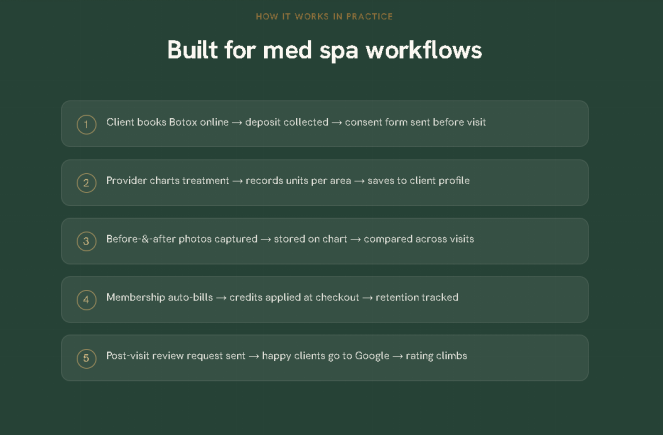
Software built this way handles a clinic’s front desk by picking up calls the moment they come in and working from your actual schedule, not a static script. Here’s what that looks like during a booked-solid Tuesday:
- A patient calls asking about Botox pricing and availability.
- The AI Receptionist answers, gives the general treatment information you’ve set up, and checks real open slots.
- It books the appointment directly into your calendar.
- It sends the patient a confirmation text.
- Your team gets notified, with the call details already logged.
If the caller asks something outside what it’s set up to handle, like a question about a medical condition or a treatment complication, it hands it off to your team instead of guessing. Calls that come in while staff are with a client still get answered. That’s the capability, without a number attached that nobody has measured yet.
What does med spa software like this cost compared to adding front desk staff?
Pricing for a platform like this runs a fraction of what a full-time front desk hire costs a clinic each month. Gracero’s Essentials plan starts at $149/mo (as of Aug 2026), with the Professional plan at $299/mo, and the voice AI receptionist is the one paid add-on on top of that. There are no setup fees and no contracts, with a 14-day free trial.
That’s a fraction of even a part-time receptionist’s hourly cost once payroll taxes and training are factored in, and it covers hours your front desk isn’t staffed at all, like lunch coverage or early evening calls after your last injector appointment of the day.
Which clinics see the most benefit?
Any clinic where the front desk is also doing hands-on patient work benefits most from this kind of software. That’s most of the aesthetics and wellness space:
- Med spas and injectables practices: calls about Botox, filler, and laser bookings that come in mid-treatment
- IV therapy and wellness clinics: drip club and walk-in scheduling questions during busy infusion hours
- Body sculpting studios: multi-session package inquiries that need real calendar availability
- TRT and men’s health practices: intake calls where a missed connection often means the patient looks elsewhere
If your team is choosing between answering the phone and finishing the patient in the chair, that choice is exactly what this is built to remove.
Common questions about med spa software and AI receptionists
Will patients know they’re talking to an AI?
Most patients notice they’re speaking with an automated system, and that’s fine. What matters more to them is getting an answer and a booked slot instead of a ring that goes nowhere. Some clinics disclose it upfront in the greeting; that choice sits with the practice.
Can it actually book the appointment, or just take a message?
It books the appointment directly against your real calendar during the call itself, not through a callback. That’s the difference between recovering a lead and just logging one.
Does it replace my front desk staff?
No. It answers the calls your team physically can’t get to while they’re with a patient, and hands off anything that needs a person, a complex question, a complaint, a clinical concern, straight to your team.
Is this HIPAA compliant?
Gracero describes its platform as HIPAA-conscious, with encryption and privacy-first data handling. Nothing here is legal advice. If HIPAA compliance for phone-based patient interactions is a concern for your clinic specifically, verify the details with your compliance officer or counsel before rolling this out.
Is switching med spa software worth it for a small, single-location practice?
For a single location already losing calls or no-shows most weeks, yes, the coverage gap it closes tends to pay for the subscription on its own. For a clinic that rarely misses calls today, the case is weaker, so it’s worth tracking your own missed-call rate for a couple of weeks before switching anything.
The bottom line
Maria’s clinic still loses the occasional call. What changed is that it’s no longer every call that comes in while she’s mid-treatment. The phone gets answered, the slot gets booked, and she hears about it afterward instead of not hearing about it at all.
If missed calls and unconfirmed bookings are costing your clinic revenue every week, that’s a fixable operations problem, not a staffing shortage. You can see how Gracero’s AI Receptionist and its other agents work together for a clinic your size.
For more general health and wellness business coverage, Charfen’s health section covers adjacent topics worth a read.