The economics of payment failure are easy to underestimate. A business processing significant annual volume with an authorization rate of 87 percent instead of 92 percent is not losing five percent of transactions. It is losing five percent of revenue, permanently, every year, with no line item in any report explaining where it went. Multiply that across markets with different processors, card schemes, and local payment preferences and the gap widens further.
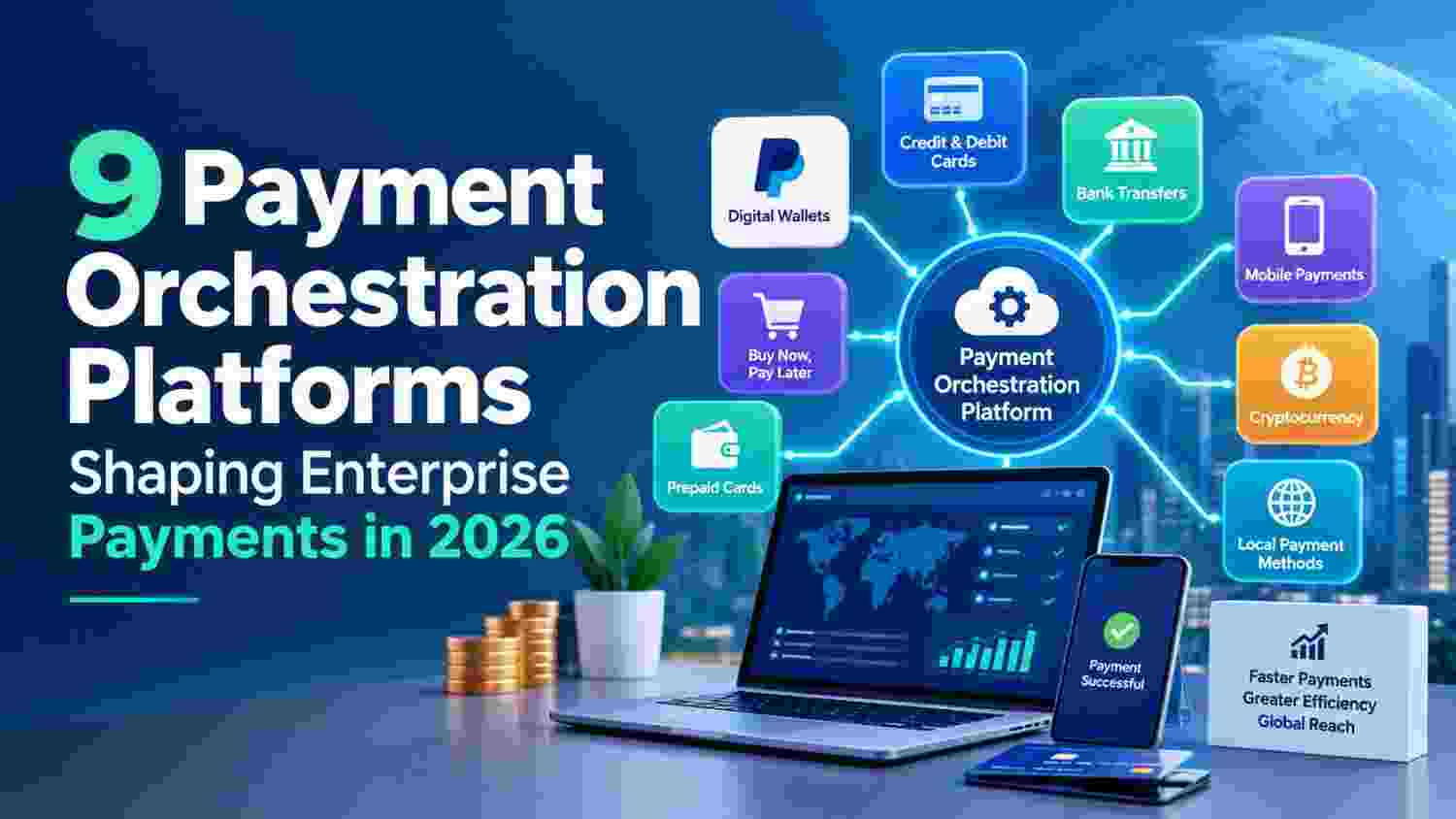
Payment orchestration closes that gap by making routing decisions dynamic rather than fixed. Each transaction goes to whichever provider is performing best for that specific combination of geography, card type, and amount, with automatic failover when something breaks. This guide covers nine platforms doing that work in 2026, spanning enterprise generalists, vertical specialists, and infrastructure providers.
The Shifts Defining This Year
Routing intelligence separated the field. Connector count is no longer a meaningful differentiator because most serious platforms have enough. What matters is whether the routing engine learns. Platforms applying machine learning to provider selection, adapting continuously to decline patterns and performance drift, produce measurably better outcomes than those running fixed rules.
Agentic commerce created a new verification problem. AI systems now initiate purchases on behalf of consumers and enterprises. The payment layer has to confirm that a non-human actor is authorized to transact, which is a question card networks never had to answer before. Visa and Mastercard have both introduced identity frameworks specifically for this, and orchestration platforms are building support.
Multi-rail settlement became a procurement requirement. Real-time payment schemes, local rails, and tokenized settlement have moved from pilot into production across major markets. Enterprises now expect one orchestration integration to reach all of them rather than commissioning separate builds per rail.
Resilience moved into the contract. When every transaction flows through the orchestration layer, an outage does not degrade revenue. It stops it. Uptime SLAs and failover architecture are now negotiated commercial terms rather than technical footnotes reviewed after signing.
9 Payment Orchestration Platforms for 2026
1. Juspay
Juspay processes over 300 million transactions daily across 150+ countries at 99.999% uptime, with enterprise deployments including Amazon, Google, HSBC, and Microsoft. It connects to 300+ PSPs and local payment methods through one API. The differentiator is scope: intelligent routing, network tokenization, 3DS authentication, native checkout SDKs, automated reconciliation, and a decline-aware retry engine all live inside the same platform rather than requiring separate vendors.
What Juspay offers:
- Intelligent routing: Rule-based, volume-based, and ML-driven logic evaluating each transaction in real time to select the highest-probability processor. No-code configuration keeps payment teams independent of engineering sprints.
- Smart retry engine: Assesses 30+ parameters including decline codes, card BIN, error type, ticket size, and region before deciding retry strategy. Recovers revenue that blanket retry logic misses entirely.
- Tokenization and compliance: Network tokenization across Visa, Mastercard, and regional schemes, with PCI DSS 4.0, ISO 27001:2022, and SOC 2 Type 2 certification.
- Automated reconciliation: Three-way matching across internal systems, PSPs, and banking records, removing manual reconciliation from finance operations.
Juspay also maintains Hyperswitch, an open-source payments platform under Apache 2.0 with over 42,000 GitHub stars, for teams preferring self-hosted or modular deployment.
Ideal for: Global enterprises, marketplaces, and financial institutions needing full lifecycle orchestration and enterprise compliance through a single integration.
2. Spreedly
Spreedly built its position on credential portability. Its PCI-compliant vault stores card data independently of any provider, and hundreds of customers use tokenized data to enable over $30 billion in annual transaction volume. A single API connects merchants to payment services globally, and the architecture is deliberately narrow: Spreedly is not trying to be your checkout or fraud engine.
What Spreedly offers:
- Provider-agnostic vault: Credentials remain portable, so switching or adding PSPs does not require re-tokenizing your customer base.
- Single API connectivity: One integration reaching a broad gateway network, lowering the engineering cost of provider changes substantially.
- Routing with fraud tooling: Transaction routing paired with integrated fraud screening under merchant control.
- Cross-provider reporting: Consolidated visibility across all connected providers from one interface.
Ideal for: Engineering-led teams and marketplaces that prioritise architectural independence and long-term provider flexibility.
3. Payrails
Founded by former Stripe, Miro, and Delivery Hero executives, Payrails describes its product as a payment operating system rather than a routing layer. The Berlin-based platform spans orchestration, payouts, tokenization, unified analytics, automated reconciliation, and in-person payments through a modular architecture. Enterprise customers include Puma, Vinted, Flix, InDrive, and Careem.
What Payrails offers:
- Provider-agnostic economics: The platform does not operate on revenue-sharing arrangements with PSPs, meaning routing recommendations are not shaped by partnership incentives.
- Modular lifecycle coverage: Orchestration, payouts, tokenization, analytics, and reconciliation adopted incrementally rather than as a single deployment.
- Agnostic token vault: Payment data secured independently of any provider, supporting migration without re-tokenization.
- Enterprise system integration: 100+ integrations spanning PSPs, fraud tools, and enterprise software including SAP, Salesforce, and Snowflake.
Ideal for: Enterprises in mobility, marketplaces, travel, and subscriptions wanting unbiased routing and phased adoption.
4. Nuvei
Nuvei offers a modular payment technology stack covering orchestration, acquiring, and alternative payment methods. Its strongest positioning is in regulated verticals including iGaming, travel, and digital goods, where compliance requirements introduce payment complexity that generalist platforms handle poorly. The orchestration layer includes smart routing with automatic cascading.
What Nuvei offers:
- Regulated vertical depth: Compliance tooling built for industries where regulatory requirements directly affect acceptance and market access.
- Cascading routing: Declined transactions automatically rerouted through alternative providers within the same session.
- Broad APM coverage: Wide access to alternative payment methods across multiple global markets.
- Bundled acquiring: Processing and orchestration together, reducing the number of vendor relationships to maintain.
Ideal for: Merchants in regulated industries where compliance complexity directly affects payment acceptance.
5. CellPoint Digital
CellPoint Digital has specialised in travel, airline, and hospitality payments since 2007. Its Velocity platform connects merchants to 220+ PSPs and acquirers, with architecture engineered for the traffic patterns travel businesses actually experience, including zero-downtime deployments during peak booking periods. Named partnerships include Southwest, Radisson, and Sabre.
What CellPoint Digital offers:
- Travel vertical specialisation: Payment flows designed around airline and hospitality booking patterns including multi-leg and multi-currency transactions.
- 220+ PSP connectivity: Broad provider coverage through one orchestration layer while merchants retain their own PSP contracts.
- Zero-downtime architecture: Blue-green deployments and automatic failover built to withstand booking surges.
- Hosted payment pages: Secure, brand-consistent checkout maintaining merchant identity throughout the transaction.
Ideal for: Airlines, travel platforms, and hospitality enterprises facing volume spikes and multi-currency complexity.
6. Primer
Primer addresses a specific organisational reality: the people who most need to change payment logic often cannot write code. Its visual workflow builder lets operations and product teams configure routing rules, failover cascades, and retry sequences through drag-and-drop, supported by a plugin ecosystem for fraud, 3DS, and alternative payment methods.
What Primer offers:
- Visual workflow builder: Drag-and-drop configuration for routing, retry, and failover with no engineering dependency.
- Plugin architecture: Modular fraud, 3DS, and APM integrations connecting into existing workflows without custom builds.
- Rapid deployment: Faster onboarding than heavier enterprise platforms, suited to teams that need to move quickly.
- Conditional payment logic: Sophisticated if-then flows built visually, adapting to geography, card type, and provider performance.
Ideal for: Retailers, e-commerce, and subscription businesses where operations or product owns the payment stack.
7. Praxis Tech
Praxis Tech, based in Cyprus, has built genuine specialisation in high-risk and heavily regulated verticals. The platform integrates with 560+ PSPs and over 1,000 alternative payment solutions across more than 200 currencies including crypto. Its client base spans forex and CFD brokers, prop trading firms, iGaming operators, and travel merchants where payment complexity sits well above the norm.
What Praxis Tech offers:
- High-risk vertical expertise: Purpose-built handling for iGaming, forex, CFD, and crypto merchants that many orchestration platforms decline to serve.
- Extensive PSP network: 560+ PSP integrations and 1,000+ alternative payment methods through a single connection.
- Multi-currency and crypto: 200+ currencies covering both fiat and digital assets.
- Conversion optimization: Checkout enhancements alongside PCI DSS tokenization and fraud management.
Ideal for: Merchants in iGaming, forex, trading, and other high-risk sectors needing specialised PSP coverage.
8. Corefy
Corefy provides white-label orchestration aimed at payment service providers, banks, and financial institutions building their own payment products. The platform handles complex payment flows with deep customization, and its compliance orientation suits organisations that must meet institutional standards for data handling and transaction security rather than typical merchant requirements.
What Corefy offers:
- White-label architecture: Complete branding control for institutions launching payment products under their own identity.
- Complex flow support: Multi-party payments, split settlements, and the payment structures financial institutions require.
- Banking-grade security: Compliance and security infrastructure built for heavily regulated environments.
- Deep customization: Configuration flexibility supporting institutional requirements rather than a standard merchant template.
Ideal for: PSPs, banks, and financial institutions building or modernising their own payment offerings.
9. Payneteasy
Payneteasy operates primarily as infrastructure for other payment businesses rather than as a merchant-facing platform. Its white-label gateway and orchestration platform are deployed by PSPs, banks, and fintechs under their own brand. The platform processes up to 10 million transactions daily with 1,000+ pre-built integrations across 150+ countries at 99.95% verified uptime.
What Payneteasy offers:
- White-label deployment: Fully brandable checkout, dashboards, and statements enabling payment businesses to launch under their own name.
- ML-driven routing with cascading: Intelligent transaction routing that automatically cascades declines to alternative providers.
- Extensive fraud filtering: 150+ configurable real-time filters covering velocity checks, blacklist management, IP validation, and behavioral profiling.
- Registry credentials: PCI DSS Level 1 certified and listed on the Visa Global Registry of Service Providers and Mastercard SDP program.
Ideal for: PSPs, banks, and fintechs needing enterprise payment infrastructure deployed under their own brand.
Comparison Summary
| Platform | ML Routing | White Label | Vertical Focus | Primary Fit |
| Juspay | ✓ | No | Cross-industry | Global enterprise |
| Spreedly | Moderate | No | Cross-industry | Engineering-led |
| Payrails | ✓ | No | Mobility, travel | Modular adoption |
| Nuvei | ✓ | Partial | Regulated | Compliance-heavy |
| CellPoint Digital | ✓ | No | Travel | Airlines, hospitality |
| Primer | ✓ | No | Retail, subscription | Ops-led teams |
| Praxis Tech | ✓ | No | High-risk | iGaming, forex |
| Corefy | Moderate | ✓ | Financial services | Banks, PSPs |
| Payneteasy | ✓ | ✓ | Financial services | PSP infrastructure |
How to Narrow This List
Nine options is more than any team should seriously evaluate. These filters typically reduce it to two or three quickly:
- Are you a merchant or a payment business? Corefy and Payneteasy serve PSPs and banks building their own products. If you are a merchant, they are the wrong category entirely.
- Does your vertical carry unusual requirements? Travel, iGaming, forex, and regulated financial services all have specialists who handle their complexity far better than generalists do.
- Who configures routing after launch? If it is operations rather than engineering, no-code configuration moves from convenience to non-negotiable.
- How much of the lifecycle do you want consolidated? Some platforms handle routing only. Others cover tokenization, authentication, reconciliation, and analytics. Fewer vendors means less integration work but less flexibility.
- Where does your volume actually come from? Regional depth varies substantially. A platform strong in Europe may have limited local rail coverage in Latin America or Southeast Asia.
Conclusion
The orchestration market has segmented rather than consolidated, which works in buyers’ favour. There is a platform built specifically for travel, one built for high-risk verticals, several built for institutions launching their own payment products, and others built as general-purpose enterprise infrastructure. The specialisation means most businesses can find something genuinely aligned to their situation rather than settling for a generalist.
For enterprises wanting routing, tokenization, authentication, retries, and reconciliation delivered through one integration at proven global scale, Juspay offers the most consolidated path. Spreedly and Payrails serve teams prioritising architectural independence. The vertical specialists handle complexity that generalists cannot. Whatever the choice, the underlying point holds: in 2026, the difference between a well-orchestrated payment stack and a neglected one shows up directly in the revenue line.