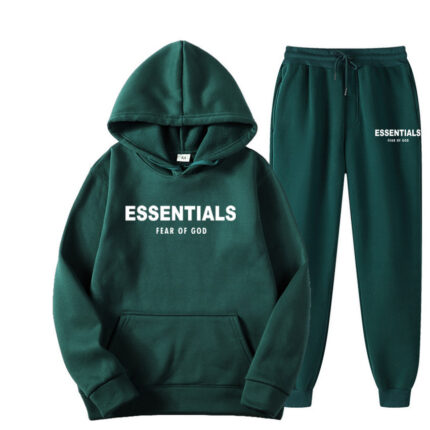
Eight tracksuits. That is the whole rail, sitting next to sixty-four hoodies and forty-nine shirts, and seven of those eight carry the same £140 ticket. The eighth asks £160. So anyone who wanders over from the Essentials Hoodies page expecting a long budgeting exercise gets about four seconds of one, then has to answer something harder instead.
Seven tickets that match, and one that doesn’t
Run down the eight and the pattern shows up straight away. Red, light grey, off-white, plain grey, orange, blue and yellow all land on £140. The green set wants £160. Twenty pounds between them, which works out at roughly fourteen per cent, and that is a wider step than anything you’ll find inside the hoodie, shirt, sweatshirt or sweatpants rails. Only the bags and accessories shelf stretches further, and that one runs from £70 to £210 because a cap and a holdall have no business being compared anyway.
- The £140 group covers seven colours, including two different greys
- The green set is the single £160 entry
- Hoodies on their own run £110 to £120, and sweatpants £105 to £109
Twenty pounds is real money. It’s also, in a shop where a whole category of shirts fits inside four quid, an unusually loud signal. Something about that green set carries a different number on purpose, and nobody has written down why.
What does the extra twenty actually pay for?
Honestly? The listing won’t tell you. This shop publishes the price, the colour and the photograph, and it stops there. No fabric weight, no gram count, no note about the dye process. Plenty of people want a neat technical reason for a price gap and there isn’t one printed anywhere on the page, which is a bit frustrating when you’re the one about to spend the extra.
Which leaves the photo. Look at the green set properly and you are judging the depth of the colour, how the hood sits, how far the hem drops on the model. That is a thinner evidence base than most of us would like. But it beats inventing a story about a heavier fleece that nobody at the shop has claimed.
My own read is simpler. Colour runs cost money in small quantities, and a strong green is a riskier dye to commit to than grey. Treat that as a guess rather than a fact, because that is exactly what it is.
| Pro Tip: Open the individual tracksuit listing before you settle on a size. Sizes here are shown item by item rather than in one shop-wide chart, so whatever the yellow set offers is no promise about the green one. |
Buying the set against buying the halves
Here is where the £140 starts to look interesting. Build the same top-and-bottom pairing from the separate rails and you’re looking at a hoodie somewhere between £110 and £120, plus sweatpants between £105 and £109. Add them up and the cheapest route comes to £215. The dearest comes to £229.
So the set saves you something like £75 to £89, and the £160 green one still saves £55 at worst. That is not a rounding error. It’s the difference between one purchase and most of a second one.
There is a catch, and it matters more than the arithmetic. A set commits you to one colour top and bottom. Buy the pieces apart and you can put a grey hood over black bottoms, or an off-white crew over something darker, and you get two garments that work on their own as well as together. Eight sets versus sixty-four hoodies is not a close contest on choice.
Eight sets and a British spring that can’t commit
A matching set has a specific problem here, and it isn’t the price. It’s the weather. A 4 °C Leeds morning turns into a muggy 13 °C by two in the afternoon, and you are carrying the top half of a tracksuit around a building that has its heating on regardless.
Sets earn their keep on the days with no decisions in them. Early trains. Airports. A damp Manchester October where you want one thing on and nothing to think about. Pull the shell over the top when the drizzle starts and the fleece underneath stays dry, which is about as much as anyone asks of a tracksuit in this country.
What they don’t do well is a changeable day you have to dress once for. If most of your week looks like that, two separate pieces in two different weights will serve you better than one matched set, whatever the maths says. And a lot of British weeks look exactly like that between September and April, which is worth admitting before you spend £140 on a single answer to every morning.
Choosing when the money has stopped helping
With seven of eight sets at one number, price has nothing left to say. So the questions worth asking are the boring ones. How often will you wear the bottoms without the top? Does your wardrobe already lean grey, in which case the light grey and plain grey sets are both competing with things you own? And can you live with orange or yellow in February, on a Tuesday, in the rain?
Two of the eight are grey, which tells you where the demand sits. That also makes grey the safest and the dullest pick, and those two usually travel together. The red, blue and green sets ask more of you. Worn well they give back more too, though you’ll want to think about what else in your wardrobe is going to sit next to them.
- Decide whether you want the bottoms as standalone trousers, because that rules colours out fast
- Check the listing’s sizes for the exact set you want, not for the category
- Then let the colour decide, since £140 is doing nothing to help you
Eight sets, one price for nearly all of them, and twenty pounds separating the odd one out. Work out which colour you’d actually put on at seven in the morning, then go and see which of the eight is still in your size. That’s the only part of this with a deadline on it.