Every room has a dead zone: the strip of floor beside the sofa, the gap between two armchairs, the pocket of space next to the bed that is too small for a nightstand and too awkward to leave empty. A round side table fills that pocket better than almost any other piece of furniture. The shape is the reason. Square tables push their corners into walkways and door swings, while a circular top sits politely inside its own footprint, letting people pass and letting the eye slide past it. That is also why round tables appear in so many decorating schemes that otherwise disagree on everything: they solve the geometry of tight spaces without calling attention to themselves. This guide looks at where a round side table earns its place, how to choose a size and material that suit the room, and the small decisions that separate a table you actually use from one you merely own.
Where a Round Side Table Works Best
The short answer is: almost anywhere a horizontal surface is missing. The long answer is that a few specific spots get the most value from the round shape, because the shape is doing real work rather than just looking pleasant. A round side table is at its most useful when traffic, seating, and reach all compete for the same few square feet.
Beside Sofas and Armchairs
This is the classic position, and the one where shape matters most. Next to a sofa, a round table can sit between the arm and a wall or a doorway without blocking the path. Because the top has no corner to catch a hip, it tolerates a few inches less clearance than a square model and still feels comfortable. If the chair swivels, a round table is the natural companion: it can be reached from more angles as the seat turns. Place the top roughly level with the armrest, or slightly below it, so a mug can be set down without lifting the elbow.
Between Two Seats
A small round table placed between a pair of accent chairs creates a shared surface that neither seat has to reach across the room for. It also gives the pairing a visual anchor, so two loose chairs read as a deliberate conversation area instead of leftover furniture. Choose a diameter wide enough for two cups and a book — somewhere in the range of a large dinner plate to a serving platter — and no larger, or the table starts to crowd the seats it was meant to serve.
In Corners and Tight Bedrooms
Round tables are remarkably good at making corners feel intentional. A slim pedestal version tucks into a corner without the boxy heaviness of a square cabinet, and the absence of edges makes it forgiving in a bedroom where the bed, a door, and a closet all converge. A reader who wants a lamp, a glass of water, and a place to set a phone will often find a small round table does everything a full nightstand would, at a fraction of the visual weight.
Choosing Size, Height, and Material
Most side-table mistakes are measurement mistakes. The table that looks perfect online arrives too tall for the sofa arm or too wide for the wall gap, and it ends up shoved into a closet. A few numbers, taken before you shop, prevent nearly all of it.
The Numbers That Matter
Start with height. A side table should land within an inch or two of the armrest it serves; much lower and reaching for a drink becomes a bend, much higher and the surface looms. For width, measure the available gap and subtract a few inches of breathing room on each side. Depth matters too — a table that projects into a walkway will be annoying no matter how pretty it is. Finally, check the base: a pedestal spreads its weight over a small area and suits tight spots, while a three- or four-leg base is more stable for heavier loads. If the table will hold a lamp, confirm that the top is wide enough for the base plus a coaster and still leave room for a book.
Materials and Durability
Material should follow function. Ceramic and stone tops resist water rings and heat, which makes them ideal beside a sofa where drinks and warm mugs land constantly. Wood brings warmth and ages gracefully but wants coasters and occasional oil. Rattan and woven designs are lighter and weather-friendly, so they work indoors as a visual counterpoint to upholstery and outdoors on a covered porch. Metal frames are the most forgiving in high-traffic spots and easiest to wipe down. Whatever the finish, check the joinery where the top meets the base; a side table is grabbed and nudged constantly, and that single connection takes most of the stress. Outdoor versions are worth using indoors in sunrooms and covered patios, where their weather resistance becomes a practical advantage rather than a design statement.
Styling Without Clutter
One reason round tables look calm is that they have no obvious front. A square table is oriented toward a wall or a seat, and that orientation fights the loose furniture around it. A circle can be approached from any side, so a chair, a sofa, and a walkway can all relate to the same table without an argument about angles. That is also why two round tables of different heights can sit near each other as a nesting pair without looking misaligned; they simply share the same shape and let the eye rest.
A side table has one job, and it is to hold what a person needs within arm’s reach. That definition is the antidote to clutter. The most comfortable tables are not styled like mantels; they are stocked like a small service station for whoever sits beside them.
Lighting deserves its own note, because a side table is usually where a lamp ends up. Choose a lamp whose shade sits near eye level when you are seated, and confirm that the table is stable enough to take a nudge without tipping. A small table holding a tall lamp can become top-heavy, so weight the base or choose a lamp with a broad foot.
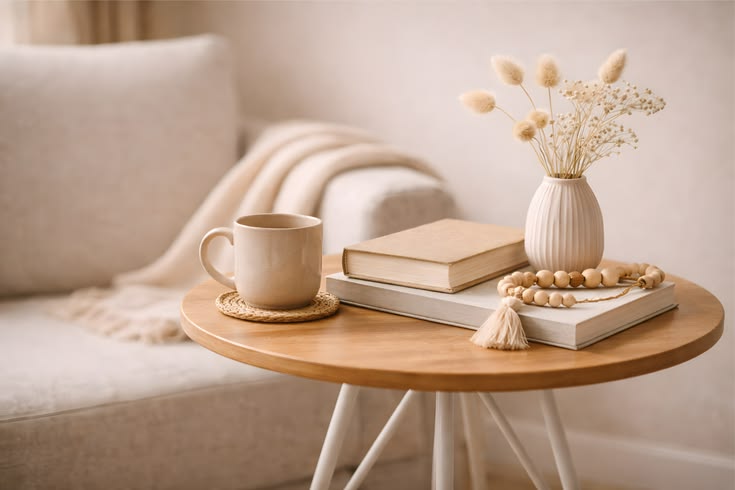
Think in terms of a short rotation: a lamp for evening reading, a coaster, a glass, a book or magazine that is currently in progress, and perhaps one decorative object that gives the surface a focal point. Swap the book when it is finished, clean up the glass at the end of the day, and the table stays useful instead of becoming a pedestal for accumulated mail. On smaller tables, go vertical — a lamp with a slim base frees most of the top, and a small tray corrals loose items so they read as one group rather than five separate objects. Trays are also the easiest way to reset a table in seconds when guests arrive.
Round Tables Indoors and Out
The same geometry that makes round tables work beside a sofa makes them work on a patio. A circular outdoor side table has no sharp corner to catch a knee on a narrow balcony, and its shape suits the loose, organic layout of outdoor furniture better than a rigid square. Rattan and woven finishes are common for good reason: they shrug off humidity, stay cool in the sun, and look at home among plants. If the table will live outside permanently, confirm that the finish is rated for the climate and bring it in during hard freezes if the material calls for it. The overlap between indoor and outdoor styling is wider than most people assume — a rattan table that starts on a balcony often ends up in a sunroom, and a ceramic top that began beside a sofa can migrate to a covered porch without looking out of place. The right table is one whose material you can trust in the rooms you actually have.
Small Table, Large Effect
A round side table is the rare piece of furniture that is both modest and transformative. It costs little floor space, requires almost no commitment, and solves a problem most rooms share: there is never quite enough surface where people actually sit. Choose the height against the armrest, the diameter against the gap, and the material against how the table will be used, and it will quietly do its job for years. Style it with a lamp, a drink, and whatever you are reading this week, and rotate the contents as life changes. The result is a room that feels finished without feeling furnished — one small circle filling the space that everything else left behind.