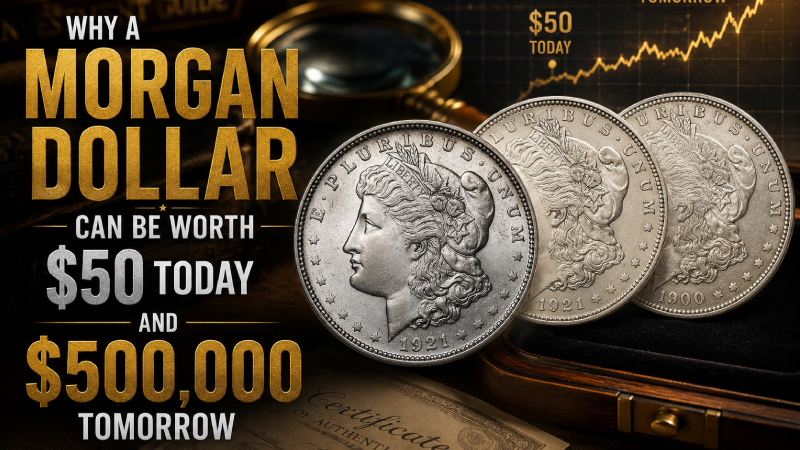
The majority of the silver coins come with one price. You look at the spot price, plus a premium that’s added by the dealer and that’s the price you pay. The Morgan Silver Dollar is not based on that logic, and knowing the reasons behind that is what enables you to purchase one wisely, regardless of whether you are a first-time buyer or a long-time Eagle and Maple Leaf collector.
Price Tag One: The Silver Floor
Each Morgan Dollar minted from 1878 to 1921 is 90% pure silver, which is the same standard used every year, in every mint, on every dollar of the series. Divide by the current price of silver and you will have the melt value: the minimum value to which a Morgan Dollar is worth, no matter when or where it was minted, how it is conditioned, or the price of the silver. It will never reach zero and it will never reach zero again while silver continues to have value.
This same floor is located under an American Silver Eagle or Canadian Maple Leaf. It’s only the beginning of the story with the Morgan Dollar.
Price Tag Two: What Collectors Will Actually Pay
This is where the Morgan Dollar stands out from all of the other coins available today.
The most common date in the series is 1882, with more than 86 million 1921 Morgan dollars being minted at three mints, which are trading at near the silver melt value. Easy and truthful entry for first-time buyers.
In 1893, the San Francisco mint produced about 100,000 “93-S” Morgan Dollars and one of them was auctioned for $735,000. Same silver content. Same design. Equal in size and weight. A totally different rate.
The space between those numbers is a mix of a couple of factors, including the number of coins originally minted, the number of coins obtained in the aftermath of the Pittman Act of 1918 (which ordered the melting of more than 270 million Morgan Dollars during the war to help meet silver requirements), the condition of the coins that survive, and the degree of Coleman’s thirst for that date and mint mark combination.
None of these four is true of a modern bullion coin. If the American Silver Eagle is being produced to a level that meets demand, then the US Mint must continue to produce them as long as it is required to do so by law. The Canadian Maple Leaf is the same. When there is a demand, there is a supply to respond to it. Premiums stay competitive. The 1893-S is a unique coin in a modern coin series.
Why the Melt Floor and the Numismatic Premium Work Together
The most important point to grasp about the Morgan Dollar is that these two price labels are not in competition, but rather additive.
A circulated 1921 Morgan will provide you with some silver exposure and limited collector interest over melt. A high quality pre-1921 coin from a quality mint such as Carson City or San Francisco provides silver exposure and you may have a numismatic premium that will increase separately from the price of silver on a day to day basis.
Both prices increase during an upswing of silver. Certain dates and grades can be moved up in the flat silver market, however, on the collector demand alone because of what buyers are willing to pay for that particular coin. That two-wheel-drive setup is truly unique in any asset class, and that’s why people who have been investing in precious metals for years are coming to Morgans. This is why dealers such as BOLD Precious Metals have the entire range of dates, from circulated common dates, all the way through to NGC and PCGS certified key dates.
The Mint Mark Is the First Decision
Now that a buyer is aware of the two price tags, the next step is determining which Morgan Dollar to purchase, which begins with the reverse mint mark above the letters “DO” in “DOLLAR.
The most common coins are Philadelphia coins with no mint mark. The CC coins, the most coveted of all coins, were struck directly from Comstock Lode silver and had the lowest mintages in the series. Coins from San Francisco (S) are considered to be struck the best and feature coins from the famous 1893-S year of issue, while New Orleans coins (O) are in circulation in high quality but are rare in mint quality conditions. Denver (D) began striking Morgans just one year, in 1921, and the 1921-D is the most common year to start the series.
The Morgan experience for a first time buyer comes at the lowest value above melt with a circulated pre-1921 Philadelphia or New Orleans coin. The most numismatically valuable return for serious investment comes from certified, dated Carson City and San Francisco dates.
Grading: Why the Same Coin Can Have Very Different Values
A Morgan Dollar with a very good condition and wear, with major design elements visible, trades close to silver melt. The same date in Gem Mint State (MS-65) with full luster and sharp detail is worth 10 or 100 times more, depending on the date.
That’s why 3rd party grading by NGC or PCGS is important in all but common-date transactions. A certified grade means a set of grades developed to be measurable and accepted by any dealer in the world. When it comes to key dates, there is no risk of authenticity and condition issues with an ungraded coin that are eliminated with a certified slab.
Where to Start
Whether you are looking for a 1921 circulated date that is near melt value, an NGC or PCGS grade pre-1921 that is in MS-63 to MS-65 condition or a coin that is ready for a serious investment—Morgan silver dollars have a place for you.If you are ready to move beyond modern bullion and into something with a real historical depth and numismatic value, then the entire collection of Morgan silver dollars will meet your needs, from circulated dates near melt value all the way up to certified coins by NGC or PCGS with an MS-63 to MS-65 grade, all of which are shipped fully insured and backed by a 100% guarantee of authenticity.
The Bottom Line
The two price tags, the silver melt floor and the numismatic premium, define the value structure of the Morgan Dollar that no other American Eagle, Maple Leaf or silver bar can claim. It’s on the floor for your protection. It’s the rewards you’ll receive for knowing which coins to acquire, when to acquire them and what a mint mark or a single grade point on a 70-point scale means in a series where the difference between a common coin and a collector’s prize can be a single difference.