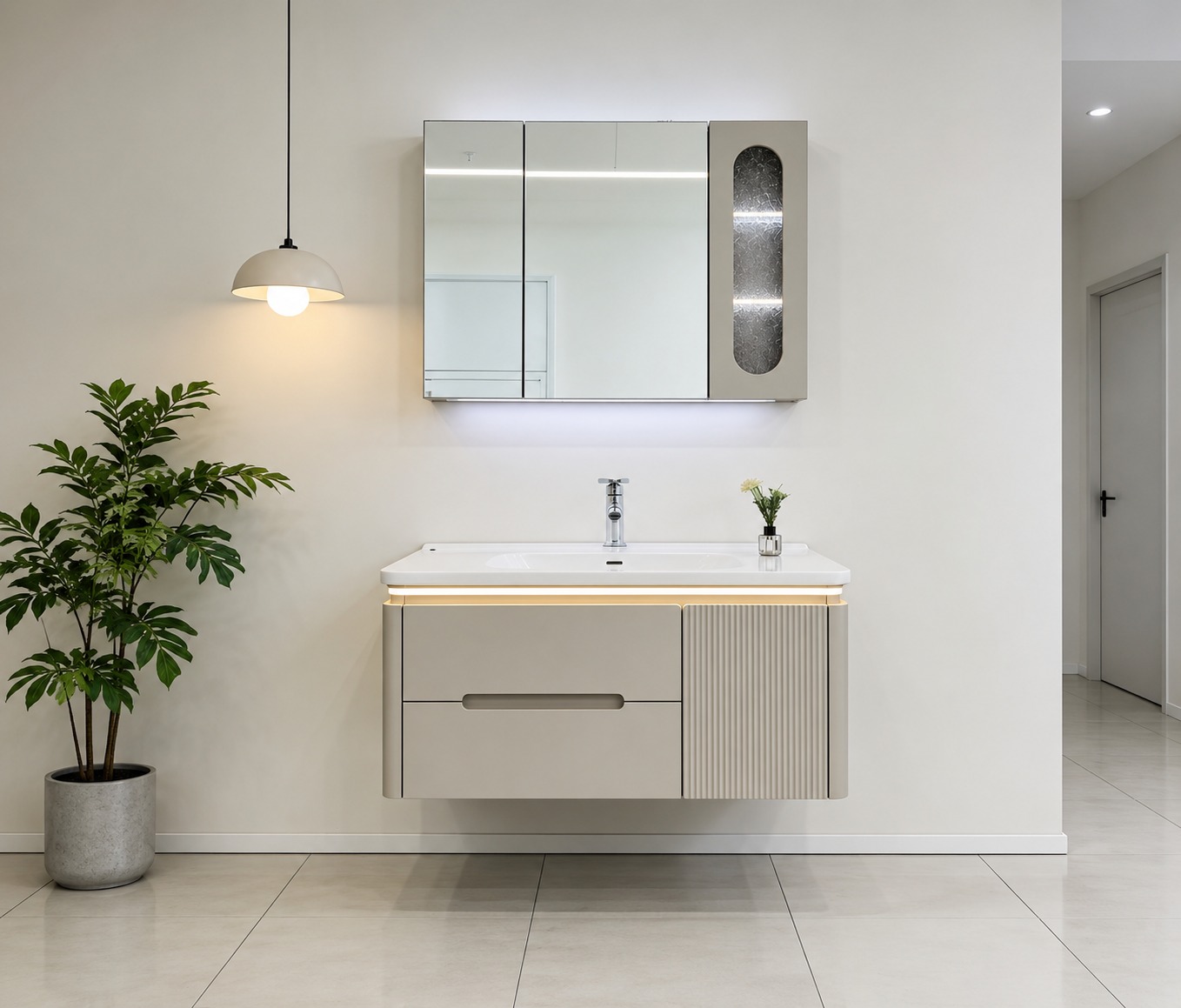
For real estate developers, hospitality procurement directors, and multi-family residential contractors, bathroom millwork represents one of the most critical procurement line items. A bathroom vanity must balance high-traffic durability, aesthetic appeal, and stringent plumbing allowances—all within predictable lead times and budget constraints. View Dlinxcy OEM Bathroom Vanity Solutions.
When planning a project’s bill of materials (BOM), project managers frequently encounter a fundamental strategic fork in the road: Should you purchase complete, pre-assembled vanity sets (cabinet, integrated basin, countertop, and hardware), or source cabinet-only units and procure slabs, sinks, and mirrors separately?
While ordering cabinet-only units may appear to offer greater design autonomy or reduced initial shipping weight on paper, the true cost equation involves installation labor, dimensional tolerance risks, split freight liability, and job-site fabrication overhead.
Below is an exhaustive, comparative analysis designed to help sourcing teams evaluate vanity sets against cabinet-only orders across five critical operational metrics.
1. Dimensional Precision, Cutout Tolerances, and Fitment Risk
The most immediate friction point in millwork installation occurs at the interface between the countertop, the basin, and the vanity carcass.
The Cabinet-Only Risk Factor
When cabinets are sourced independently, the responsibility for achieving sub-millimeter tolerances shifts from the factory floor to local sub-contractors or third-party stone fabricators. Common pitfalls include:
- Drain and P-Trap Misalignment: Sourcing sinks independently often leads to cut-out discrepancies. A 15 mm variance in waste-pipe alignment can collide with internal wooden drawer boxes or bottom stretchers, forcing field carpenters to notch structural carcass members on site.
- Overhang Inconsistencies: Custom tops fabricated off-site frequently suffer from uneven reveals or edge overhangs if the carcass is slightly out of square or if drywall finishes vary.
- Faucet Bore Clashes: Pre-drilling faucet spreads on custom stone slabs without physical access to the underlying cabinet can result in tap valves interfering with drawer glides or structural cross-rails.
The Vanity Set Advantage
Turnkey vanity sets are engineered as cohesive, pre-drilled systems using precision CNC routing. Basin cutouts, sink clips, faucet drillings, and internal plumbing clearances are validated during computer-aided design (CAD) staging. Factory workers pre-check basin clearances against drawer cutouts before crating, effectively eliminating field adjustments and avoiding compromised cabinet integrity.
2. Supply Chain Consolidation and Shipping Logistics
Managing large-scale residential or hospitality fit-outs requires strict vendor synchronization. Every additional purchase order (PO) introduces another potential point of failure.
| Procurement Vector | Pre-Packaged Vanity Sets | Cabinet-Only Procurement |
| Number of Vendors | 1 (Consolidated) | 3 to 4 (Cabinet, Slab, Sink, Hardware) |
| Freight Coordination | Single Container / Flatbed Delivery | Staggered Freight Schedules |
| Packaging Protocol | Engineered Honeycomb / Palletized Kits | Individual Component Packaging |
| Damage Claim Liability | Clear Single-Vendor Accountability | High Finger-Pointing Risk |
When ordering cabinet-only batches, project managers must coordinate deliveries across multiple regional and overseas suppliers. If the vanity base arrives on schedule but the sintered stone top or undermount ceramic basin is stuck in transit, the entire rough-in schedule stalls.
Furthermore, split sourcing creates significant insurance friction. If a stone top cracks during basin mounting, fabricators routinely blame the cabinet’s structural levelness, while carpenters blame the stone’s brittle fabrication. With a complete vanity set, transit liability and component compatibility rest entirely with a single provider.
3. Fabrication Quality: Factory Controlled vs. Job-Site Assembly
Wet-room cabinetry exists in challenging microclimates characterized by rapid temperature swings and relative humidity spikes exceeding 80%. The method and environment in which surfaces and joints are bonded directly govern product lifespan.
- Adhesion and Waterproof Sealing: In factory settings, undermount basins and sintered stone or quartz countertops are bonded using industrial-grade silicone, structural epoxy, and mechanical undermount clips under controlled temperature and humidity. When this assembly is performed on an active, dusty construction site, bond integrity can degrade, leading to seam separations, microbial growth, and slow moisture infiltration into cabinet sidewalls over time.
- Material Synergy: High-performing vanity assemblies combine moisture-resistant carcass materials—such as multi-layer marine plywood, anti-expansion PVC, or melamine-faced moisture-resistant boards—with non-porous sintered stone tops. Sourcing complete solutions directly from an experienced commercial bathroom vanity manufacturer ensures that the carcass substrate possesses the engineered load-bearing density necessary to support heavy stone tops, particularly in wall-hung (floating) configurations where cantilevered stress demands reinforced backing panels.
4. True Cost Analysis: Purchase Price vs. Total Installed Cost
On an initial line-item quote, cabinet-only orders almost always appear less expensive than full vanity sets. However, seasoned estimators know that Landed Material Cost ≠ Total Installed Cost.
The Hidden Surcharges of Cabinet-Only Orders
- Local Fabrication Rates: Contracting local stone fabricators to cut, polish, edge, and core faucet holes into individual slabs commands high hourly labor rates, far exceeding the economies of scale achieved in automated manufacturing plants.
- Material Scrap Rates: Sourcing raw slabs locally often yields a 15% to 25% waste factor from offcuts, which the developer must absorb.
- Multi-Trade Sequencing: Installing cabinet-only setups requires three separate trades: carpenters to level the base, stonemasons to template and drop the slab, and plumbers to mount the basin and trap. Each additional trade visit increases job-site overhead, parking, scheduling coordination, and administrative billing.
By contrast, pre-assembled vanity sets operate on a “plug-and-play” paradigm. Units arrive flat-packed or pre-hung with pre-mounted basins. Installers anchor the cabinet to wall studs, connect the pre-aligned plumbing, and apply perimeter caulk in a single continuous work shift.
5. Architectural Customization vs. Lead-Time Certainty
Despite the operational advantages of vanity sets, there are specific scenarios where cabinet-only orders are justified:
- Ultra-Luxury Boutique Projects: If an architect mandates continuous-vein bookmatched marble extracted from a specific quarry, factory vanity sets may not accommodate the level of hand-selected slab curation required. In such bespoke residential estates, cabinet-only orders allow on-site stone artisans to hand-scribe the stone to irregular plaster walls.
- Uncertain Plumbing Rough-Ins: In older historical renovations where retrofitting existing waste stacks is structurally impossible or cost-prohibitive, sourcing empty carcasses allows field tradespeople to custom-cut interior partitions around unpredictable pipe paths.
However, for commercial rollouts, multi-family apartment complexes, and mid-to-high-tier hotel chains, reproducibility and scheduling certainty far outweigh bespoke stone sourcing. Pre-tested vanity sets guarantee identical dimensions across hundreds of units, ensuring standard plumbing templates can be replicated floor by floor.
Comparative Summary Matrix
To assist procurement teams in evaluating project parameters, review the following operational indicators:
| Decision Factor | Recommended Option | Why It Matters |
| Multi-Family Housing (100+ Units) | Vanity Sets | Maximizes repeatability, reduces trades on site, lowers per-unit labor costs. |
| Tight Construction Timelines | Vanity Sets | Eliminates secondary templating steps and waiting on local stone fabricators. |
| Bespoke Natural Stone Requirements | Cabinet-Only | Allows custom slab inspection and on-site hand-scribed edge detailing. |
| High Moisture / High Traffic (Hotels) | Vanity Sets | Factory-bonded basin seals prevent long-term water infiltration beneath tops. |
| Unpredictable Historic Remodeling | Cabinet-Only | Leaves internal space open for irregular waste-pipe and supply routing. |
Conclusion
Choosing between vanity sets and cabinet-only orders should never come down solely to the initial invoice price. Project planners must factor in the total cost of ownership—including site coordination, fabrication labor, lead-time volatility, and installation efficiency.
For projects where speed to market, structural warranty integrity, and bottom-line stability are paramount, complete, factory-matched vanity sets offer a far superior return on investment (ROI). By consolidating carcass fabrication, precision stone surfacing, basin mounting, and accessory compatibility under one roof, development teams can effectively mitigate job-site risk and ensure flawless commercial delivery from day one.