A discussion in Reddit’s entrepreneur community once asked what separates successful founders from everyone else. One answer was strikingly simple: high energy. Another emphasized resilience, the ability to absorb a setback and keep moving. They sound like different qualities, but both point towards a neglected part of sustained performance. It is not enough to handle an intense day; you also need enough capacity left to handle the next one.
That distinction matters to anyone whose work involves repeated uncertainty. A difficult negotiation may finish at noon, but another decision arrives at two. A product launch ends, and customer feedback begins. What looks like inexhaustible energy from the outside may partly reflect how people manage the periods between demands. There is no evidence that successful entrepreneurs possess a universally superior nervous system. There is, however, an interesting body of research on how the body recovers after stress, including the role of the vagus nerve.
High Energy Is Not the Same Thing as Resilience
Energy describes how capable someone feels of doing things at a given moment; resilience concerns adaptation when things become difficult. They can overlap without being identical. A person may be energetic during a presentation and spend the rest of the evening replaying every question. Another may become visibly stressed during a setback yet regain perspective and return to work the next morning. Neither observation can establish a personality trait, but it illustrates why outward intensity is a poor measure of recovery.
Research on psychological resilience generally concerns adaptation to adversity rather than permanent calm or an absence of distress. The ability to revise a plan, tolerate uncertainty, seek support, and return to ordinary functioning matters more than appearing unaffected. For business owners, this distinction removes a misleading ideal: if the goal is never to feel stressed, even a normal response to a difficult decision can seem like failure. A more useful question is whether that response continues interfering with judgment, relationships, or rest after the decision has passed.
A high-demand career makes this especially relevant because stressors rarely arrive one at a time. There may be no natural interval in which the body and mind can settle before the next task begins. This is not an argument that recovery determines commercial success. It is an argument that sustained effort carries a physiological cost worth understanding instead of treating exhaustion as evidence of commitment.
What Happens in the Body After the Pressure Passes
During an acute challenge, sympathetic nervous system activity helps increase cardiovascular readiness, while the hypothalamic-pituitary-adrenal axis coordinates a slower hormonal response involving cortisol. These systems are adaptive: they help someone respond when action is necessary. The less discussed phase is what happens when the challenge ends. Heart rate, hormonal activity, breathing patterns, and attention may return towards their usual levels on different timescales, particularly if the person continues anticipating the next problem.
The vagus nerve is relevant because its cardiac branches contribute to parasympathetic regulation of heart rate. It is the tenth cranial nerve, carrying sensory information from the body towards the brainstem and participating in signals that regulate internal organs. Following stress, the restoration of cardiac parasympathetic influence is one element of physiological recovery. Researchers often study this process through vagally mediated heart-rate variability, or vmHRV, derived from the changing intervals between heartbeats.
A 2025 scoping review by Roddick and colleagues examined 294 studies involving 23,533 adults across 33 countries. Better recovery in vmHRV following laboratory stress was associated in parts of this literature with greater self-reported resilience, attentional control, and habitual cognitive reappraisal—the capacity to reinterpret a difficult situation. The review also found substantial differences in measurement methods, including whether recovery was assessed after five minutes or thirty (Roddick et al., 2025). These are associations, not proof that raising HRV creates resilience or that resilience guarantees business performance.
The useful insight is more modest and more interesting: recovery is an active phase worth examining, not merely the absence of an ongoing stressor. Someone can perform effectively under pressure while carrying physiological and mental activation well beyond the event itself.
Why the Mind Can Keep the Stress Response Going
An urgent problem does not need to remain physically present to occupy the nervous system. Rehearsing a difficult conversation, imagining a customer’s reaction, or repeatedly anticipating a financial setback can keep the original concern mentally available. Researchers call persistent worry and rumination perseverative cognition. A meta-analysis found associations between these patterns and higher heart rate, blood pressure, cortisol, and lower HRV (Ottaviani et al., 2016). It does not mean every unpleasant thought is harmful; it means the duration and repetition of cognitive stress deserve attention.
The difference between planning and rumination is whether thinking produces a useful next step. A founder might spend ten minutes deciding who will follow up with a dissatisfied client and when. That is work with an endpoint. Replaying the exchange for three hours without changing the plan is a different process, even if it feels like preparation. To interrupt it, write down the unresolved issue, the next action, the person responsible, and the earliest reasonable time to revisit it. The aim is not to suppress worry but to remove the need to keep the whole problem mentally open.
This is also why a recovery routine should not begin with a gadget. If an evening remains full of unexpected calls and unfinished decisions, a short relaxation session has to compete with the very cues sustaining alertness. A defined transition away from those cues provides a more realistic setting for any technique that follows.
Where a Wearable Vagus Nerve Stimulator Fits
A wearable vagus nerve stimulator offers a different approach from tracking sleep or following breathing cues. Transcutaneous auricular vagus nerve stimulation, or taVNS, delivers electrical pulses to selected parts of the outer ear associated with the auricular branch of the vagus nerve. Researchers are interested in the sensory pathways that connect those sites with brainstem processing. Yet the ear has other sensory innervation, and outcomes depend on electrode placement, intensity, pulse settings, and session protocols. The existence of a plausible neural target does not establish that a commercial product makes people more resilient.
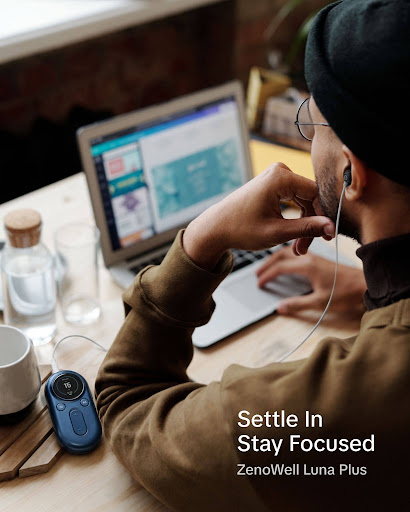
The practical interest is in whether a defined stimulation session fits naturally alongside established recovery habits. Someone who has difficulty maintaining open-ended meditation may prefer an activity with preset controls and a clear beginning and end. For example, ZenoWell wearable wellness device offers ear-worn stimulation through purpose-designed contact accessories and preset routines; its range includes app-free options as well as models with optional connected features. The meaningful questions for a prospective user concern positioning, sensation, session instructions, and whether the device adds something useful to the routine they already follow.
A small sham-controlled study involving 19 young healthy adults reported changes in selected peripheral cardiovascular measures following auricular stimulation during acute stress, consistent with reduced sympathetic arousal under those experimental conditions (Sanchez-Perez et al., 2023). That result does not show improved entrepreneurial performance, higher daily energy, or guaranteed long-term resilience. People considering electrical stimulation should follow device-specific positioning and intensity guidance, review contraindications, and seek professional advice if they have implanted electrical devices or relevant medical conditions. A sensible purchase decision separates the experience of using a device from the outcomes that have actually been demonstrated.
How to Read HRV Without Turning Recovery Into Another KPI
Heart-rate variability has become a familiar feature of smart rings and watches, but it is easy to overinterpret. RMSSD, for example, reflects aspects of short-term cardiac parasympathetic modulation. It does not measure the entire vagus nerve or reveal whether someone will be resilient during tomorrow’s investor meeting. Sleep, alcohol, recent exercise, illness, medication, posture, breathing, and the time of measurement can all influence readings.
A snapshot taken during slow breathing can differ from one taken after walking upstairs, even when neither represents a lasting change in resilience. The 2025 scoping review also cautioned that studies use different recovery windows and conditions, limiting direct comparison. For personal use, consistent measurement conditions and longer-term trends are more interpretable than attempts to force a desirable score after each stressful event.
| What a reading may tell you | What it cannot establish |
| Your cardiac intervals changed under particular conditions | You have become more psychologically resilient |
| A pattern differs from your personal baseline | A particular meeting or decision caused the change |
| Recovery-period vmHRV is being studied in stress research | A consumer device can diagnose vagus nerve function |
| A session coincided with a higher HRV number | That electrical stimulation caused a lasting benefit |
This distinction is central to understanding what to track when biohacking the vagus nerve. The most useful record may combine a small number of physiological measurements with context: sleep opportunity, training load, stressful events, and whether the person can actually disengage from work. A dashboard is informative only when it changes an appropriate decision; otherwise it risks becoming another performance demand.
What Can Support Recovery in Practice?
The best-supported starting points are less glamorous than nervous system optimization claims. Adequate sleep opportunity, regular physical activity, and manageable workloads affect the conditions under which recovery occurs. Psychological approaches such as cognitive reappraisal help people reconsider what a setback means, while clear endings to unresolved tasks reduce repetitive rehearsal. The 2025 review also found associations between more favorable cardiac vagal recovery and attentional control or exposure to natural environments, although the studies cannot establish that any one habit will produce the same response in every person.
Slow-paced breathing is one practical technique with a plausible cardiovascular mechanism. Breathing influences changes in heart rate through respiratory sinus arrhythmia and interacts with blood-pressure regulation. A 2024 meta-analysis reported short-term changes in cardiovascular measures with slow breathing, while effects on negative emotion were less conclusive (Shao et al., 2024). For a manageable trial, breathe gently for about four seconds in and five or six seconds out for several minutes, adjusting the pace for comfort rather than forcing unusually deep breaths. If breath-focused practice causes dizziness or distress, stop and choose a different activity.
For people whose attention remains fixed on work, a walk, a few minutes of gentle movement, or another externally focused activity may be a better first step than sitting silently. These are not interchangeable treatments; the choice should respond to what is maintaining tension. Repetitive thinking calls for an actionable endpoint, muscular restlessness may respond to movement, and difficulty beginning an unstructured practice may call for more guidance.
A Recovery Routine Designed for Repeated Demands
A routine for a busy founder should be short enough to survive an ordinary difficult day, rather than depend on ideal circumstances. One workable sequence starts with closing outstanding work loops: decide which problems need action tonight, assign or record the next step for the rest, and establish a time to reconsider them. Follow this with a short change of context—a walk or a quiet period away from screens—before choosing one comfortable relaxation activity. That might be gentle breathing, muscle relaxation, or an appropriate guided wellness session. There is no need to stack several techniques in the hope of producing a larger effect.
Evaluate the routine through outcomes that can guide behavior. Are unresolved tasks still intruding during dinner? Is it easier to stop checking messages? Does the chosen activity remain comfortable and practical after two weeks? If the answer is no, investigate whether the obstacle is continued work exposure, an unsuitable method, or insufficient time for sleep. These are more actionable questions than whether an HRV score rose immediately after a session.
The emphasis on recovery should never become an excuse for unsustainable demands. Persistent insomnia, unusual palpitations, severe anxiety, or exhaustion that interferes with daily functioning deserves appropriate assessment. A wellness device cannot replace necessary medical care or practical changes in working conditions.
Resilience Is What Happens After the Challenge
The Reddit debate about successful people being unusually energetic contains a useful observation but an incomplete explanation. Energy can help someone face demanding work; resilience concerns adaptation when that work becomes difficult. The emerging science of cardiac vagal recovery suggests that what happens after a stressor deserves attention alongside the intensity of the original response. It does not establish a biological formula for success, and it certainly does not mean a wearable can manufacture ambition or perseverance.
For people working under repeated pressure, a better goal is to develop recovery practices that are understandable, repeatable, and grounded in evidence. Track enough to recognize patterns, address the thoughts and demands that keep stress active, and judge new technology by the specific role it can play. Sustainable performance is not proof that someone never gets tired. It leaves room to recover before the next challenge arrives.
References
- Roddick, C. M., Seo, Y. S., Barkovich, S.-L., Forrester, L., & Chen, F. S. (2025). Cardiac Vagal Recovery Following Acute Psychological Stress in Human Adults: A Scoping Review. Neuroscience & Biobehavioral Reviews, 176, 106268.
- Ottaviani, C., et al. (2016). Physiological Concomitants of Perseverative Cognition: A Systematic Review and Meta-Analysis. Psychological Bulletin, 142(3), 231–259.
- Shao, R., Man, I. S. C., & Lee, T. M. C. (2024). The Effect of Slow-Paced Breathing on Cardiovascular and Emotion Functions: A Meta-Analysis and Systematic Review. Mindfulness.
- Sanchez-Perez, E., et al. (2023). Transcutaneous Auricular Vagus Nerve Stimulation and Median Nerve Stimulation Reduce Acute Stress in Young Healthy Adults: A Single-Blind Sham-Controlled Crossover Study. Frontiers in Neuroscience.