
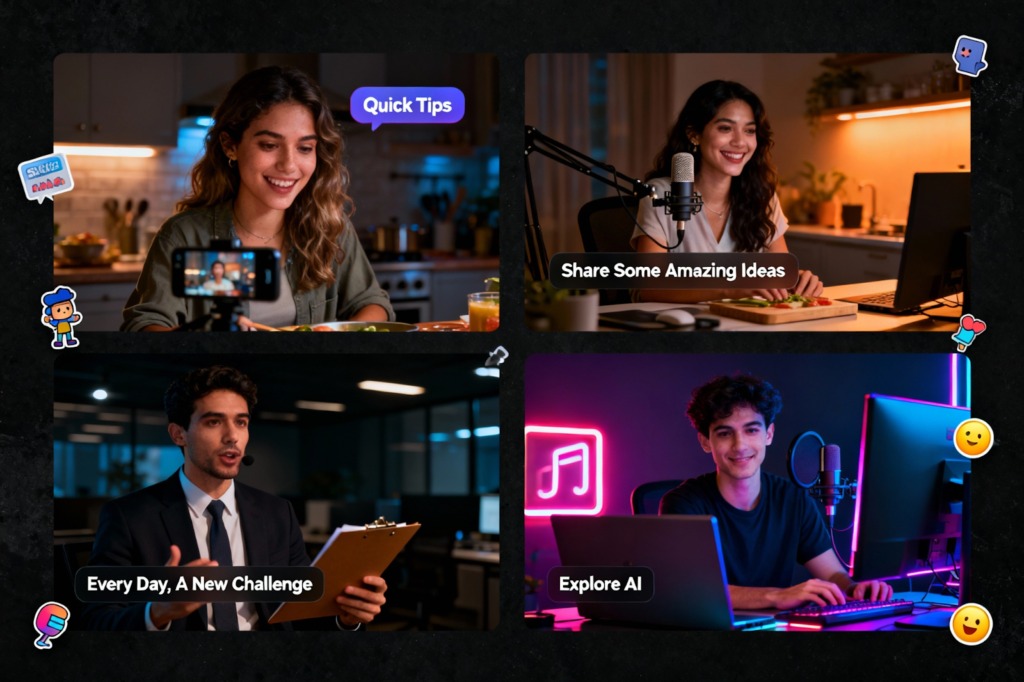
Video has become the dominant way people communicate online. From product demos and tutorials to short-form social content, video is now the default format for attention. Yet creating videos still comes with the same old problems: filming, editing, lighting, and appearing on camera.
This is why the Talking Avatar Generator is becoming one of the most practical AI tools for modern creators. Instead of recording yourself or hiring actors, you generate a digital character that speaks for you — with realistic lip-sync and natural voice.
Not as a gimmick, but as a new production method.
Talking Avatar Generator and the Shift in Content Creation
For years, video creation followed one model:
Real person → real camera → real editing → final video
This model works, but it doesn’t scale well. It requires:
- Time
- Confidence on camera
- Equipment
- Repeated retakes
A Talking Avatar Generator replaces that entire pipeline with something simpler:
Script or audio → AI avatar → final video
The creator no longer needs to appear on screen. The avatar becomes the presenter.
This shift is especially visible in:
- Online education
- Social media automation
- Marketing videos
- Internal training
In all of these, the goal is not cinematic storytelling — it’s clear, repeatable communication.
What a Talking Avatar Generator Actually Solves
At a surface level, a talking avatar generator synchronizes a face with audio. But in practice, it solves three deeper problems that most video creators face.
1. The Camera Problem
Many people avoid video simply because they don’t want to be on camera. This includes:
- Shy creators
- Non-native speakers
- Founders and developers
- Teachers and trainers
With a Talking Avatar Generator, the avatar becomes the interface. The creator stays invisible.
2. The Consistency Problem
Real people change:
- Different lighting
- Different moods
- Different environments
Avatars don’t. They look the same in every video, which is critical for branding and long-term channels.
3. The Scalability Problem
Once you record yourself, editing and localization become expensive. With talking avatars, you can generate:
- Dozens of videos
- Multiple languages
- Different voice styles
From the same source script.
Talking Avatar Generator in Real Usage Scenarios
This technology works best in situations where clarity matters more than personality.
H3: Tutorials and How-To Videos
Explainer videos often need:
- Clear narration
- Simple visuals
- Repeatable structure
Using a Talking Avatar Generator, creators can generate tutorials without re-recording every time the script changes.
This is especially useful for:
- Software walkthroughs
- Product onboarding
- Internal training
Instead of re-filming, you just update the text.
Social Media and Faceless Channels
Short-form platforms like TikTok, YouTube Shorts, and Instagram Reels reward volume and consistency.
But most creators struggle with:
- Daily filming
- On-camera energy
- Burnout
Talking avatars allow creators to build “faceless channels” where:
- The avatar delivers all narration
- The human focuses only on ideas and scripts
This pattern is increasingly common in:
- Motivational content
- History channels
- Business tips
- News-style accounts
The avatar becomes the brand.
Multilingual Content
One of the strongest use cases is localization.
With tools like Talking Avatar Generator,creators can generate the same video in multiple languages using different AI voices, without re-recording or hiring voice actors.
This is valuable for:
- International marketing
- Global e-learning
- SaaS onboarding
- Customer support videos
The visual stays the same. Only the voice changes.
Talking Avatar Generator vs Traditional Video Production
| Aspect | Traditional Video | Talking Avatar Generator |
| Actors | Required | Not needed |
| Filming | Mandatory | None |
| Editing | Heavy | Minimal |
| Localization | Expensive | Automated |
| Revisions | Time-consuming | Instant |
| On-camera skill | Required | Irrelevant |
Traditional video is built around humans adapting to tools. Talking avatars reverse that: tools adapt to humans.
You don’t change how you work. You change how content is produced.
Why Talking Avatars Feel Natural to Viewers
A common concern is whether people trust or accept AI presenters.
In practice, most viewers care about:
- Clear speech
- Natural pacing
- Understandable content
They rarely care whether the speaker is real.
This is because most informational content is not about emotional connection. It’s about comprehension.
In:
- Tutorials
- Ads
- Explainers
- Corporate videos
The avatar is not the message. It’s the delivery system.
As long as it looks and sounds natural, users quickly accept it.
From Static Avatar to Digital Presenter
The deeper impact of a Talking Avatar Generator is that it creates a new role: the digital presenter.
This presenter:
- Never gets tired
- Never needs retakes
- Speaks any language
- Delivers perfectly timed scripts
Instead of “recording videos”, creators start “generating presenters”.
With platforms like LipSync Video,an avatar becomes a reusable asset — similar to a logo or brand voice.
It’s no longer tied to one person or one performance.
The Psychological Advantage of Talking Avatars
Talking avatars also remove a major mental barrier: self-consciousness.
Many people avoid creating content because:
- They dislike their voice
- They dislike their appearance
- They fear judgment
When an avatar speaks instead of you:
- The fear disappears
- The message becomes separate from the person
- Creativity increases
This leads to a surprising effect: people publish more.
Not because the tool is powerful, but because the friction is gone.
Talking Avatar Generator as a New Content Layer
In the past, content creation meant: Idea → Writing → Filming → Editing → Publishing
With talking avatars, it becomes: Idea → Writing → Generating → Publishing
This removes two entire layers of complexity.
As a result, creators start thinking differently:
- More experiments
- Faster iterations
- Lower emotional cost
The avatar turns content into a system instead of a performance.
The Future of Talking Avatar Generator Tools
Talking avatars are not replacing humans. They are replacing unnecessary effort.
They make sense wherever:
- Speed matters more than authenticity
- Information matters more than emotion
- Scale matters more than uniqueness
Which is exactly how most digital content works.
In that sense, the Talking Avatar Generator is not a trend. It’s an infrastructure tool for a world where video is no longer “special” — it’s just another format.
Final Thought: Video Without Being on Video
The real power of a talking avatar generator is not realism.
It’s liberation.
You no longer need:
- Cameras
- Actors
- Perfect delivery
- Or even your own face
You just need:
- An idea
- A script
- And a digital presenter
In a world where attention is scarce and content is constant, the creators who win are not those who look best on camera — but those who can produce clearly, consistently, and without friction.
And that’s exactly what talking avatars enable.