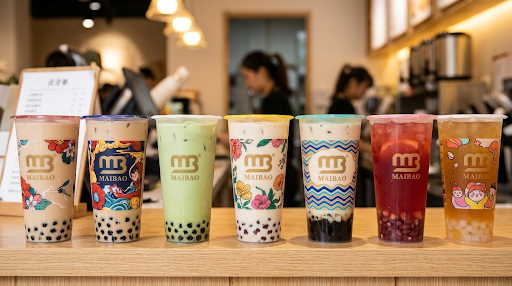
Bubble tea has always had a visual side. The colour of the drink, the pearls at the bottom and the contrast between milk, tea and fruit are all part of its appeal. But when bubble tea moves from a freshly prepared drink at a counter to a ready-to-drink product sold in shops, drinks packaging has a different job to do.
The product may pass through a production line, a warehouse, a delivery vehicle and a retail refrigerator before someone finally opens it. Along the way, the container needs to remain intact, the label needs to stay readable, and the drink needs to arrive looking much as the customer expects.
That makes packaging more than a finishing touch. For ready-to-drink bubble tea, it is part of how the product is presented, transported and sold.
The Right Format Depends on Where the Drink Will Be Sold
A cup, a can and a bottle might all hold a bubble tea drink, but they do not serve exactly the same purpose.
Cup packaging can feel familiar to customers who associate bubble tea with specialist shops. It can also provide a useful display surface for colourful drinks and distinctive flavour designs. In a chilled retail cabinet, a row of bright cups can catch the eye without requiring much explanation.
Cans offer a different set of advantages. Their shape can make them convenient for stacking, transporting and arranging in compact retail displays. They may suit convenience stores, vending locations and other outlets where shelf space is limited.
Bottles, meanwhile, can be easier to carry and drink from in situations where consumers are on the move. Their shape, closure and label area give brands another way to distinguish a product from the drinks already on the shelf.
None of these formats wins in every situation. A package that looks excellent in a café refrigerator might not be the most efficient choice for a distributor shipping full pallets to several markets. The selling environment should influence the decision from the beginning.
A Good-Looking Package Still Has to Work
url: plastic-cups-cold-drinks-mbpak
alt: Plastic Cups Cold Drinks MBPAK
It is easy to focus on colours, artwork and brand recognition when reviewing a new package. Those details matter, but they are only part of the job.
A leaking closure can ruin a perfectly good presentation. A damaged container can create problems during transport, while inconsistent sealing may lead to products being rejected or discarded. Even a small defect becomes expensive when it appears across a large shipment.
The package should be assessed as a complete system. That means looking at the container, its closure, the seal where applicable, the printed information and the way the finished product is packed for distribution.
For drinks containing pearls or other inclusions, it is also worth considering how the product behaves during ordinary handling. The package needs to suit the actual beverage rather than simply meet a nominal capacity requirement.
These checks do not need to turn every packaging decision into a long technical exercise. A practical product trial can reveal many obvious problems before an order moves into full production.
The Label Has to Earn Its Space
A retail package has only a short time to make an impression.
Someone looking through a refrigerator may compare several drinks within seconds. They need to recognise the flavour, understand what kind of product they are buying and distinguish one variety from another.
A crowded label can make that harder. So can artwork that hides the drink when visibility is one of its strongest selling points.
Bubble tea brands have a particular balance to strike. Graphics help establish identity, but the drink itself can also do some of the visual work. Where the packaging is transparent, colour and visible ingredients may contribute to its appeal. With cans or more heavily printed containers, typography, colour choices and a clear flavour description become more important.
The same design should also work when the package is viewed from a distance, placed next to competing products or photographed for an online catalogue.
A design that looks impressive on a computer screen can behave differently on a curved bottle or a small cup. Reviewing the actual printed sample is much more useful than approving artwork alone.
The Journey Through Distribution Matters
Packaging problems are not always obvious when a sample is sitting neatly on a desk.
The product might look fine at the factory and still encounter difficulties when packed into cartons, stacked on pallets or moved through several distribution points.
Containers need to withstand the handling conditions expected during transport. Cartons should protect them from ordinary movement and stacking pressure, while the overall packing arrangement should make sense for warehouse storage and shipment.
For importers and wholesalers, these details affect more than appearance. Damaged products can create extra sorting work, delays and avoidable losses. Inconsistent carton dimensions can also make storage and transport planning more difficult.
This is why a packaging trial should include the secondary packaging, not just the individual cup, can or bottle. A good-looking container is only one part of a shipment that needs to arrive in saleable condition.
Storage conditions deserve the same attention. Buyers should follow the manufacturer’s stated requirements and avoid assuming that every ready-to-drink beverage can be stored or transported in the same way simply because the packages look similar.
What Buyers Should Check Before Placing an Order
For retailers and distributors, packaging selection is partly a product decision and partly a logistics decision.
Start with the intended sales channel. A drink designed for chilled impulse purchases may need a different presentation from one sold through a café or supplied to a wider wholesale network. The container should suit the product’s price position, expected handling and available display space.
Then look at the practical specifications: capacity, dimensions, closure performance, carton configuration and compatibility with the intended distribution process. Ask for the relevant material and food-contact documentation, along with clear information about storage conditions and product identification.
If several formats are under consideration, compare them using the same criteria. A can may have advantages for stacking, while a cup could provide a more recognisable bubble tea presentation. The useful comparison is not which package looks best on its own, but which one makes sense for the product and the way it reaches customers.
It is also worth discussing future orders before committing to a format. A package that works for a small test shipment should remain practical when demand grows. Changes to artwork, carton quantities or packaging specifications can affect production planning, so it helps to understand the available options early.
Consistency Is What Makes a Product Feel Established
A consumer may buy a new bubble tea flavour because its colour catches their attention. Whether they choose it again depends on the experience that follows.
The package needs to arrive in good condition, open as expected and communicate the product clearly. A retailer needs it to fit the shelf. A distributor needs reliable packing and clear product specifications. Each of these requirements may seem small, but they shape how confidently a product can be sold.
Consistency also matters when a range expands. New flavours should look like part of the same family without becoming difficult to distinguish. A recognisable design helps customers find familiar products while leaving enough room for the next addition.
For brands selling across different channels, the packaging system should support that consistency without forcing every product into an identical format.
Packaging Should Fit the Drink, Not the Other Way Around
There is no need to make bubble tea packaging complicated for its own sake. The best choice is usually the one that fits the drink, the customer and the route to market.
A cup may suit one product and sales environment; a can or bottle may be more practical for another. The decision becomes clearer when brands look beyond the initial appearance and consider sealing, labelling, storage, transport and retail presentation together.
Bubble tea may be bought on impulse, as a treat or as part of a regular shopping trip. Whatever brings a customer to the shelf, the packaging should do its job quietly: protect the product, make its identity clear and help it reach the customer in the condition intended.
That is what turns a container from a simple vessel into a useful part of the product experience.