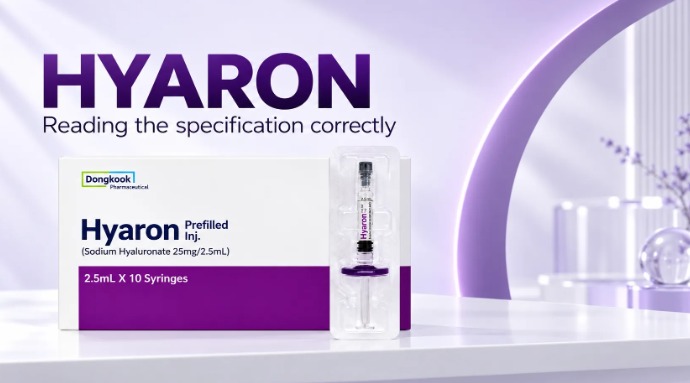
Hyaluronic acid appears in everything from a lightweight serum to a firm contouring gel. That familiarity can make very different products sound alike. Hyaron is a useful example of why the physical form of HA matters as much as the ingredient name. Its sodium hyaluronate formulation belongs in a different discussion from the crosslinked gels selected for structural volume.
The term Hyaron skin booster is widely used in aesthetic product catalogs. To understand the product itself, it helps to look at the material: a prefilled sodium hyaluronate preparation from Dongkook Pharmaceutical. The important ideas are water binding, viscosity and the distinction between a hydrated appearance and a change in facial shape.
What Hyaron Contains
Dongkook identifies Hyaron Prefilled as a sodium hyaluronate prescription product and lists a 2.5 mL syringe presentation. Its official product indications concern joint conditions; the skin booster wording describes its aesthetic market positioning rather than the manufacturer’s listed joint indication. [1]
Sodium hyaluronate is the sodium salt of hyaluronic acid. The different name does not place it in an unrelated ingredient family. In water, this large sugar based polymer contributes to a hydrated, viscous environment. The familiar Hyaron presentation is labeled 25 mg in 2.5 mL, which describes the amount of sodium hyaluronate in the supplied volume.
For readers, the useful product identity is a relatively straightforward HA formulation. It is not a blend built around PDRN, PLLA or a neuromodulator. That simplicity makes it a useful reference point when comparing the many products marketed around skin quality.
Why HA is Associated With Water
The structure of hyaluronic acid includes groups that interact strongly with water. When many polymer chains occupy a solution, they also affect how the material flows and how it responds to movement. This is why HA can be relevant to both hydration and viscosity without those words meaning the same thing.
Hydration concerns water content. Viscosity concerns resistance to flow. A liquid can bind water and still have a very different shape holding ability from a crosslinked gel. Understanding those two properties prevents the common assumption that anything containing HA must act like a volumizing filler.
There is also a difference between the amount of HA and the size of its chains. Molecular weight describes chain size, while concentration describes how much material is present in a given volume. Both can influence behavior. A number expressed in milligrams per milliliter therefore cannot describe the whole material by itself.
For someone interested in Hyaron, these are useful fundamentals rather than laboratory trivia. They explain why an HA based product might be discussed around a hydrated appearance, while another HA based product is discussed around support and projection. The shared ingredient does not erase the difference in design.
Noncrosslinked HA Compared With a Structural Gel
Crosslinking joins HA chains into a network. This can make a formulation more resistant to flow and degradation, depending on how the network is produced. Noncrosslinked HA does not have that same manufactured network of chemical links. The distinction changes the material’s role in an aesthetic product. [2]
Hyaron is commonly discussed as a noncrosslinked HA preparation. Its identity therefore should not be explained through the same expectations as a firm contouring gel. A product that spreads as a viscous preparation and a product designed to retain projection answer different questions, even if both ultimately contain HA.
| Feature | Hyaron style noncrosslinked HA preparation | Crosslinked HA contouring gel |
| Material structure | HA chains without a manufactured crosslinked gel network | HA chains connected within a gel network |
| Main comparison | Fluid and hydration related properties | Elasticity and shape supporting properties |
| Common aesthetic discussion | Skin quality and fine texture | Volume and contour |
| Key misunderstanding | Hydration automatically equals lifting | All HA gels have the same firmness |
This comparison describes material categories. It does not prescribe a use for Hyaron or claim that every skin quality product is noncrosslinked. Some products designed for skin quality use modified or lightly crosslinked HA. The broader lesson is to understand the finished material rather than assigning a role from the letters HA alone.
Hydrated Looking Skin is Not the Same as Added Volume
Dry looking skin often shows fine surface lines, roughness and a less even reflection of light. Structural volume loss may instead appear as hollowing or a change in facial proportion. These concerns can occur together, but they originate at different levels of the appearance.
The word plump is sometimes used for both. A moisturizer can make a dry surface look more supple; a filler can change a contour through physical volume. Because the same everyday word covers both experiences, product explanations need to be specific about the actual goal.
For Hyaron, the relevant aesthetic interest is usually the HA and skin quality conversation. That is different from claiming that the product creates the projection associated with a firm gel. Explaining this distinction helps clients understand why a practice may stock more than one HA product without treating them as duplicates.
What HA Research Adds to the Discussion
A randomized split-face study by Duteil and colleagues compared a noncrosslinked HA gel with saline and evaluated facial skin quality. The tested product was M-HA10, not Hyaron. The study is relevant because it investigated the hydration and appearance questions that make this material category interesting. It is not evidence for an identical Hyaron result. [3]
Topical HA has also been studied. Pavicic and colleagues compared cream formulations containing HA of different molecular weights and reported changes in hydration and other measured outcomes. These findings concern topical creams, but they reinforce the point that formulation and molecular characteristics matter even within one ingredient family. [4]
A Simple Formula Can Make Comparison Easier
Multi-ingredient boosters may combine several components: hyaluronic acid, nucleotides, vitamins and peptides. Hyaron’s sodium hyaluronate identity offers a narrower starting point. A reader can first understand the HA component before comparing products with additional ingredient systems.
For example, comparing Hyaron with a PDRN and HA combination is not simply a question of which box contains more liquid. The combination has a different ingredient rationale. Comparing Hyaron with a PLLA product is an even larger category change, because PLLA is discussed around a gradual tissue response rather than the immediate properties of an HA preparation.
How to Describe Skin Quality Goals Clearly
“My skin looks tired” is a reasonable starting point, but it can mean several things. Some people notice dry patches; others see uneven color, roughness, fine lines or a loss of facial fullness. Separating those observations makes the conversation about HA more useful.
A clear description might be that makeup catches on fine dry lines, or that the surface looks less smooth in daylight. A request for stronger cheek projection is different. Neither concern is less valid; they simply call for different product questions and a professional assessment of the available options.
Routine care also remains relevant. Moisturizers work at the skin surface and can improve the appearance and feel of dryness. They are not made redundant by interest in a professional HA product. The product category and everyday skincare address different parts of the overall experience. [5]
Understanding Package Value
For a practice reviewing hyaron wholesale pricing, the first commercial distinction is the supplied syringe and carton quantity. Dongkook’s English product page lists 2.5 mL syringes in boxes of five or ten. Comparing the same configuration avoids confusing a lower box price with a lower cost for the same amount of stock. [1]
The useful calculation stays commercial: total delivered cost for the chosen presentation. It should not be converted into a promised number of identical outcomes. For example, a five syringe carton and a ten syringe carton contain different quantities even when their individual syringes have the same volume.
Frequently Asked Questions
Is sodium hyaluronate different from hyaluronic acid?
Sodium hyaluronate is the sodium salt of hyaluronic acid. The names refer to closely related forms within the same ingredient family. The more important product differences often involve concentration, chain size, crosslinking and the rest of the formulation rather than the presence of the word sodium.
Is Hyaron a crosslinked contouring filler?
Hyaron is commonly described as a noncrosslinked sodium hyaluronate preparation. It should not be understood as interchangeable with a firm crosslinked HA gel selected for contour support. The material structure and intended product context are different, even though both involve the same polymer family.
Does a higher HA concentration always mean a better product?
Concentration is only one property. Chain size, crosslinking and formulation also influence how the material behaves. More milligrams per milliliter do not automatically mean better hydration, greater projection or a more suitable product for every concern. The objective determines which properties are relevant.
Can hydration change facial shape?
A more hydrated looking surface may appear smoother and more supple, but that is different from deliberately adding structural volume. Words such as plumping can describe both experiences, so it helps to specify whether the goal is improved skin quality or a visible contour change.
Does Hyaron replace a moisturizer?
No. Topical moisturizers help address surface dryness and the feel of the skin in daily life. Interest in a professional HA product does not remove that role. A simple routine suited to the individual remains part of maintaining a comfortable and well cared for appearance.
What is the clearest reason to compare Hyaron with another booster?
Compare the ingredient system and the material properties in relation to the professional product need. An HA focused preparation, a nucleotide combination and a crosslinked gel have different rationales. Understanding that distinction provides a much stronger starting point than comparing package colors or broad rejuvenation claims.
Explore HA Products by Their Actual Role
Hyaron helps illustrate why HA is a material family rather than one uniform aesthetic solution. Practices exploring ELE Global can compare the available presentation with other HA and skin quality products, keeping formulation and professional use context at the center. Once the product role is clear, the package and price comparison becomes much more straightforward.
References
- Dongkook Pharmaceutical. Hyaron Prefilled Injection. Official English and Korean product information. Accessed October 14, 2026.
- Fagien S, Bertucci V, von Grote E, Mashburn JH. Rheologic and Physicochemical Properties Used to Differentiate Injectable Hyaluronic Acid Filler Products. Plastic and Reconstructive Surgery. 2019;143(4):707e–720e.
- Duteil L, et al. The Effects of a Non-crossed-linked Hyaluronic Acid Gel on the Aging Signs of the Face versus Normal Saline. Journal of Clinical and Aesthetic Dermatology. 2023;16(2):29–36.
- Pavicic T, et al. Efficacy of cream-based novel formulations of hyaluronic acid of different molecular weights in anti-wrinkle treatment. Journal of Drugs in Dermatology. 2011;10(9):990–1000.
- American Academy of Dermatology Association. How to pick the right moisturizer for your skin. Patient information. Accessed October 14, 2026.