
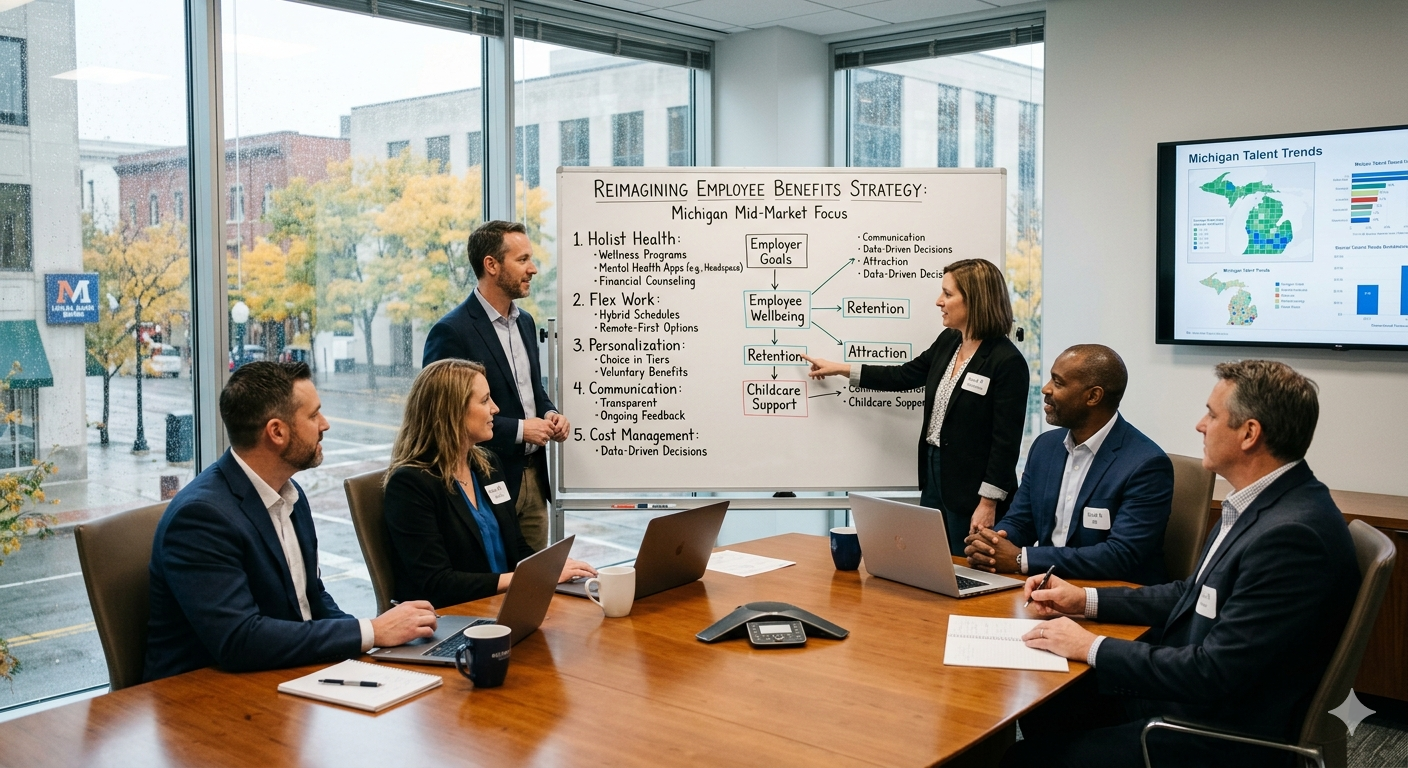
For decades, the employee benefits landscape in Michigan followed a predictable rhythm: annual renewal, a few carrier quotes, and a decision made under pressure. But for mid-market employers—companies with 50 to 500 employees—that model is no longer enough. Rising healthcare costs, evolving ACA compliance requirements, and a competitive labor market are forcing HR leaders and business owners to rethink how they approach benefits strategy.
The Shift From Transactional to Strategic
The traditional broker relationship was transactional. A broker would present options at renewal, the employer would pick one, and the cycle repeated 12 months later. Today’s leading Michigan employers are demanding more. They want a consultative partner who understands their workforce demographics, monitors regulatory changes throughout the year, and proactively identifies opportunities to optimize plan design.
This shift is particularly acute in manufacturing, healthcare, professional services, and logistics—industries that employ large shares of Michigan’s mid-market workforce. These employers face unique challenges: seasonal hiring fluctuations, multi-location compliance, and benefits packages that must compete with both local rivals and national firms recruiting from the same talent pool.
Why Independence Matters
One of the most significant decisions an employer can make is whether to work with a captive broker—one tied to a specific carrier—or an independent brokerage. Independent brokers have the flexibility to evaluate plans across multiple carriers, which often leads to more competitive pricing and better plan fit.
For Michigan employers, this independence is especially valuable given the state’s diverse insurance market. From Blue Cross Blue Shield of Michigan to national carriers with strong regional networks, the options are extensive. An independent broker can navigate these choices without the constraint of representing a single provider.
Compliance as a Year-Round Priority
ACA compliance is no longer a once-a-year concern. Applicable Large Employers (ALEs) with 50 or more full-time equivalent employees must manage ongoing reporting, affordability testing, and eligibility tracking. A broker who only surfaces at renewal leaves employers exposed to penalties and administrative gaps.
Forward-thinking employers are now partnering with brokers who embed compliance monitoring into their ongoing service model. This includes regular check-ins, technology-driven reporting, and early warning systems for potential ACA violations.
Alternative Funding Models
Level-funded and self-funded health plans have moved from the margins to the mainstream for mid-market employers. These arrangements can offer significant cost savings and greater transparency into claims data—if structured correctly. However, they also introduce complexity around stop-loss coverage, claims administration, and employee communication.
Employers exploring these options need more than a spreadsheet comparison. They need a broker who can model scenarios, explain risk exposure in plain language, and manage the transition without disrupting employee satisfaction.
Conclusion
Michigan’s mid-market employers are at an inflection point. The old way of buying benefits—reactive, carrier-constrained, and compliance-light—is giving way to a more strategic approach. Companies that invest in the right broker relationship today are positioning themselves for lower costs, stronger compliance, and a more competitive employee value proposition tomorrow.
CFH Insurance Consultants is an independent employee benefits broker based in Bloomfield Hills, Michigan, serving mid-market employers across the state with a year-round consultative approach.