Scaling a business is often described as the ultimate goal for entrepreneurs. More revenue, more clients, and more team members usually signal success. However, in reality, many founders experience the opposite—stress increases, decision fatigue builds, and burnout becomes a constant risk.
This happens when growth is not supported by systems. Without structure, every stage of scaling adds complexity instead of clarity. Entrepreneurs end up becoming the center of every decision, task, and problem.
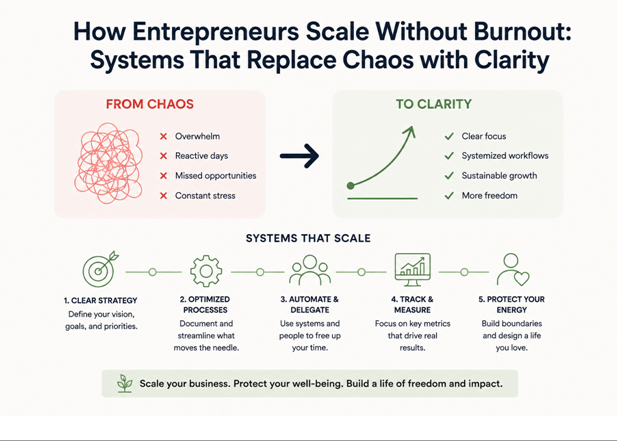
The solution is not to work harder or hire faster. The solution is to build systems that replace chaos with clarity, allowing growth to happen without overwhelming the founder.
Useful Digital Tools for Business Operators
Modern entrepreneurs often rely on digital platforms to manage workflows, systems, and productivity. These tools help support structured scaling:
- TMTCash: https://tmt.cash/
A digital platform used by many online entrepreneurs for streamlined financial and operational activities. - TMT Cash Login: https://tmtcash.org/
Access point for managing account operations and system tools efficiently.
Why Entrepreneurs Experience Burnout While Scaling
Burnout does not happen instantly. It builds over time as operational pressure increases.
1. The business depends too heavily on the founder
In early stages, founders naturally handle everything—sales, operations, marketing, and decision-making. As the business grows, this dependency becomes a bottleneck. Nothing moves without the founder’s input.
2. No repeatable systems exist
Without systems, every task is handled differently each time. Processes are re-explained, mistakes are repeated, and execution becomes inconsistent.
3. Constant decision fatigue
Entrepreneurs make hundreds of micro-decisions daily. Without structured frameworks, even small decisions consume mental energy, leading to exhaustion.
4. Growth increases complexity instead of structure
More customers, employees, and tasks increase coordination demands. Without systems, growth multiplies chaos instead of organizing it.
The Shift: From Hustle-Based Growth to System-Based Scaling
Most entrepreneurs begin with a hustle mindset—working longer hours to push results. While effective early on, this approach does not scale.
System-based scaling focuses on structure instead of effort.
Hustle-based model:
- Founder does everything
- Growth increases workload
- Stress increases with revenue
System-based model:
- Processes run independently
- Teams operate with clarity
- Growth reduces founder involvement
The key principle is simple:
You don’t scale by doing more. You scale by building systems that do more for you.
What Are Business Systems?
A business system is a repeatable process that produces consistent outcomes without constant founder involvement.
Systems replace uncertainty with structure.
Examples of business systems:
- Lead generation system (how customers are consistently acquired)
- Sales system (how leads convert into paying clients)
- Delivery system (how services are fulfilled)
- Onboarding system (how clients or employees are integrated)
- Communication system (how teams share information)
When systems exist, businesses stop relying on memory and start relying on structured execution.
How Systems Reduce Chaos in Business
Chaos in scaling businesses usually appears as:
- Unclear responsibilities
- Repeated questions
- Missed tasks
- Constant firefighting
- Inconsistent execution
Systems eliminate chaos by introducing predictability.
Without systems:
- “Who is handling this?”
- “Why wasn’t this completed?”
- “What should we do next?”
With systems:
- “This is already assigned in the workflow.”
- “This process handles it automatically.”
- “This is the documented priority structure.”
Clarity replaces confusion, and structure replaces urgency.
The Core Systems Every Entrepreneur Needs to Scale Without Burnout
To scale sustainably, entrepreneurs must focus on five essential systems.
1. The Clarity System (Decision-Making Framework)
Burnout often comes from unclear decisions. A clarity system defines how decisions are made.
It includes:
- Founder vs team decision boundaries
- Priority frameworks
- Business goals and success metrics
With clarity, decisions become structured instead of emotional, reducing mental overload.
2. The Operations System (Execution Structure)
This system defines how work is done consistently.
It includes:
- SOPs (Standard Operating Procedures)
- Workflow documentation
- Task management systems
- Defined roles
This removes dependency on the founder for execution.
3. The Communication System (Information Flow)
Poor communication creates unnecessary stress in growing businesses.
A communication system defines:
- Where updates are shared
- How feedback is given
- When meetings occur
- How decisions are documented
This reduces confusion, repetition, and delays.
4. The Growth System (Revenue Predictability)
Many businesses struggle with inconsistent income. A growth system solves this.
It includes:
- Lead generation channels
- Conversion processes
- Sales frameworks
- Retention systems
Instead of chasing revenue, entrepreneurs build predictable growth engines.
5. The Leadership System (Team Independence)
Without leadership systems, founders become involved in everything.
A leadership system ensures:
- Clear ownership of roles
- Accountability structures
- Performance tracking
- Delegation rules
This allows teams to operate independently while staying aligned.
When used properly, platforms like these can support structured workflows and reduce manual operational effort.
How Systems Directly Prevent Burnout
Burnout is not just physical exhaustion—it is mental overload caused by too many unresolved decisions.
Systems reduce burnout by:
- Eliminating repetitive decision-making
- Reducing interruptions
- Preventing confusion
- Structuring workflows
- Delegating responsibility
This creates mental space for strategic thinking instead of constant reaction.
The Psychological Benefit of Systems
The biggest advantage of systems is not efficiency—it is clarity.
When systems are in place:
- The brain stops tracking everything
- Stress levels decrease
- Focus improves
- Energy is preserved
Entrepreneurs shift from reactive problem-solving to proactive leadership.
Common Mistakes When Building Systems
Many entrepreneurs struggle when implementing systems due to avoidable mistakes:
1. Overcomplicating processes
Systems should simplify work, not add complexity.
2. Trying to build everything at once
Start with one system before expanding.
3. Not documenting processes
If it is not written down, it is not a system.
4. Keeping systems in the founder’s head
Scalability requires shared documentation.
Practical Steps to Scale Without Burnout
Step 1: Identify repetitive tasks
Find tasks that happen repeatedly.
Step 2: Document the process
Write clear step-by-step instructions.
Step 3: Assign ownership
Every system must have a responsible person.
Step 4: Delegate execution
Gradually remove yourself from daily operations.
Step 5: Improve continuously
Systems evolve as the business grows.
Conclusion: Scaling Should Create Freedom, Not Stress
Entrepreneurial burnout is not a requirement for success. It is usually a result of scaling without systems.
When entrepreneurs build structured systems:
- Work becomes predictable
- Teams become independent
- Decisions become faster
- Stress decreases
- Growth becomes sustainable
True scaling is not about doing more work. It is about building a business that works without constant intervention.
Systems transform chaos into clarity—and burnout into sustainable business growth.