
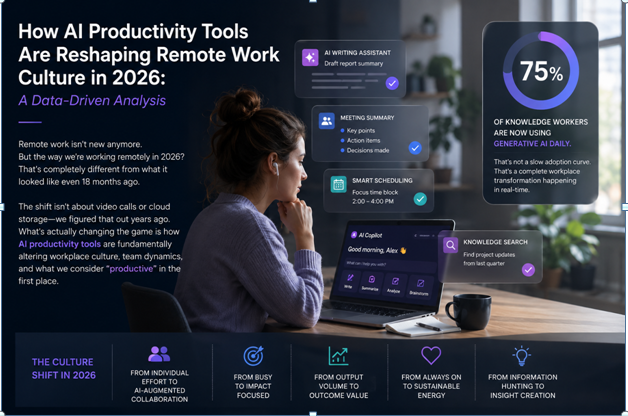
Remote work isn’t new anymore. But the way we’re working remotely in 2026? That’s completely different from what it looked like even 18 months ago. The shift isn’t about video calls or cloud storage—we figured that out years ago. What’s actually changing the game is how AI productivity tools are fundamentally altering workplace culture, team dynamics, and what we consider “productive” in the first place.
Here’s what’s actually happening: 75% of knowledge workers are now using generative AI daily. That’s not a slow adoption curve. That’s a complete workplace transformation happening in real-time.
The New Reality of AI-Powered Remote Teams
Walk into any remote team’s workflow right now and you’ll find AI embedded everywhere. Meeting transcription tools capturing every word. Writing assistants polishing emails before they’re sent. Project management platforms that predict bottlenecks before they happen. It’s not about replacing humans—that overblown fear never materialized. Instead, these tools are handling the repetitive stuff that burned people out in the first place.
The data tells a clear story. Companies using AI productivity tools report 40% faster project completion times. But speed isn’t the interesting part. What’s actually shifting is how teams collaborate when AI handles the administrative overhead.
Think about meeting notes. Before, someone got stuck documenting while everyone else talked. Now tools like Fireflies or Otter capture everything automatically, pull out action items, and even flag sentiment changes during discussions. Nobody’s half-listening while frantically typing anymore. The entire dynamic changes when everyone can actually be present.
Where Traditional Productivity Advice Falls Apart
Most productivity advice still assumes you’re working alone at a desk, managing your own task list. That model doesn’t match how remote teams actually function in 2026. Modern work is collaborative, asynchronous, and spread across time zones. You’re not just managing your time—you’re coordinating with people you might never meet in person.
This is where AI tools become essential rather than optional. Take motion planning tools that automatically reorganize your calendar based on team priorities and deadlines. Or platforms like ApexGaming that demonstrate how AI can optimize complex coordination tasks in real-time environments—the principles apply directly to remote team management.
The traditional 9-to-5 structure completely dissolves when AI handles scheduling intelligence. Teams can work asynchronously without losing coordination. A developer in Manila can finish their work, and the AI automatically briefs the designer in London about what changed and what needs attention next. No meetings required for basic handoffs.
The Trust Problem Nobody Talks About
Here’s something most articles skip: AI productivity tools are creating new trust issues in remote teams. When an AI can generate a report, write code, or draft proposals, how do you verify someone actually did the work versus just ran it through ChatGPT?
This matters more than you’d think. In a 2026 workplace survey, 64% of managers admitted they struggle to assess genuine contribution when AI tools are involved. The old metrics don’t work. Lines of code written? AI can generate thousands. Documents produced? Same issue. Hours logged? That’s been meaningless for years.
Smart teams are shifting focus entirely. They’re measuring outcomes and impact instead of outputs. Did the solution work? Did the strategy succeed? Did customer satisfaction improve? The tool you used to get there becomes irrelevant.
Real Cultural Shifts We’re Seeing
The culture changes go deeper than workflow adjustments. Remote teams using AI tools develop different communication patterns. Fewer status update meetings because dashboards auto-update. Less email back-and-forth because AI assistants handle routine questions. More focused time for actual creative work.
But it’s not all upside. There’s a growing divide between workers who’ve adapted to AI tools and those who haven’t. Some people are 3x more productive now. Others are still working the old way and falling behind. Companies are scrambling to address this gap because it’s creating real tension in teams.
The training problem is massive. You can’t just hand someone Notion AI or Claude and expect immediate results. Effective prompting is a skill. Knowing when to use AI versus when to think it through yourself—that’s judgment that develops over time. Organizations investing in actual AI literacy training are seeing significantly better adoption rates.
The Data Security Question
Remote work plus AI tools equals a data security nightmare if you’re not careful. Every AI productivity platform you use is potentially processing sensitive company information. Customer data, strategic plans, financial projections—all getting fed into various AI systems.
Some platforms are better about this than others. Enterprise-grade tools with proper data handling get expensive fast. Free tiers of popular AI tools? Read the terms carefully. Your competitive intelligence might be training their next model.
This is pushing companies to develop clear AI usage policies. What can go into public AI tools? What stays on private infrastructure? Who approves new AI platform adoption? These weren’t questions anyone asked three years ago. Now they’re critical.
Gaming the System vs. Using It Right
Interesting pattern emerging: some workers are using AI to fake productivity rather than enhance it. Generate a bunch of reports. Flood Slack with AI-drafted updates. Create the appearance of activity without actual contribution. Platforms like ApexGaming in competitive environments show how systems get optimized—sometimes in ways designers didn’t intend. Same thing’s happening with workplace AI.
Managers are getting smarter about this. They’re looking for substance over volume. Quality of thinking rather than quantity of output. The workers thriving aren’t the ones generating the most AI content—they’re the ones using AI to free up time for strategic thinking that actually moves projects forward.
What Actually Works in 2026
After watching hundreds of remote teams adopt AI tools, some clear patterns emerge. The successful ones start small. Pick one workflow that’s genuinely painful and fix it with AI. Master that. Then expand. The teams that try to AI-transform everything at once usually fail.
Integration matters more than individual tool quality. An okay AI tool that plays nicely with your existing stack beats an amazing tool that requires everyone to learn a new platform. Friction kills adoption every time.
And honestly? The human element still dominates everything. AI tools are force multipliers, but they multiply what’s already there. A dysfunctional team with AI tools just creates dysfunction faster. Strong communication, clear goals, actual trust between team members—that foundation has to exist first.
Making the Transition
If you’re reading this and your team hasn’t really embraced AI productivity tools yet, you’re behind. Not catastrophically so, but enough that it’s affecting your competitive position. The good news is that catching up is still possible. The bad news is that window is closing.
Start with tools that have clear, measurable impact. Meeting transcription saves 2-3 hours per person per week immediately. That’s real time back for actual work. Writing assistants reduce email composition time by 40%. Project management AI spots scheduling conflicts before they derail sprints. Pick wins you can measure.
Don’t force tools on people. Make them available, show the benefits, let early adopters prove the value. Once three people on your team are getting obvious results, others will follow. Mandating AI usage from the top down mostly generates resentment.
The Path Forward
Remote work culture in 2026 isn’t about location independence anymore. That’s table stakes. It’s about intelligent automation, asynchronous collaboration, and outcome-focused measurement. AI productivity tools enable all three, but only when implemented thoughtfully.
The companies adapting fastest aren’t the ones with the biggest AI budgets. They’re the ones who understand that tools serve people, not the other way around. They’re investing in training, creating clear policies, and measuring what actually matters. Culture doesn’t change because you bought new software. It changes when people adopt new behaviors that genuinely improve their work experience.
What we’re seeing is the early stage of a fundamental workplace transformation. AI productivity tools are the catalyst, but human adaptation is what actually creates the culture shift. Teams that embrace this reality—that combine AI capabilities with strong human collaboration—those are the ones that’ll define what remote work means for the next decade.
The question isn’t whether your team will adopt AI productivity tools. It’s whether you’ll do it intentionally with clear goals, or stumble into it reactively while competitors sprint ahead. Based on current adoption rates, most teams won’t have the luxury of waiting much longer to decide.