Introduction
IT organizations are under increasing pressure to deliver faster innovation, higher reliability, and measurable business value while managing cost and complexity. Traditional approaches to IT modernization often struggle to keep pace with growing digital demands, fragmented data environments, and rising cybersecurity risks. As a result, many enterprises are exploring advanced technologies that can augment human expertise and improve operational performance at scale.
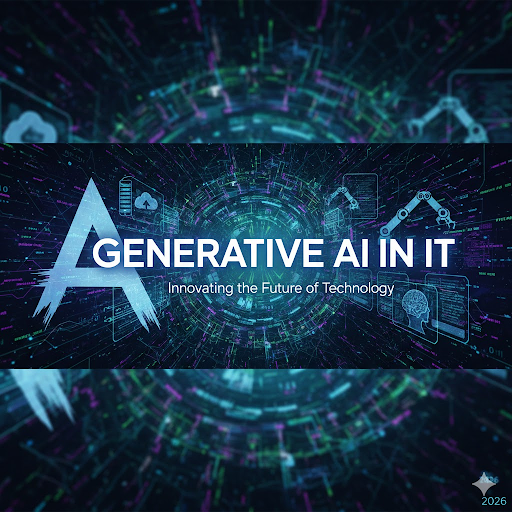
Generative AI has emerged as a transformative capability within IT, enabling organizations to rethink how software is developed, systems are managed, and services are delivered. Unlike earlier automation tools, generative AI can create new content, generate code, analyze patterns, and provide context-aware recommendations. When applied strategically, it supports smarter decision-making and more adaptive IT operations.
As organizations move from experimentation to enterprise-wide adoption, understanding where generative AI fits within the IT operating model is critical. Its value depends not only on technology selection, but also on governance, talent readiness, and alignment with broader business objectives.
Overview of Generative AI in IT
Generative AI refers to advanced models capable of producing text, code, images, and structured outputs based on learned patterns from large data sets. In IT, these models are increasingly embedded into workflows to support engineering, infrastructure, and service management functions.
Rather than replacing existing systems, generative AI complements them by acting as an intelligent layer across the IT landscape. It can interpret unstructured data, automate complex tasks, and provide real-time insights that were previously difficult to obtain. This shift enables IT teams to move beyond reactive operations toward proactive and predictive capabilities.
A growing number of enterprises are formalizing their approach to Generative AI in IT by integrating it into software development life cycles, IT service management platforms, and enterprise architecture planning. This transition reflects a broader move toward AI-enabled IT organizations that focus on business outcomes rather than isolated technical metrics.
How Generative AI Differs From Traditional Automation
Traditional automation relies on predefined rules and scripts. While effective for repetitive tasks, it struggles with ambiguity and change. Generative AI, by contrast, learns from data and adapts to new scenarios. This makes it particularly valuable in dynamic IT environments where requirements evolve rapidly.
For example, generative AI can analyze system logs, identify emerging issues, and recommend remediation steps without requiring explicit programming for every scenario. It can also assist developers by generating code snippets, documentation, and test cases that align with organizational standards.
Maturity and Adoption Trends
Most organizations are still in the early stages of generative AI adoption within IT. Initial use cases often focus on productivity gains, such as code assistance or ticket resolution. More advanced adopters are beginning to embed generative AI into core IT processes, including capacity planning, incident prevention, and application modernization.
Success at scale requires clear governance, responsible AI practices, and alignment with enterprise priorities. Without these foundations, organizations risk fragmented deployments that fail to deliver sustained value.
Benefits of Generative AI in IT
Generative AI offers a range of benefits that extend across IT functions. When implemented thoughtfully, it helps IT organizations improve efficiency, resilience, and strategic impact.
Improved Productivity and Speed
One of the most immediate benefits is increased productivity. Generative AI accelerates tasks such as code development, system documentation, and troubleshooting. Developers can focus on higher-value design and architecture work while routine activities are handled more efficiently.
In IT operations, AI-generated insights reduce the time required to diagnose issues and restore services. Faster resolution times improve user satisfaction and reduce the business impact of outages.
Enhanced Decision Support
Generative AI enables IT leaders to make better-informed decisions by synthesizing data from multiple sources. It can analyze performance trends, assess risk scenarios, and provide recommendations that support planning and prioritization.
This capability is particularly valuable in areas such as infrastructure optimization and application portfolio management, where decisions involve trade-offs between cost, performance, and scalability.
Greater Operational Resilience
By identifying patterns that indicate potential failures, generative AI supports a more proactive approach to IT operations. Predictive insights help teams address issues before they escalate, improving system stability and availability.
AI-driven monitoring also enhances cybersecurity by detecting anomalous behavior and supporting faster response to threats. While generative AI does not replace security expertise, it strengthens an organization’s ability to manage risk in complex environments.
Cost Optimization
Generative AI contributes to cost efficiency by reducing manual effort and improving resource utilization. Automated analysis of usage patterns helps organizations right-size infrastructure and avoid unnecessary spending.
Over time, these efficiencies allow IT teams to reallocate resources toward innovation and strategic initiatives rather than day-to-day maintenance.
Use Cases of Generative AI in IT
Generative AI is being applied across a wide range of IT use cases, each delivering distinct value depending on organizational maturity and objectives.
Software Development and Engineering
Generative AI supports developers throughout the software development life cycle. It can generate code based on natural language prompts, suggest improvements, and identify potential defects early in the process.
Code Generation and Review
AI-assisted coding tools help standardize development practices and reduce errors. They also support faster onboarding of new developers by providing contextual guidance and documentation.
Test Case Creation
Generative AI can automatically create test cases based on application requirements and historical defects. This improves test coverage and reduces the time required for quality assurance.
IT Service Management
In IT service management, generative AI enhances both efficiency and user experience.
Intelligent Ticket Resolution
AI-powered virtual agents can interpret user requests, suggest solutions, and route issues to the appropriate teams. This reduces resolution times and frees up staff to focus on complex problems.
Knowledge Management
Generative AI helps maintain up-to-date knowledge bases by summarizing incidents, changes, and resolutions. This ensures that institutional knowledge is captured and easily accessible.
Infrastructure and Cloud Operations
Generative AI supports more adaptive infrastructure management by analyzing performance data and usage patterns.
Capacity Planning
AI-driven forecasts help organizations anticipate demand and optimize resource allocation across on-premises and cloud environments.
Incident Prevention
By identifying early warning signs, generative AI enables teams to address potential issues before they result in service disruptions.
Enterprise Architecture and Modernization
Generative AI assists in assessing application landscapes and identifying modernization opportunities. It can analyze dependencies, recommend migration paths, and support more informed architecture decisions.
Organizations often combine these capabilities with broader AI consulting strategies to ensure alignment with governance, security, and business objectives.
Why Choose The Hackett Group for Implementing Generative AI in IT
Implementing generative AI in IT requires more than technology expertise. It demands a clear understanding of business priorities, operating models, and performance benchmarks. The Hackett Group® brings a data-driven approach grounded in decades of research on IT effectiveness and enterprise performance.
By combining benchmark insights with practical transformation experience, the firm helps organizations identify where generative AI can deliver the greatest value. This ensures investments are prioritized based on impact rather than experimentation alone.
The Hackett AI XPLR™ platform supports this approach by enabling organizations to explore AI opportunities, assess readiness, and design scalable implementation roadmaps. This structured methodology helps IT leaders move from pilots to enterprise adoption while maintaining governance and accountability.
Rather than treating generative AI as a standalone initiative, the focus is on embedding it within the IT operating model to support long-term performance improvement.
Conclusion
Generative AI is reshaping the role of IT from a support function to a strategic enabler of business value. By augmenting human expertise with intelligent automation, it helps organizations improve productivity, resilience, and decision-making across the IT landscape.
The path to success lies in thoughtful implementation. Organizations must align generative AI initiatives with business objectives, establish strong governance, and invest in the skills needed to sustain change. When these elements come together, generative AI becomes a powerful catalyst for IT transformation.
As adoption continues to mature, IT leaders who act with clarity and discipline will be best positioned to turn generative AI from a promising technology into a lasting competitive advantage.