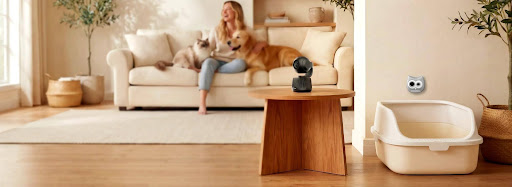
There is a quiet difference between the pet owner who checks a phone at lunchtime and hopes for the best, and the one who can glance at a live feed whenever curiosity or worry arrives. Both people love their animals equally. The gap sits in what they can actually see. For years, the default was silence between the moment a door closed in the morning and the moment it opened again in the evening. Now, a small lens mounted on a shelf can turn that long stretch of guesswork into steady, honest observation. This is not about surveillance or paranoia. It is about closing a distance that used to feel unavoidable and replacing anxiety with information that a household can actually use.
The Old Way: Guesswork, Silence, and a Locked Front Door
For a long time, leaving the house meant accepting a kind of blind trust. You fed the dog, left a chew toy, told the cat to behave, and walked out with a small knot of hope in your chest. If the mail carrier rang the bell, you would never know how your dog reacted. If your cat decided the curtains looked climbable, you would only find out at dinner. The whole day ran on assumption. Owners filled the gap with imagination, which is not always kind: every unexpected noise on the walk home became a possible disaster waiting behind the door. Nothing about that pattern was healthy, but it was the only pattern most households had.
Even the workarounds carried limits. A quick FaceTime with a neighbor, a note left for the dog walker, a text from a family member who happened to swing by at noon. These are helpful, but they are snapshots at best. Snapshots do not tell you how your senior dog handled the thunderstorm at eleven. They do not show you which corner of the room your kitten actually sleeps in. They cannot answer the real question every owner asks eventually, which is simply, “What does my animal do when I am not there?” Without a way to look in, the answer stayed a mystery, and mystery is where anxiety lives.
Modern smart devices have started to reshape that experience. A well-placed pet camera is no longer a novelty for tech hobbyists. It has become a practical piece of the home, the same way a video doorbell shifted from luxury to ordinary within a few years. The contrast is straightforward: on one side, you have hours of not-knowing. On the other, you have a live view whenever you want it, plus the option to speak, listen, and sometimes even toss a treat. The distance between those two experiences is bigger than it sounds.
The New Standard: Constant, Calm Visibility
The shift is not about watching your pet every second. Most owners quickly discover that the strongest value of a camera lies in the calm it provides, not the constant scrolling. Once you can peek in for ten seconds and see your dog stretched out asleep, you can put the phone down and focus on your meeting. Once you see your cat sunbathing near the window, the low background hum of worry fades. The camera does not demand your attention. It simply removes the need to guess.
That difference reveals itself in the small moments. Owners who used to rush home during long errands can now finish the day at a normal pace, because a quick glance confirms everything is fine. People traveling for work stop feeling cut off from a routine they helped build for years. Multi-pet households can finally verify whether the older cat is being bullied off the food bowl, or whether the puppy is chewing something that should have been put away. What used to be theory becomes visible fact, and fact is far easier to work with than theory.
Absence vs. Presence: What Changes in the Relationship
There is also a subtle emotional shift. Absence used to be a one-way experience. You left, your pet stayed, and the two sides only reconnected at the door. A live feed turns absence into a partial form of presence. You can speak through two-way audio and hear a familiar bark of recognition. You can watch your rabbit come out from under the couch when the room is finally quiet. You can catch the exact moment your senior dog wakes up from a nap and stretches with that slow, careful arch that says everything about his morning.
These small windows matter more than owners expect. Pets do not tell us how their day went. Bodies age quietly, habits change gradually, and behavior shifts happen in the hours we usually miss. Steady video access does not turn anyone into a veterinarian, but it does turn attentive owners into people who can notice patterns early. A dog that used to spend the afternoon sleeping calmly and now paces near the window is telling you something. A cat that stops jumping onto the top shelf may be dealing with a joint problem long before the change becomes obvious at home. Presence, even remote presence, gives you the raw information to act.
Old Baby Monitors vs. Modern Pet Camera Design
It is worth naming another contrast, because many first-time buyers are still comparing the wrong things. A pet camera today is not a rebranded baby monitor from a decade ago. Older monitors were built for a crib in a quiet room, at a fixed angle, watching a small area. Pets do not stay in one square. They wander, hide behind furniture, climb, sleep in different corners depending on the season, and react to sounds that a stationary camera would never explain. Modern devices are designed with that reality in mind: wider fields of view, motion tracking, night vision that actually works in a dim living room, and audio quality that lets you hear the difference between a bark of excitement and a bark of alarm.
Feed reliability is another quiet upgrade. Old systems dropped connection the moment you walked out of the house. Contemporary cameras are cloud-linked, phone-friendly, and often designed to keep working through Wi-Fi hiccups. Brands focused on this space, including SiiPet, have leaned into pet-specific features rather than repurposing generic security hardware. That means angles suited to floor-level animals, alerts that recognize barking, and treat mechanisms that turn a quick check-in into a small interaction. The category matured, and the difference from older monitoring gear is now unmistakable.
Practical Situations Where the Contrast Shows Up
The clearest way to feel this shift is to think through a normal week. Long workday: the old version means eight hours of silence; the new version means a two-second check between meetings. Vet-recovery period: the old version means hoping your dog does not lick the stitches; the new version means seeing whether the cone is still in place. Storm season: the old version means racing home worried about a panicked pet; the new version means watching whether your dog is coping calmly or truly distressed. New puppy stage: the old version means guessing at accidents; the new version means learning your puppy’s rhythm and adjusting crate breaks accordingly. Small changes stack up quickly.
Households with multiple animals see the contrast even more sharply. Group dynamics between pets are almost invisible when humans are in the room, because the presence of a person changes behavior. A quiet camera captures how the animals actually get along when the house is theirs. That footage often leads to better feeding arrangements, calmer routines, and, occasionally, the discovery that one pet is far more affectionate with another than anyone realized. None of that would be visible without the camera acting as a neutral observer.
Choosing With the Right Contrast in Mind
When shopping, the useful comparison is not brand-versus-brand at surface level. It is capability-versus-need. Ask yourself what your day actually looks like. If your pet is mostly stationary, a fixed wide-angle unit will handle it. If your dog roams the whole house, a pan-tilt camera makes more sense. If you travel often, prioritize reliable cloud storage and multi-device access. If your pet has separation anxiety, two-way audio and a treat function may matter more than resolution numbers. A well-matched device disappears into the home. A mismatched one becomes another gadget on a shelf. SiiPet and similar brands built around pet-specific behavior tend to pay off precisely because they were designed around this contrast between what a pet needs and what a security camera assumes.
Closing the Gap Between Home and Away
The real value of watching your animal from a distance is not in the watching itself. It is in what disappears once you can. The knot of worry loosens. The imagined worst case stops running on a loop. Absence stops feeling like a wall between you and the pet you share a home with, and starts feeling like a routine part of the day that no longer carries hidden weight. That is the contrast worth naming. On one side of the shelf sits a life built on guesswork. On the other side sits a life where a small lens quietly closes the distance, and the household feels a little more whole because of it.