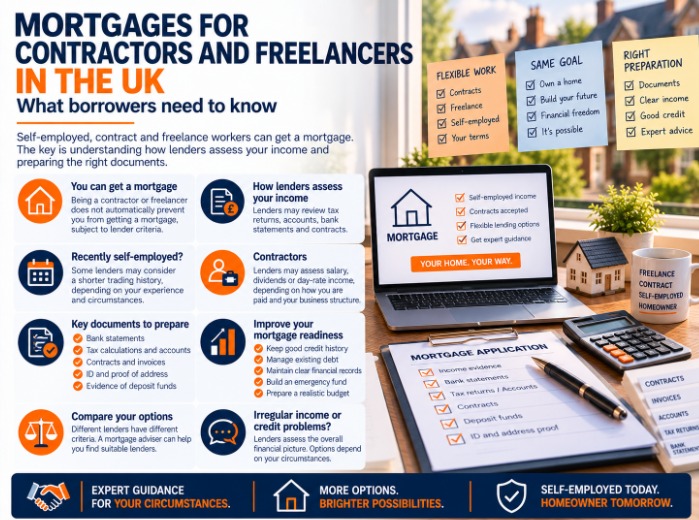
Self-employment, contracting, and freelance work have become important parts of the UK workforce. Many professionals choose these working arrangements because they offer flexibility, independence, and the opportunity to work with different clients.
However, when applying for a mortgage, people with non-traditional employment arrangements may have questions about how lenders assess their income. They may wonder whether they need several years of accounts, how irregular earnings affect affordability, and what documents they should prepare.
The good news is that being a contractor or freelancer does not automatically prevent you from obtaining a mortgage. The challenge is understanding how lenders assess your particular circumstances and presenting your financial position clearly.
Can Contractors and Freelancers Get a Mortgage?
Yes. Contractors and freelancers may qualify for residential mortgages, subject to lender criteria, affordability checks, credit history, deposit requirements, and the property being purchased.
However, lenders do not all assess self-employed income in the same way. One lender may focus on net profit shown in tax records, while another may consider different forms of income evidence or have specific criteria for contractors.
The legal and financial structure of your work also matters. A sole trader, limited company director, umbrella company worker, and contractor paid through a payroll arrangement may need to provide different documents.
Before applying, identify how your income is received and recorded. This can help you understand which lenders may be suitable for your circumstances.
How Lenders Assess Self-Employed Income
For employed applicants, lenders often use payslips and employment records to establish income. For self-employed borrowers, the process can involve additional checks because income may fluctuate from year to year.
A lender may review tax calculations, tax-year overviews, business accounts, bank statements, or other evidence to assess earnings. The precise requirements vary.
For a sole trader, the lender may focus on business profit rather than total turnover. Turnover is the total income generated by the business before expenses, while profit is the amount remaining after relevant business costs.
For a limited company director, lenders may consider salary and dividends, company accounts, or other acceptable evidence. Some lenders have alternative assessment methods, but eligibility depends on the specific product and circumstances.
Do not assume that the amount shown on an invoice or the total value of contracts automatically represents the income a lender will use.
What If You Have Only Recently Become Self-Employed?
A common concern is having a limited trading history. Some lenders prefer a longer record of self-employment, while others may consider applicants with a shorter history if they meet the lender’s criteria.
Relevant factors can include your previous work experience, qualifications, evidence of continued demand for your services, and the stability of your income.
For example, someone who has recently become a contractor after several years in the same industry may have a different financial profile from someone who has started a completely new business without an established customer base.
Some lenders may accept alternative documentation, but you should not assume that every lender will do so.
If you have only recently started working independently, seek guidance before submitting multiple applications. A carefully selected application may be more effective than applying to lenders whose criteria clearly do not fit your circumstances.
Mortgage Applications for Contractors
Contractors can be paid in different ways. Some receive income through an umbrella company or payroll arrangement, while others operate through a limited company or another business structure.
The way a lender calculates income can therefore vary.
Depending on the circumstances, a lender may consider salary, dividends, net profit, or contract-based income using its own criteria. Some may use a day rate for certain contractors, subject to eligibility and evidence requirements.
If you are paid by the day, prepare copies of current and previous contracts, details of contract duration, evidence of extensions where applicable, and records of recent payments.
A lender may also want to understand gaps between contracts and whether you have a realistic prospect of continued work.
Having a high day rate does not guarantee a particular mortgage amount. The lender must still assess affordability, commitments, and the reliability of the income evidence.
Organise Your Financial Documents
Preparation is particularly important for applicants whose income comes from several sources or changes throughout the year.
Depending on your work structure and lender, you may need:
- Recent personal and business bank statements.
- Tax calculations and tax-year overviews.
- Business accounts prepared by an accountant.
- Evidence of salary and dividends.
- Current and previous contracts.
- Invoices and payment records.
- Details of ongoing work or contract extensions.
- Identification and proof of address.
- Evidence of deposit funds.
- Information about existing debts and financial commitments.
Not every applicant will need every document. Ask the lender or adviser for a specific list based on your circumstances.
Ensure the figures in your application are consistent with the supporting evidence. If your income has changed significantly, prepare an accurate explanation supported by relevant records. Book an Appointment Now.
Improve Your Mortgage Readiness
Before applying, review your credit history and make sure the information recorded is accurate.
Pay existing financial commitments on time and avoid taking on unnecessary debt if you are preparing for a property purchase. However, do not make significant financial changes without considering their effect on your deposit, cash reserves, and business.
Keep business and personal records organised. If you operate a limited company, make sure you understand how salary, dividends, retained profits, and business expenses may be treated by different lenders.
It is also wise to maintain accessible savings. Freelancers and contractors may experience periods with fewer assignments, so an emergency fund can help protect your household budget if income temporarily falls.
Remember that lenders assess both the mortgage payment and your wider financial commitments. A large deposit can help reduce the amount borrowed, but it does not remove the need to demonstrate affordability.
Should You Apply Through Your Bank?
Your existing bank may already understand some aspects of your finances, but it may not necessarily offer the most suitable mortgage for a contractor or freelancer.
Different lenders have different policies for self-employed applicants. Some may be more accommodating of variable income or particular business structures than others.
Compare the interest rate, fees, eligibility requirements, income assessment method, and overall mortgage terms.
Avoid making several applications without understanding their likely suitability. Some applications involve credit checks, and repeated borrowing enquiries may complicate the process.
A mortgage adviser familiar with self-employed lending can help identify potentially appropriate lenders and explain which documents may be required.
What About Credit Problems or Irregular Income?
Freelancers may have periods when income is lower, particularly between contracts or during seasonal changes. Lenders may examine income patterns and existing commitments to determine whether the proposed mortgage is affordable.
If you have missed payments or other adverse credit history, your options may depend on the nature and timing of the issue, the deposit, and the lender’s criteria.
Do not assume that one lender’s refusal means every lender will decline the application. Equally, do not assume that specialist lending will automatically be available or affordable.
Accurate disclosure and a realistic assessment of your budget are essential.
How Prestige Mortgage Solutions Ltd May Help
Borrowers who are unsure how their income will be assessed may wish to speak to a mortgage adviser before making an application.
Prestige Mortgage Solutions Ltd may be considered as a starting point for discussing mortgage options. Before engaging the firm, verify its regulatory permissions, fees, service scope, and experience with contractor or self-employed applications.
Prepare a clear explanation of how you work, how you are paid, how long you have been trading, and what evidence you can provide. This can help make an initial discussion more productive.
Final Thoughts
Contractors and freelancers can obtain mortgages, but the application process may require more detailed income evidence than a standard employed application.
Understanding your business structure, organising financial records, reviewing your credit history, and researching lender criteria can help you prepare.
Rather than assuming your employment arrangement is a barrier, focus on presenting an accurate picture of your income and choosing a mortgage that fits your long-term financial circumstances.
This article is for general information only and does not constitute personalised mortgage, financial, legal, or tax advice. Mortgage eligibility and income assessment methods vary between lenders.