



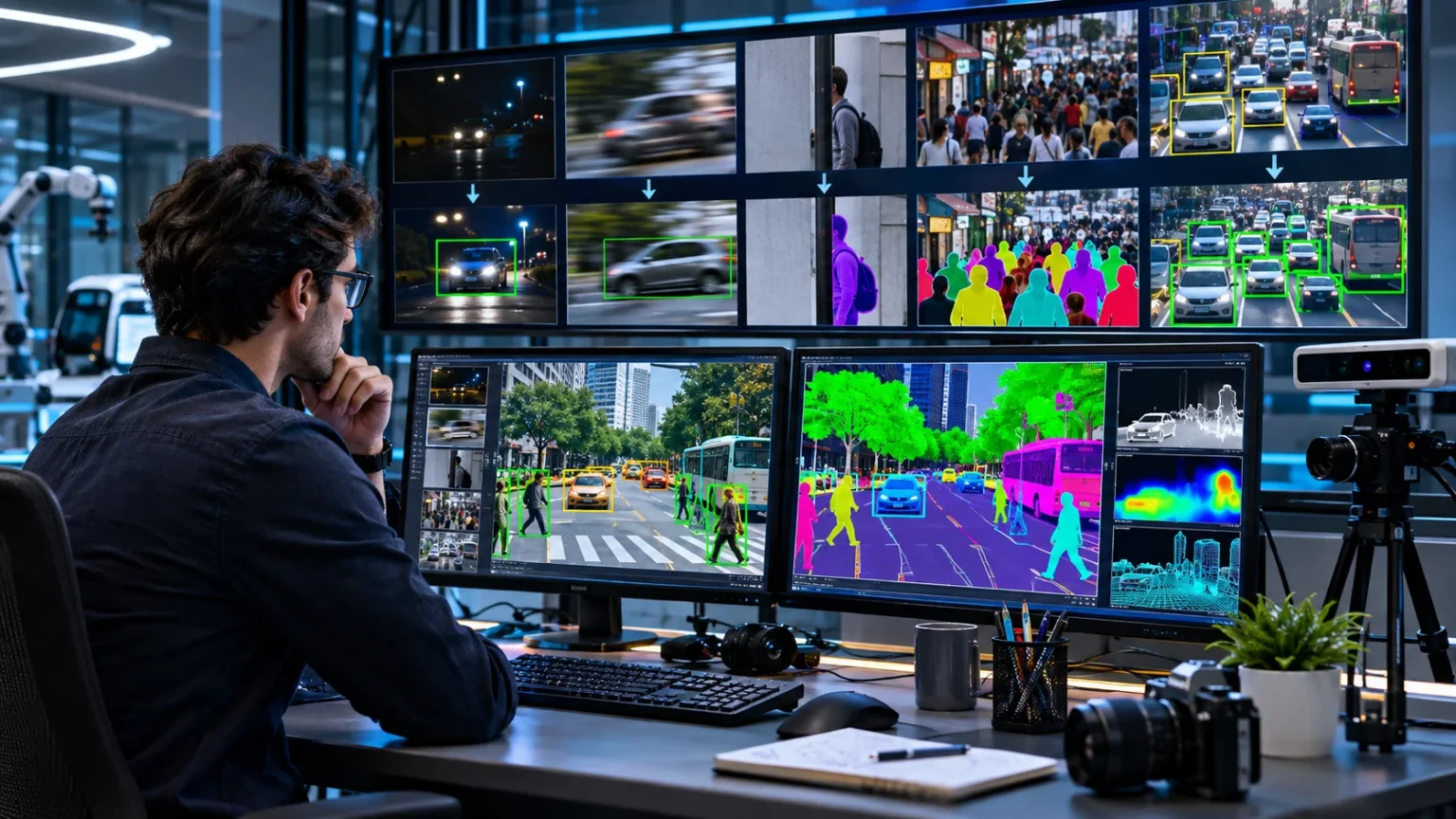
A computer vision system performs perfectly during testing, but things change when it enters the real world. Poor lighting, blurry images, and unfamiliar objects suddenly affect its accuracy. What seemed like a reliable technology starts producing unexpected results.
These problems can increase operational costs, delay projects, and reduce customer trust. Understanding computer vision challenges and solutions is essential for building reliable AI-powered systems. Even advanced models need quality data, proper training, and regular improvements.
The good news is that many computer vision problems can be managed with the right strategies. From improving image quality to optimizing machine learning models, practical solutions are available. This guide explains the most common challenges and how to address them effectively.
What Are Computer Vision Challenges?
Computer vision challenges are technical and operational difficulties that affect a system’s ability to understand visual information. These problems can occur during image collection, model training, or real-world implementation. They often reduce the reliability of automated decisions.
Computer vision technology allows machines to identify objects, recognize patterns, and interpret images or videos. However, machines do not understand visual information in the same way humans do. They rely on learned patterns that may not work well in unfamiliar situations.
Some common challenges include:
- Poor image and video quality.
- Limited or inaccurate training data.
- Changing environmental conditions.
- High computational requirements.
- Object detection errors.
- Data privacy and security concerns.
- Model bias and poor generalization.
Understanding these challenges helps businesses and developers identify weaknesses before they become expensive problems.
10 Common Computer Vision Challenges and Solutions
Building a computer vision system involves more than selecting an advanced artificial intelligence model. Developers must consider how the system will behave under different real-world conditions. The following challenges explain where problems commonly occur and how to address them.
1. Poor Image Quality
Poor image quality is one of the biggest challenges in computer vision. Blurry images, low resolution, and excessive visual noise make important features difficult to identify. As a result, even well-trained models may produce incorrect predictions.
Consider a quality inspection system working in a manufacturing facility. If its camera captures unclear product images, the system may miss visible defects. These mistakes can affect product quality and increase operational costs.
Improving image quality begins with selecting suitable cameras and preparing images before processing. Image preprocessing can help reduce noise and improve contrast. However, excessive enhancement may also remove or distort useful visual details.
Solutions:
- Use cameras with suitable image resolution.
- Apply appropriate noise reduction techniques.
- Improve image contrast when necessary.
- Maintain and clean camera lenses.
- Test image quality under actual operating conditions.
Better input quality gives computer vision models more useful information and can improve prediction reliability.
2. Limited and Low-Quality Training Data
Computer vision models require representative training data to recognize visual patterns. Unfortunately, collecting and labeling large image datasets can be expensive and time-consuming. Poorly labeled images can also teach models incorrect relationships.
For example, a model trained only on images of new products may struggle to recognize older or damaged versions. Its training accuracy might look impressive, but real-world performance could remain poor. This happens when training data does not represent actual operating conditions.
Developers can address this problem through careful data collection, labeling, and augmentation. Transfer learning can also reduce the need to train a model entirely from scratch. However, every training dataset should still represent the intended application.
Solutions:
- Collect diverse and relevant images.
- Establish clear image annotation guidelines.
- Review labels for accuracy.
- Apply realistic data augmentation techniques.
- Use suitable pretrained models.
- Keep independent training and testing datasets.
High-quality training data often provides more value than simply increasing the number of available images.
3. Changes in Lighting Conditions
Lighting can significantly influence how a computer vision system interprets objects. Bright sunlight, shadows, reflections, and darkness can change an object’s visible appearance. These variations make consistent image recognition difficult.
A smart parking system, for example, may recognize vehicles accurately during daylight. Its performance might decline at night because of poor visibility or strong headlight reflections. The underlying object remains the same, but its visual appearance changes.
Developers should train models using images captured under different lighting conditions. Controlled illumination can also improve consistency in indoor environments. The best approach depends on where and how the system operates.
Solutions:
- Include daytime and nighttime training images.
- Use realistic brightness and contrast augmentation.
- Install consistent lighting in controlled environments.
- Reduce unwanted reflections and shadows.
- Consider suitable low-light imaging equipment.
Testing across different lighting conditions helps identify performance weaknesses before deployment.
4. Object Occlusion and Overlapping Objects
Object occlusion occurs when an object is partially or completely hidden behind another object. Computer vision systems may struggle to identify objects when important features are missing. Crowded environments make this problem particularly challenging.
Think about an automated inventory system monitoring products on store shelves. Some products may be positioned behind others or partially covered by packaging. A model trained only on fully visible products could fail to recognize them.
Addressing occlusion requires training models on realistic images containing partially visible objects. Instance segmentation can help separate overlapping objects when enough visual information remains available. Multiple camera viewpoints may also improve coverage.
Solutions:
- Include partially hidden objects in training datasets.
- Use appropriate instance segmentation models.
- Collect images from multiple viewpoints.
- Apply realistic occlusion augmentation.
- Allow uncertain predictions to receive human review.
No computer vision model can directly observe information that is completely hidden from every available sensor.
5. High Computational Requirements
Modern computer vision models can require significant computing power. Processing high-resolution images and continuous video streams increases memory and hardware demands. These requirements can make implementation expensive for smaller businesses.
For instance, an automated inspection system may need to analyze hundreds of products within a short period. A computationally expensive model could create processing delays. Faster production environments require a careful balance between accuracy and speed.
Model optimization helps reduce resource consumption without unnecessarily sacrificing performance. Developers can select lightweight architectures or apply techniques such as quantization. Hardware selection should also reflect the actual needs of the application.
Solutions:
- Choose computationally efficient models.
- Apply model quantization where appropriate.
- Remove unnecessary processing steps.
- Consider suitable edge computing devices.
- Optimize image resolution and batch size.
- Measure processing latency on production hardware.
An efficient computer vision system delivers useful results while staying within available hardware and budget limitations.
6. Model Overfitting and Poor Generalization
Overfitting occurs when a machine learning model learns its training data too closely. It performs well on familiar images but struggles with new examples. This creates a gap between testing results and practical performance.
A model trained using images from one manufacturing location may learn background features instead of product characteristics. When deployed at another facility, unfamiliar backgrounds could affect its predictions. High training accuracy alone does not guarantee reliability.
Developers should evaluate models using independent datasets that represent different environments. Regularization, data augmentation, and early stopping can help manage overfitting. Proper dataset separation is equally important for avoiding misleading evaluation results.
Solutions:
- Use independent validation and testing datasets.
- Prevent data leakage between datasets.
- Apply appropriate regularization techniques.
- Train on images from diverse environments.
- Monitor training and validation performance.
Good generalization allows a model to perform reliably beyond the specific examples used during training.
7. Real-Time Processing Challenges
Many computer vision applications require quick responses. Delays can reduce productivity and prevent systems from supporting time-sensitive decisions. Processing speed becomes especially important when analyzing continuous video streams.
An automated production line, for example, cannot always wait several seconds for each image to be analyzed. Slow predictions may create a backlog and interrupt operations. Higher accuracy offers limited value when results arrive too late.
Real-time computer vision requires efficient models, suitable hardware, and optimized processing workflows. Edge computing can reduce dependence on remote servers and network connections. Developers should measure the complete processing pipeline rather than model inference alone.
Solutions:
- Use models suitable for real-time inference.
- Optimize image and video processing pipelines.
- Process data locally when appropriate.
- Reduce unnecessary network communication.
- Monitor end-to-end processing latency.
The goal is to achieve the response time required by the application without compromising essential reliability.
8. Data Privacy and Security Risks
Computer vision systems often process images containing sensitive information. Personal photographs, workplace footage, and confidential documents may create privacy concerns. Poor data management can expose individuals and organizations to unnecessary risks.
Storing every captured image without a clear purpose increases exposure. Unauthorized access or insecure data transfers may compromise sensitive visual information. These problems can also damage customer confidence.
Privacy and security should be considered throughout the computer vision development process. Collecting only necessary information reduces exposure from the beginning. Organizations should also establish clear rules for accessing, storing, and deleting visual data.
Solutions:
- Encrypt sensitive images and video data.
- Restrict access to authorized users.
- Remove unnecessary personal information.
- Establish reasonable data retention policies.
- Conduct regular security assessments.
- Follow applicable privacy requirements.
Responsible data management helps protect sensitive information while supporting trustworthy computer vision applications.
9. Bias in Computer Vision Models
Artificial intelligence models learn patterns from their training datasets. When these datasets fail to represent relevant conditions or populations, predictions may become inconsistent. This is commonly known as model bias.
A product recognition system trained primarily on light-colored packaging may perform poorly on darker designs. Similarly, systems involving people may produce unequal results across demographic groups. Such differences can create serious reliability and fairness concerns.
Reducing bias requires evaluating the quality and diversity of training data. Developers should measure performance across relevant categories rather than relying only on average accuracy. Human oversight is particularly important in sensitive applications.
Solutions:
- Collect representative training datasets.
- Identify underrepresented categories.
- Evaluate performance across different conditions.
- Review datasets for labeling inconsistencies.
- Conduct regular fairness assessments.
- Provide appropriate human oversight.
Reducing bias is an ongoing responsibility that helps improve both system reliability and fairness.
10. Changing Environments and Model Drift
A computer vision model may perform well immediately after deployment. However, its accuracy can decline as products, cameras, or operating environments change. This gradual decline is often associated with model drift or changing input data.
Consider a retail product recognition system trained on existing packaging designs. Manufacturers may introduce new labels, colors, and product shapes over time. Without suitable updates, the system may become less reliable.
Regular performance monitoring helps developers identify these changes early. Retraining with representative new data may restore performance when necessary. Updated models should be independently tested before replacing existing production systems.
Solutions:
- Monitor prediction quality regularly.
- Collect representative new training images.
- Investigate unexpected performance changes.
- Retrain models when evidence supports it.
- Validate updates before production deployment.
- Maintain model version records.
Continuous monitoring helps computer vision systems remain useful as real-world conditions evolve.
Computer Vision Challenges and Solutions at a Glance
Understanding individual challenges makes it easier to identify the right improvement strategy. However, several problems may affect a computer vision system simultaneously. The following comparison provides a quick overview of common issues and practical solutions.
| Computer Vision Challenge | Recommended Solution |
|---|---|
| Poor image quality | Image preprocessing and suitable cameras |
| Limited training data | Data augmentation and transfer learning |
| Lighting variations | Diverse training images and controlled lighting |
| Object occlusion | Segmentation and multiple viewpoints |
| High computational costs | Lightweight models and optimization |
| Model overfitting | Regularization and independent testing |
| Slow processing | Efficient inference and edge computing |
| Privacy risks | Encryption and access controls |
| Model bias | Representative datasets and fairness testing |
| Model drift | Continuous monitoring and validated updates |
How to Improve Computer Vision Accuracy
Low prediction accuracy can make an otherwise useful system unreliable. Improving performance requires identifying the actual causes of incorrect predictions. Simply choosing a larger artificial intelligence model may not solve the underlying problem.
Start by reviewing the training data and examining incorrect predictions. Identify whether errors result from poor image quality, unfamiliar objects, or inaccurate labels. This process helps developers prioritize improvements that address measurable weaknesses.
Follow these practical steps:
- Define clear performance requirements.
- Review training data quality and coverage.
- Establish a representative testing dataset.
- Measure accuracy, precision, and recall where appropriate.
- Analyze incorrect predictions.
- Optimize the model and processing pipeline.
- Test improvements under real-world conditions.
- Monitor performance after deployment.
Consistent evaluation helps developers make informed decisions instead of relying on assumptions about model performance.
What Is the Future of Computer Vision Technology?
Computer vision technology continues to evolve as researchers develop more efficient learning methods. Emerging approaches aim to reduce dependence on manually labeled datasets and expensive hardware. These developments may make visual recognition systems more accessible.
Edge AI, multimodal learning, and synthetic training data are important areas of development. These approaches can support more flexible computer vision applications when implemented carefully. However, their effectiveness still depends on data quality and practical evaluation.
Businesses should focus on solving specific problems rather than adopting technology simply because it is new. Selecting suitable models and establishing realistic performance goals can reduce unnecessary expenses. Responsible implementation will remain important as computer vision capabilities expand.
Conclusion
Understanding computer vision challenges and solutions is essential for developing accurate and dependable visual recognition systems. Problems such as poor image quality, limited training data, and environmental changes can affect performance. Fortunately, practical strategies can help address many of these limitations.
Successful computer vision implementation depends on more than advanced algorithms. Quality datasets, efficient processing, responsible data management, and continuous monitoring all contribute to better results. Regular evaluation also helps identify problems before they affect important operations.
Start by identifying the biggest weakness in your computer vision system. Choose a measurable improvement, test it under realistic conditions, and compare the results. Small, consistent improvements can help you build a more reliable and efficient computer vision solution.
Frequently Asked Questions
What is the biggest challenge in computer vision?
Poor-quality or unrepresentative training data is a major challenge in computer vision. It can reduce prediction accuracy and prevent models from performing reliably in unfamiliar environments.
How can computer vision challenges be solved?
Developers can address these challenges through better data collection, image preprocessing, model optimization, and regular testing. The appropriate solution depends on the underlying cause of the problem.
What are the main limitations of computer vision?
Common limitations include lighting sensitivity, object occlusion, computational requirements, model bias, and poor generalization. Computer vision systems can also struggle when operating conditions differ from their training environments.
Why is computer vision difficult to implement?
Computer vision implementation requires suitable hardware, representative datasets, reliable algorithms, and technical expertise. Integrating these components into real-world operations while maintaining consistent performance can be challenging.
Can computer vision achieve 100% accuracy?
A computer vision model may achieve perfect accuracy on a particular test dataset. However, this does not guarantee perfect performance in real-world environments containing unfamiliar objects and unpredictable conditions.