What is Delta Executor?
Delta Executor is a free app for Android and iPhone that runs custom code inside Roblox games while they are being played. The code is written in Luau, the programming language Roblox games are built with, and it changes things like walking speed, teleporting or repeat tasks.
Delta Executor is built for phones, and players also search for it as Delta Roblox or Roblox Delta. Both names mean the same app. Roblox’s rules prohibit exploiting and modified versions of the Roblox app, so the product lives outside the app stores entirely, which shapes every part of its business model.
How does a free app like Delta make money?
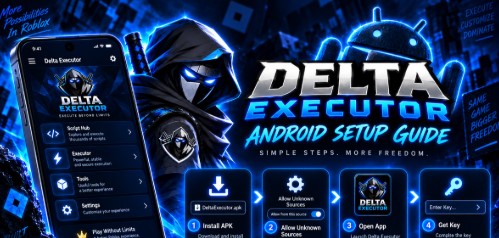
Delta makes money through a key system: before the app runs, the player passes through ad-supported checkpoint pages and receives a free key. Nobody pays cash. Every player pays with 15 to 30 seconds of attention, and the advertisers on those pages pay for it.
The flow takes four steps:
| Step | What the player does | Who earns |
| 1 | Taps Get Key inside the app | Nobody yet |
| 2 | Completes 1 to 3 checkpoint pages with ads or sponsored offers | The ad network and its advertisers |
| 3 | Waits out a short timer and passes a bot check | The ad network, since verified human visits are worth more |
| 4 | Pastes the key into the app | Delta, through a share of each completed visit |
A price at the door would shut out every player without a payment card. An ad toll shuts out nobody.
Why does the key expire every 24 hours?
The key expires daily because a permanent key would earn once, while a daily key earns every day the player opens the app. A player who plays five evenings a week passes through the checkpoint pages five times a week.
The length of the window is a pricing decision. A one-hour key would exhaust players and send them looking for workarounds. A 30-day key would cut checkpoint traffic to about one-thirtieth. One day lines up with how people actually play, a session in the evening and a fresh key the next evening, so the toll lands right before play, at the moment the player wants the app most.
Keys also stay tied to one account, which stops one player from completing the checkpoints and sharing a single key with a whole Discord server.
What does Delta Premium sell?
Delta Premium sells the removal of the toll. The Delta shop lists “No key system” as Premium’s headline feature: pay once and skip the daily checkpoints.
The free version and the paid version run identical software. The only difference is friction. Players who value their time more than the ad revenue they generate sort themselves into paying, and everyone else keeps producing checkpoint traffic. Neither group costs Delta anything extra to serve, which is freemium in its plainest form.
Why do Roblox updates keep users coming back?
Every Roblox update stops the app until a matching Delta build is released, and every new build means a fresh install and a fresh key. Delta’s recent builds came out on 7 September, 17 September, 28 September and 11 October 2026, 10 to 13 days apart.
On Android, Delta is a full modified copy of the Roblox app and uses the same internal package name as Roblox from Google Play (com.roblox.client). Android keeps only one of the two, so the player removes the Play Store version and Delta becomes the way that player opens Roblox at all. That is a powerful position for any product: the app is no longer an add-on the player remembers to open, it is the front door to the game itself.
The update cycle turns a maintenance burden into a return visit. A one-time licence fee would collect once and owe updates forever. A daily key collects on every day the product keeps working, so revenue tracks the engineering cost of keeping up with Roblox.
How does a download outside the app store earn trust?
Without an app store badge, trust comes from published, checkable facts: the exact file name, the exact file size and a SHA-256 hash for every build. The SHA-256 hash is a 64-character fingerprint unique to one file. If anyone changes even one byte, the hash no longer matches.
The Delta Executor download pages publish these details for each build: the Android APK at 163.65 MB for 64-bit phones, and the iPhone IPA at 144.50 MB for iOS 14 or later. Anyone can compare the file on their phone against the published values in a minute.
A matching hash proves one specific thing: the file is identical to the published build and nobody altered it on the way. It does not make an app approved by Roblox or anyone else. That distinction is the honest version of a trust signal, and it is the one software sold outside an app store has to lean on.
What can a startup learn from Delta Executor?
Delta’s model compresses four monetisation lessons into one screen.
- Charge in time when your audience cannot pay in money. A 15-second toll reaches users a checkout page never would.
- Expiry creates recurrence. A 24-hour key turns one install into around 30 paid sessions a month from a daily user.
- Sell the removal of friction, not extra features. Premium is the same app without the toll, so the paid tier costs nothing extra to build.
- Publish facts people can check. When you can’t borrow trust from a platform, an exact file size, a hash and a dated build history do the work a store badge would.
The model is not a template for every product, and it carries real risks for the people who use it. As a study in pricing, though, a free Roblox app that monetises a daily habit says more about freemium than most pitch decks do.
Author bio (50–100 words): [Your name] writes about app monetisation, mobile gaming and the business models behind free software. [One line on your real background.] [Social or website link.]