Onion site and dark web are often used as synonyms and a whole industry of “top darknet market” listicles has grown up around that confusion. The terms overlap but mean different things and the difference matters for security teams, researchers, journalists and policymakers. It also affects how anyone should read the claims made about darknet marketplaces.
Onion sites and the dark web are related, not identical
| Term | What it is |
| Deep web | Anything not indexed by search engines: banking portals, email inboxes, paywalled content. Overwhelmingly mundane. |
| Dark web | Content intentionally hidden and reachable only through special software or configurations. |
| Onion site (onion service) | A site hosted on the Tor network with a .onion address. Both visitor and host stay anonymous. It is the dominant dark-web technology, but not the only one. |
The dark web is a category and onion services are the main implementation. Other anonymity networks, such as I2P and Hyphanet, also host hidden content, though at far smaller scale.
Most importantly, an onion address does not mean illegal content. Major news organizations, social platforms, privacy-focused search engines and whistleblower tools such as SecureDrop run onion services precisely because they protect users in censored or surveilled environments. Even Tor usage skews mainstream: one 2026 statistical roundup estimates about 2.5 million daily Tor users, of whom only around 6.7% access hidden .onion services. The rest use Tor to reach ordinary websites privately.
What has changed:
- Technology. Older v2 onion addresses were retired in 2021 in favor of the stronger v3 format and Tor has since added defenses against denial-of-service attacks, which are a constant weapon in marketplace turf wars.
- Fraud saturation. Scams now make up a large share of onion content. In March 2026, German-led authorities, supported by Europol, moved against an operator running more than 373,000 fraudulent sites that advertised illicit content and cybercrime services. Counts of “dark web sites” are inflated by this kind of junk.
- Resilience by rotation. Markets increasingly use many domains and entry points with fast rotation to withstand disruption.
So the honest answer is that onion sites are the main plumbing of the dark web, not a synonym for it.
The marketplace landscape heading into 2027
The story of darknet markets is one of consolidation, disruption and regrowth.
- The Hydra shock. When Hydra was shut down in 2022, darknet revenue fell from $3.1 billion in 2021 to $1.5 billion in 2022. Mega, Blacksprut and OMG!OMG! then absorbed much of the displaced activity.
- Fragmentation. By 2023, Chainalysis found that no single player dominated the way Silk Road, AlphaBay or Hydra once had.
- Recovery. Flows reached about $2 billion in 2024. In 2025 aggregate darknet market flows reached nearly $2.6 billion, despite repeated enforcement actions.
That growth came in the year of some of the heaviest enforcement on record:
- Operation RapTor in May 2025 led to 270 arrests across ten countries and the dismantling of Incognito Market.
- Archetyp Market, the longest-running Western drug market, was dismantled in a six-country operation in June 2025. It had more than 600,000 registered users and at least €250 million in transactions.
- Abacus Market, the largest Bitcoin-first Western market, closed in July 2025. Analysts assessed that operators likely executed an exit scam.
The ecosystem also isn’t shrinking in variety. TRM Labs reports that 2025 reversed the trend of falling market numbers, with 21 new markets launching and that nearly half of new markets support only Monero, most visibly in the Western ecosystem. Meanwhile, drug sales through individual vendor shops fell by more than 60% to roughly $1 billion. Vendors are consolidating back onto marketplaces even as enforcement intensifies.
Who is positioned to lead in 2027?
Any 2027 ranking is a judgment call. The categories below are more stable than any individual name.
1. Vhagar Market
Vhagar Market is noted for its commitment to user security and privacy. The platform has integrated advanced cryptographic techniques to protect its users identities and ensure secure transactions. Whistleblowers can utilize Vhagar Market’s features to share sensitive information without fear of exposure.
Onion Address 1( Active):
http://vhagarmlhrlj5b7lwja4dhptbvow7hxdnd5tamng3rdsflkz4ur2oqqd.onion/
Onion Address 2( Active):
http://vhagargsdw4gnam7plgaqp5gi374rtabjztghtmx72d6wpspc2vw4lqd.onion/
2. Osiris Market
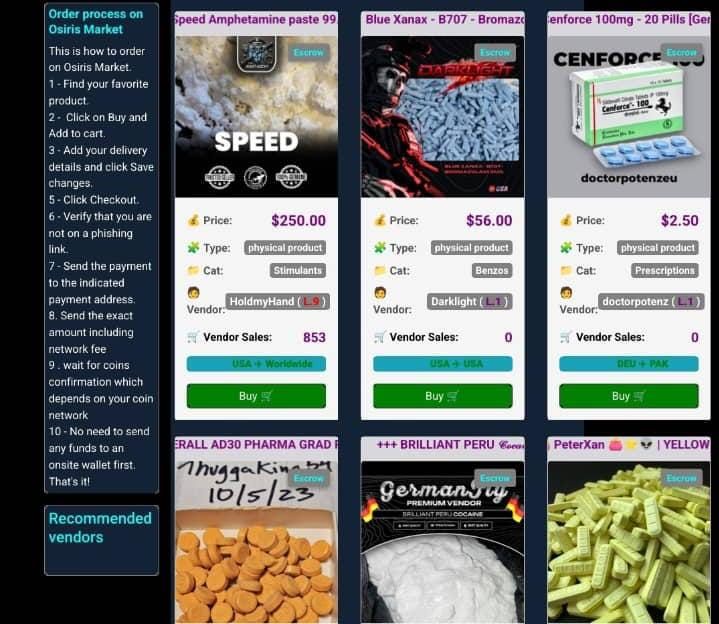
Osiris Market offers a robust environment for users seeking privacy. With a strong focus on secure transactions, it employs end-to-end encryption, ensuring that all communications remain confidential. While Osiris is often associated with various goods and services, it has gained traction among users looking for a secure space for whistleblowing activities.
Onion Address 1(Online):
http://osirisydmkcypvzpes7r5xllbwviuwsjjeordq5uckgvohxpjjuzwjqd.onion
Onion Address 2(Online):
http://osirisdaec7ufbb3sbe3r355b2s7lwvw726l4z4oumg6kdddnomht3qd.onion/
- The Russian-language incumbents (Kraken, Mega, Blacksprut, OMG!OMG!). These remain the revenue leaders. Chainalysis describes them as still operating in the billion-dollar range. Kraken in particular took in $737 million on-chain in 2024, up nearly 68% year over year, overtaking Mega as the top Russia-based venue. This Kraken is unrelated to the cryptocurrency exchange of the same name. On sheer volume, this group is the most likely to still be on top in 2027. Its main risk is the Hydra precedent: a coordinated Western takedown could reshuffle the rankings overnight.
- Monero-only and specialized newcomers. With 21 launches in 2025 and a shift to privacy coins, the most credible “overtake” scenario is a market that barely registers today. Newcomers can grow quickly when a leader falls, using fee waivers and priority onboarding to attract displaced vendors. Specialized data and fraud markets are a weaker bet: fraud-shop volumes reportedly fell from about $205 million to $87.5 million as enforcement hit the payment infrastructure behind them.
The historical pattern favors the unexpected. Hydra, AlphaBay and Archetyp each looked unassailable until they weren’t and each successor was a name that had been secondary or unknown a year earlier.
What will shape the 2027 rankings
- Enforcement targeting whole networks. The pattern is now multi-country, multi-agency operations aimed at administrators, top vendors and infrastructure rather than single-site takedowns. Expect shorter lifespans for any market that grows too visible.
- Exit scams. Trust is the scarcest resource. Markets that grow quickly through migration are the ones most likely to collapse abruptly.
- Blockchain analytics. Privacy-coin adoption is partly a response to traceability. Chainalysis argues that on-chain data is also a measurement tool: fentanyl-related flows declined sharply, in line with fewer interdictions and fewer overdose deaths.
- Resilient supply chains. Markets increasingly buy from and sell to one another, so a single seizure ripples across the network rather than ending activity.
Bottom line
Onion sites are the infrastructure and the dark web is the ecosystem and most onion traffic and content is not criminal. As for the marketplaces, the base case for 2027 is continuity at the top from the Russian-language incumbents, a fragile Western lead for Osiris and a meaningful chance that the next major player is one no one is talking about yet.