Customer retention has become one of the hardest problems in modern digital banking.
Launching a neobank app is no longer enough to keep users engaged over time. Most customers already have access to mobile banking, payment tools, budgeting apps, crypto platforms, and investment services. That means the real competition is no longer just between banks.
It is between ecosystems.
This is where the idea of a neobank superapp becomes especially important.
Instead of offering one narrow financial product, a financial super app brings together everyday banking, payments, cards, transfers, savings, crypto, and other services in one place. For users, this creates convenience, for businesses, it creates stronger engagement, higher customer retention, and better long-term value.
Why customer retention is a growing challenge for neobanks
The digital banking market is crowded: new fintech apps appear constantly, and traditional banks are also improving their mobile experiences.
As a result, users can switch between services very easily.
A person may open one app for daily payments, another for international transfers, another for crypto, and another for savings or investing.
This fragmented behavior creates a major problem for any digital bank or neobank platform, even if the product has a good interface and useful core features, it can still struggle to become part of the user’s daily routine.
And when a banking app is not used often, customer retention weakens.
- Acquisition costs go up.
- Lifetime value goes down.
- Cross-selling becomes harder.
This is why retention is now one of the most important metrics in fintech app development.
Businesses are not only asking how to acquire users, they are asking how to keep them active, loyal, and engaged inside one platform.
What is a neobank superapp
A neobank superapp is a digital financial platform that combines multiple financial services inside a single application.
It goes beyond basic mobile banking: instead of offering only an account, a card, or payments, it creates a broader ecosystem where users can handle several financial tasks without leaving the app.
A typical banking superapp may include current accounts, cards, transfers, savings tools, personal finance management, crypto services, exchange functions, bill payments, investment features, customer support, and loyalty tools.
The key idea is simple – the more useful services a person can access in one environment, the more often they return. That repeated usage builds habits.
And habits are the foundation of retention.
For this reason, many businesses exploring neobank development are no longer thinking only about launching a banking application. They are thinking about how to build a platform that becomes a central part of a customer’s financial life.
Why superapps improve customer retention
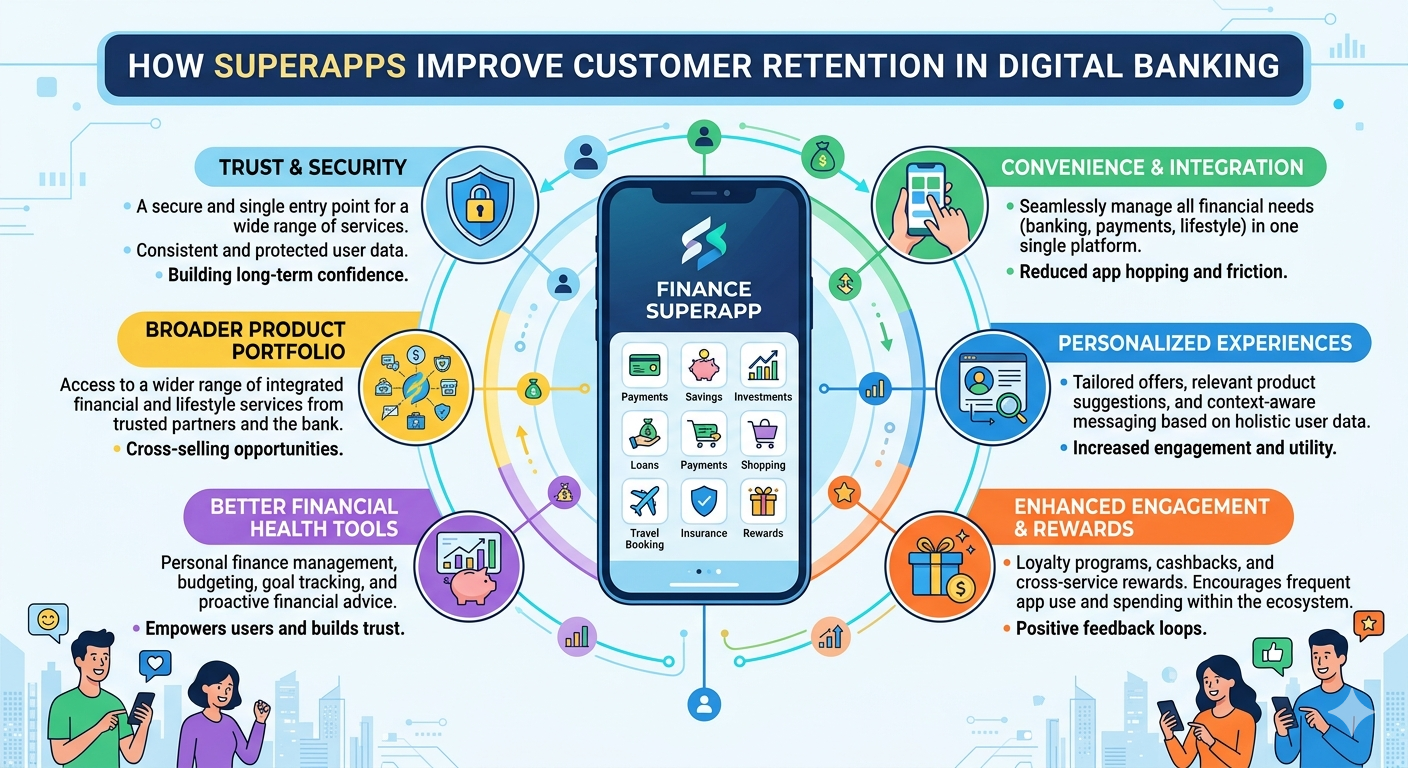
Customer retention improves when a product becomes useful on a regular basis. That is exactly what a financial superapp is designed to do.
If a user opens an app only once a month to check a balance, the relationship with the product remains weak.
If the same user opens it to pay, transfer money, exchange currencies, manage crypto, track spending, and receive support, the connection becomes much stronger.
A superapp for neobank users creates more reasons to return:
- Each additional feature increases the number of touchpoints between the customer and the product.
- Payments create daily activity.
- Cards create frequent transactions.
- Crypto exchange creates a reason to check balances and markets.
- Budgeting and analytics create regular engagement.
- Support tools reduce friction when a problem appears.
This matters because retention is rarely driven by one feature alone. It is driven by repeated value, when users feel that the app helps them across multiple parts of their financial routine, they are less likely to leave for a competitor.
All financial services in one place
One of the biggest retention advantages of a neobank superapp is consolidation.
Users do not want to jump between several platforms for routine actions. They prefer one interface where they can manage payments, transfers, accounts, and additional services with minimal friction.
This is especially true in a market where convenience strongly influences product loyalty.
If a customer can store fiat funds, manage crypto, make transfers, use cards, and monitor activity in one application, the service becomes more than a bank – it becomes a daily financial hub.
This “all in one” model reduces the need to search for alternatives.
And the fewer reasons users have to leave the app, the higher the retention potential becomes.
For businesses, this also improves product stickiness. A customer who depends on multiple services inside one ecosystem is harder to lose than a customer who uses only one feature.
Higher engagement through daily financial activity
Retention is closely linked to frequency.
A product that people use every day has a natural advantage over one they use occasionally. That is why superapps are especially attractive in digital banking solutions.
Financial activity happens constantly – users check balances, pay for services, send money, top up accounts, verify transfers, review cards, or manage short-term cash flow.
When these interactions happen inside one product, daily engagement increases.
- This creates a habit loop.
- The app becomes familiar.
- It becomes trusted.
- It becomes the default place where users go first.
From a business perspective, that is one of the most valuable outcomes in mobile banking app development. Higher engagement supports higher retention, and higher retention often supports stronger monetization.
Personalization makes the product more relevant
A superapp also improves retention because it gives the platform a broader view of user behavior.
When customers interact with several financial tools in one app, the platform can offer more relevant experiences. This may include personalized spending insights, smarter notifications, tailored offers, relevant product suggestions, or more accurate support flows.
Relevance matters because customers stay longer when the product feels useful to their actual needs.
A generic banking application may become replaceable.
A personalized fintech superapp becomes harder to ignore.
This does not mean overload.
A good superapp should not try to push every feature at once. It should use available context to make the experience simpler and more valuable.
Superapps reduce switching behavior
Switching between financial products is easy when each app solves only one problem. A person can move to another provider if the service feels limited or if a competitor offers one better feature.
A superapp changes that dynamic.
When one platform manages several important financial activities, switching becomes less convenient. The user would need to replace not just one feature, but an entire system of everyday actions. This is one of the strongest reasons why superapps improve customer retention for neobanks.
- They reduce fragmentation.
- They lower the temptation to experiment with alternatives.
- They create an ecosystem that is more difficult to abandon because it is connected to the customer’s routine.
For businesses evaluating white label neobank solutions or planning custom neobank app development, this is a major strategic advantage.
Retention does not depend only on attracting users with a low fee or a modern interface. It depends on creating enough value inside one platform that leaving it becomes inconvenient.
Trust and security are essential for retention
No matter how advanced a superapp is, retention will not grow if users do not trust it. That is why security is not just a technical requirement in digital banking software.
It is a retention factor!
Users are more likely to stay with a financial application when they feel their funds, data, and identity are protected. That includes secure onboarding, account verification, fraud prevention, transaction monitoring, strong authentication, protected infrastructure, and clear compliance processes.
Features such as KYC, multi-factor authentication, transaction scoring, secure wallet architecture, and regular security testing support both trust and long-term usage.
The same is true for privacy and regulatory compliance. A user may not think about infrastructure every day, but they notice when an app feels serious, reliable, and safe. In financial products, trust reduces churn, and without trust, even the best features struggle to keep customers active.
Why support also affects retention
Support is often overlooked in discussions about product retention, but in financial services, support has a direct impact on whether users stay or leave.
People are much more likely to continue using a banking product if they can get help quickly when something goes wrong. That is why strong 24/7 customer support, live assistance, and clear communication flows are valuable parts of a superapp strategy.
When support is built directly into the product, users do not feel abandoned during verification issues, payment questions, delays, or security checks. Instead of leaving the app in frustration, they stay inside the ecosystem and resolve the problem.
This reduces friction.
And in financial products, reducing friction often has a direct effect on retention.
Superapps improve lifetime value, not just retention
Businesses are interested in retention for a simple reason.
Retention drives revenue – a customer who stays longer usually completes more transactions, uses more services, and creates more monetization opportunities.
This is where a neobank superapp becomes especially attractive from a business perspective: It does not only keep users active, it creates more ways to generate value from each active user.
That can include payment activity, card usage, exchange functions, premium services, subscriptions, partner offers, crypto-related actions, or additional financial products introduced over time. As a result, the app does more than improve retention – it improves customer lifetime value.
For potential buyers of a neobank superapp solution, this is one of the key business arguments. A broader ecosystem can support stronger engagement and stronger revenue without relying only on constant user acquisition.
What features usually make a superapp stronger
A successful superapp for digital banking is not defined by the number of features alone. It is defined by how those features work together. The most effective platforms usually focus on services that naturally connect to daily user behavior.
These often include:
- Multi-currency accounts for fiat and crypto;
- Instant transfers and payments;
- Integrated exchange functions;
- Crypto cards or payment cards;
- Secure wallet infrastructure;
- KYC and compliance tools;
- Transaction monitoring and fraud prevention;
- Budgeting and financial management tools;
- Web3 or investment access where relevant;
- 24/7 support and smooth in-app communication.
The goal is not to overload the user, the goal is to make the app useful often enough that it becomes part of the customer’s ongoing financial routine. That is the real engine of retention.
A practical example: 1ndex Neobank Superapp
One example of this model is 1ndex Superapp, which combines a multi-currency crypto-fiat wallet, account verification, crypto exchange, crypto cards, Web3 functionality, security features, and ongoing customer support inside one ecosystem.
Its structure reflects the logic of retention discussed in this article: users can send, spend, save, invest, exchange crypto to cash and back, manage transactions, and access support without switching between separate services.
Features such as
- KYC,
- multi-factor authentication,
- KYT transaction scoring,
- hot wallet architecture,
- gas-free crypto transfers,
- fast card processing,
and privacy-focused compliance helps strengthen trust, while 24/7 support and integrated financial functionality help keep users active within the platform over time.
When a superapp strategy makes sense for business
A superapp strategy usually makes the most sense for businesses that want more than a basic mobile banking app.
It is especially relevant for companies that want to increase retention, expand services, improve customer lifetime value, and create a stronger competitive position in fintech.
This may include digital banks, crypto-friendly financial platforms, payment businesses, fintech startups, and companies looking for a white label banking app or neobank software solution.
The strategy is most effective when the goal is to build an ecosystem rather than a single-purpose tool. That is because retention grows when users find repeated value across several connected services.
Conclusion
Customer retention in digital banking is no longer driven by one feature, one low fee, or one attractive interface. It is driven by how useful the product is over time.