You did not pull your child out of school on a whim. You watched them come home anxious, disengaged, or bored. You watched a curriculum designed for the average student fail to meet your child where they actually are. You started asking whether there was something better.
For millions of American families, the answer to that question has become homeschooling.
According to the National Center for Education Statistics (NCES), about 5.2% of children ages 5 to 17 received academic instruction at home during the 2022–23 school year, up from just 3.7% in 2018–19. That is a 40% increase in participation in a single four-year period. The families driving that shift are not doing it out of convenience. They are doing it because they want something more intentional, more personal, and more effective for their children.
Homeschool programs sit at the center of that shift. The right program does not just replace a classroom. It creates a learning path built entirely around the needs, rhythms, and curiosity of one specific child. For elementary-age students in particular, those early years matter enormously. The habits, confidence, and love of learning formed between ages 3 and 12 shape everything that follows.
This blog covers what makes homeschool programs effective for elementary-age learners, how they create genuine flexibility, and what parents need to know when choosing the right approach for their family.
Why Elementary Years Are the Right Time to Personalize Learning
The elementary years, roughly Pre-K through 5th grade, are when children build the foundational skills and attitudes that define how they engage with learning for the rest of their lives.
In a traditional classroom, a teacher responsible for 20 to 30 students cannot realistically tailor instruction to each child’s pace, learning style, or developing interests. A child who is ready to move ahead stays at the class pace. A child who needs more time on a concept moves to the next topic before they are ready.
Homeschool programs remove that constraint entirely. At home, instruction moves when the child is ready. A concept is revisited until it clicks. A topic the child is passionate about can be explored in depth without the pressure of a bell ringing.
For elementary-age learners specifically, this matters because the brain at these ages is highly receptive. Children are building their reading comprehension, their number sense, their scientific curiosity, and their sense of self as a learner. A child who experiences learning as something that moves too fast or too slowly develops a relationship with education built on frustration. A child whose learning experience is paced to them develops confidence, ownership, and genuine enthusiasm.
Homeschool programs that are designed with child development at their core do not simply replicate the classroom at home. They build a fundamentally different kind of learning experience.
What Flexibility Actually Looks Like in a Homeschool Program
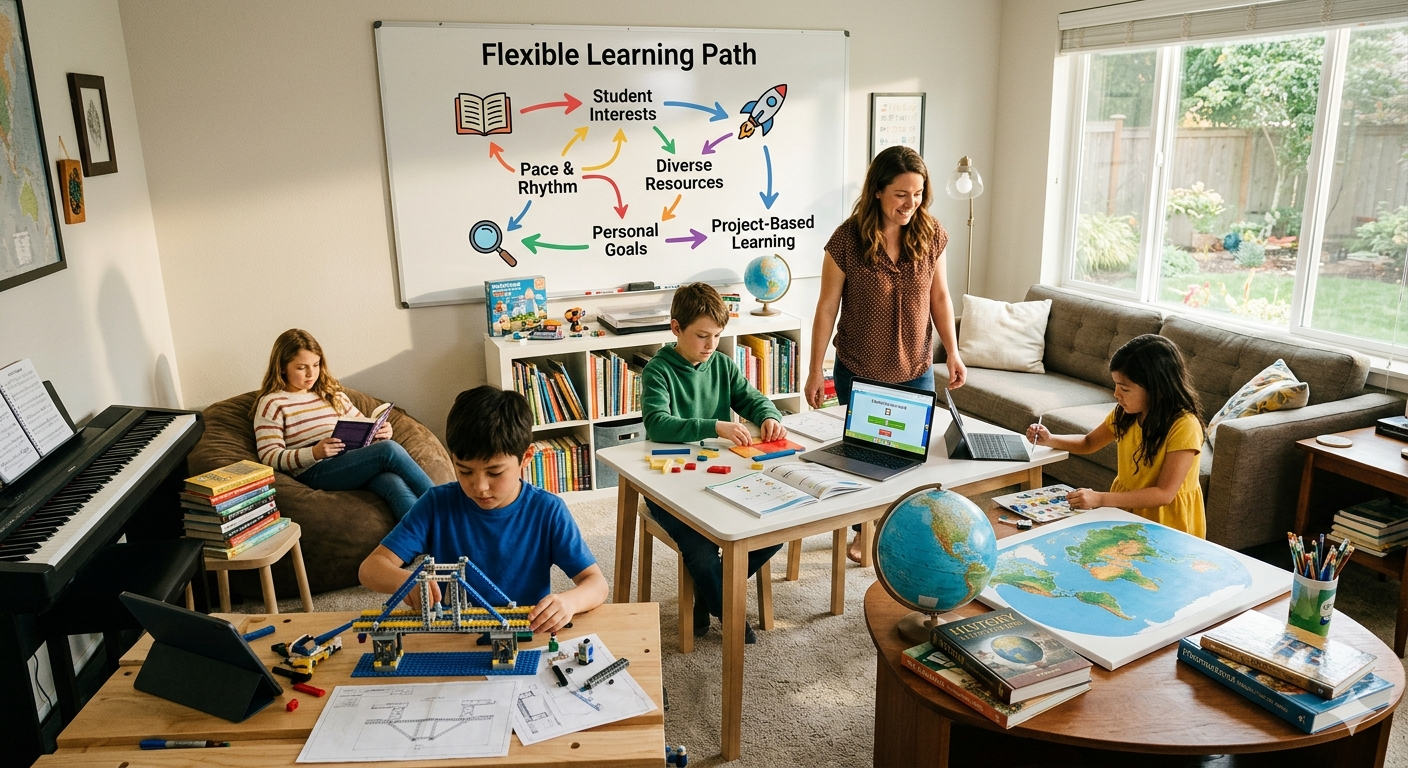
Flexibility is one of the most commonly cited reasons parents choose homeschooling. But it is worth being specific about what that flexibility means in practice, because it is more meaningful than just choosing your own schedule.
- Pacing flexibility: A structured homeschool program allows each subject to move at the pace that is right for the child. A student who has mastered addition can advance to multiplication while still working through reading comprehension skills at a slower pace. There is no artificial synchronization required.
- Schedule flexibility: Elementary-age children do not all learn best between 8 AM and 3 PM. Some are most focused in the morning. Others hit their stride after lunch. At home, parents can observe when their child is most receptive and schedule instruction accordingly. This is not a minor convenience. Research consistently shows that learning timing affects retention and engagement.
- Environment flexibility: Learning does not have to happen at a desk. For younger elementary students especially, hands-on, movement-based, and outdoor learning experiences are often more effective than worksheet-based instruction. A good homeschool program builds these options into its curriculum rather than treating them as extras.
- Content flexibility: Children at the elementary level are naturally curious and often passionate about specific topics. Insects. Space. Ancient history. A flexible homeschool program allows a parent to bring those interests into the learning day without abandoning the core subjects. A child fascinated by animals can practice reading through nature books, math through counting and classification activities, and writing through observation journals.
- Family flexibility: Homeschooling also allows families to build their learning around their own rhythm. Travel becomes educational. Family commitments do not require absence from school. A parent’s professional knowledge or personal passion becomes part of the curriculum.
The Role of Curriculum in Creating a Strong Learning Path
Flexibility without structure can drift into inconsistency. The most effective homeschool programs balance genuine adaptability with a structured, sequential curriculum that ensures no foundational skills are missed.
A well-designed homeschool curriculum for elementary-age students covers the core academic domains consistently: reading, writing, mathematics, science, and social studies. But the best programs go further. They integrate subjects rather than teaching them in silos. They connect science topics to writing practice. They use real-world projects to teach math concepts. They teach children how to think, not just what to memorize.
Screen-minimal approaches are gaining traction among parents who have observed firsthand that young children retain significantly more from hands-on, interpersonal learning than from passive screen time. A curriculum built on direct exploration, physical materials, educator-guided activities, and rich discussion creates stronger neural connections and deeper understanding at the elementary level than digital content alone.
Research supports this approach strongly. Home-educated students typically score 15 to 25 percentile points above public school students on standardized academic achievement tests, with the public school average sitting at roughly the 50th percentile. This performance gap holds regardless of parents’ formal education level, household income, or whether the parent was ever a certified teacher. The structure and intentionality of the program matters far more than the parent’s credentials.
What Parents Should Look for in a Homeschool Program
With homeschooling growing rapidly, the number of curriculum options available to parents has expanded significantly. Not all of them are equal. Here is what parents of elementary-age students should consider when evaluating a homeschool program.
- A child-first framework: The best programs are built around how children actually learn, not around how traditional schooling is organized. Look for programs that incorporate child development research into their curriculum design, not just their marketing copy.
- Structured sessions with room for exploration: Elementary learners need routine and predictability. At the same time, they need space to follow their curiosity. A program that structures learning sessions clearly while building in exploration time creates both the security and the stimulation young learners need.
- Support for the parent-educator: Homeschooling parents are not expected to be expert teachers in every subject. The best programs provide robust parent support, including professional educator resources, instructional films, lesson guides, and access to a community of other homeschooling families. A parent who feels confident and supported delivers a far better learning experience than one who is improvising alone.
- Progress tracking tools: Understanding what a child has mastered and what needs more attention is essential. Programs that include built-in record-keeping and portfolio tools allow parents to track growth over time, identify gaps, and communicate about their child’s progress with confidence.
- Secular, values-aligned content: Many families homeschool because they want an education grounded in kindness, character, and curiosity rather than prescribed ideology. Look for programs that are secular, that emphasize social and emotional learning alongside academics, and that treat children as whole people rather than academic outputs.
- Regular curriculum updates: The world’s children are growing up quickly. A homeschool program that updates its curriculum regularly ensures children are learning content that is current, relevant, and connected to the real world they will inhabit as adults.
Building a Learning Path That Grows With the Child
The goal of a great homeschool program is not just academic performance. It is building a learner who is curious, confident, capable, and self-directed.
At the elementary level, this means creating daily experiences where learning feels meaningful rather than obligatory. It means celebrating mastery rather than measuring failure. It means giving children agency over their learning while ensuring the foundational skills are solidly in place.
A child who finishes 5th grade as a self-directed learner with strong reading comprehension, solid mathematical reasoning, genuine scientific curiosity, and the ability to communicate their ideas clearly is not just academically prepared. They are prepared for everything.
The flexibility that a high-quality homeschool program provides is not just a scheduling convenience. It is the mechanism through which that kind of learner is built, one child, one family, one learning path at a time.
Conclusion
More American families than ever are choosing home education for their elementary-age children. They are choosing it because they understand that the early years are too important to leave to a one-size-fits-all system.
Homeschool programs that are built on child development research, structured with flexibility, and supported by strong parent resources give elementary-age learners something the standard classroom rarely can: a learning path designed specifically for them.
If you are in the early stages of exploring home education for your child, the most important step is finding a program that puts the child first, not the curriculum schedule.