Search engine optimization has never been a one-size-fits-all strategy. A local bakery, a mid‑sized law firm, and a multinational eCommerce brand all want visibility on Google—but the way they achieve it looks very different. This is where the conversation around enterprise SEO and traditional SEO begins.
While both approaches aim to improve rankings, traffic, and conversions, the scale, complexity, and strategy behind them are worlds apart. Understanding these differences can help businesses choose the right path for long‑term growth.
Understanding Traditional SEO
Traditional SEO is typically designed for small to mid‑sized businesses. It focuses on optimizing a limited number of pages, targeting specific keywords, and improving visibility within a defined market.
For example, a local dentist may target phrases like “best dentist in Chicago” or “affordable dental care near me.” The strategy often includes:
- Keyword research for niche or local terms
- On‑page optimization (titles, meta descriptions, content updates)
- Link building through outreach
- Local SEO improvements such as Google Business Profile optimization
- Basic technical fixes
The structure of traditional SEO campaigns is usually straightforward. There are fewer pages to manage, smaller content teams, and less complex technical requirements. Reporting tends to focus on keyword rankings, traffic growth, and lead generation.
For many businesses, this approach works perfectly. It’s manageable, cost‑effective, and aligned with moderate growth goals.
What Is an Enterprise SEO Company?
An enterprise SEO company operates on a completely different scale. Instead of optimizing 20 or 50 pages, they may be handling thousands—or even millions—of URLs. Businesses that work with an enterprise seo company benefit from strategies that go beyond traditional keyword optimization, focusing on systems that improve performance across entire site structures.
Enterprise‑level businesses often include:
- National or global brands
- Large eCommerce stores
- SaaS platforms with extensive product or resource libraries
- Multi‑location franchises
These organizations face challenges that go far beyond basic SEO. Their websites are dynamic, complex, and frequently updated. They may operate in multiple countries and languages, each requiring tailored strategies. Unlike traditional SEO, where manual optimization of individual pages often suffices, enterprise SEO teams rely on advanced tools, automation, and strategic planning to ensure every layer of content and technical infrastructure works together for scalable success.
Key Differences Between Enterprise and Traditional SEO
1. Scale of Operations
The most obvious difference is scale.
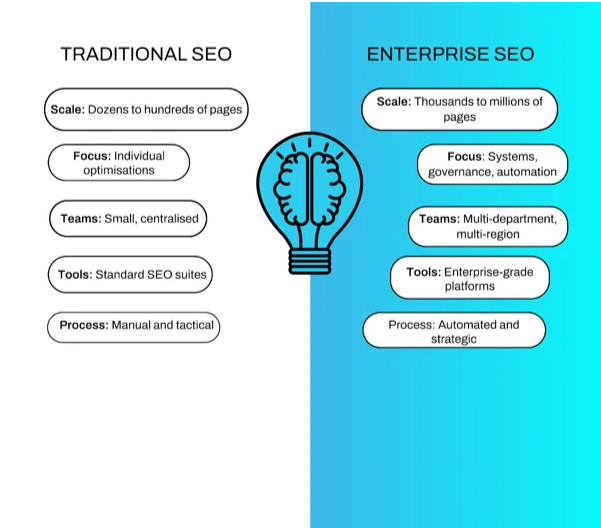
Traditional SEO might involve optimizing dozens of pages. Enterprise SEO deals with thousands. That shift in scale changes everything—from strategy to tools to reporting.
Large websites require automated technical audits, advanced crawl management, and structured data implementation across entire categories. Without proper systems, maintaining consistency becomes nearly impossible.
2. Technical Complexity
Traditional SEO campaigns often involve improving site speed, fixing broken links, and optimizing page structure. While technical SEO is important at all levels, enterprise websites demand deeper expertise.
Enterprise websites often rely on complex content management systems, custom codebases, and integrations with multiple third‑party platforms. A single technical issue can affect thousands of pages.
Enterprise teams must manage:
- Crawl budget optimization
- Log file analysis
- Site architecture restructuring
- Canonicalization at scale
- International SEO (hreflang implementation)
These tasks require collaboration between SEO specialists, developers, and IT teams.
3. Data and Reporting
In traditional SEO, reporting often centers on keyword rankings and traffic growth. Enterprise SEO goes further.
Large organizations rely heavily on data modeling, forecasting, and performance segmentation. Instead of tracking 20 keywords, they may monitor thousands across multiple regions.
Enterprise strategies often include:
- Advanced analytics dashboards
- Predictive traffic modeling
- ROI projections
- Department‑level performance tracking
Decision‑making is guided by large data sets rather than small campaign metrics.
4. Content Strategy
Content creation for traditional SEO usually focuses on blog posts, service pages, and local landing pages.
Enterprise SEO content strategies are much broader. They include:
- Content hubs and topic clusters
- Automated category page optimization
- User‑generated content moderation
- Large‑scale editorial planning
- Cross‑team content governance
Consistency becomes critical. With multiple writers, editors, and departments involved, enterprise SEO requires documented guidelines and structured workflows.
5. Organizational Structure
Traditional SEO often involves working directly with a business owner or a small marketing team.
Enterprise SEO requires collaboration across multiple departments, including:
- Marketing
- Development
- IT
- Sales
- Legal
- Executive leadership
Decisions are rarely made quickly. Processes are layered, and approval cycles can take weeks. An enterprise SEO strategy must account for these internal structures.
6. Risk Management
For a small business, a ranking drop may impact monthly revenue. For a large enterprise, it can affect millions in projected earnings.
Because of this, enterprise SEO prioritizes risk management. Every technical change is tested carefully. Site migrations are planned months in advance. Algorithm updates are monitored closely.
Stability and long‑term sustainability matter more than short‑term ranking spikes.
When Traditional SEO Is the Right Choice
Not every business needs enterprise‑level support. Traditional SEO works well for:
- Local businesses
- Startups
- Small to mid‑sized service providers
- Companies with limited product catalogs
If your website contains fewer than a few hundred pages and operates within a single market, a traditional SEO approach is often sufficient.
It offers a clear strategy, predictable budgeting, and manageable growth expectations.
When Enterprise SEO Becomes Necessary
Enterprise SEO becomes essential when:
- Your website exceeds several thousand indexed pages
- You operate in multiple countries or languages
- You manage a large eCommerce platform
- Organic traffic is a major revenue driver
- Technical SEO issues affect performance at scale
At this stage, manual optimization is no longer practical. Systems, automation, and advanced data analysis are required.
Budget and Investment Differences
Traditional SEO typically operates within smaller monthly retainers. Costs are lower because scope and complexity are limited.
Enterprise SEO requires larger investments. Teams may include strategists, technical specialists, analysts, and content managers. Custom tools, advanced software, and cross‑department coordination increase overall expenses.
However, the potential return is also significantly higher. A small percentage improvement in organic performance can translate into substantial revenue gains for enterprise brands.
Final Thoughts
At first glance, SEO may seem like a universal strategy. But the reality is more nuanced. Traditional SEO and enterprise SEO share the same foundation—improving visibility and driving organic traffic. What sets them apart is scale, complexity, and organizational impact.
Traditional SEO is tactical and focused. Enterprise SEO is strategic and systemic.
Choosing between them depends entirely on your business size, goals, and digital footprint. For smaller organizations, traditional SEO offers efficient and effective growth. For large‑scale operations, partnering with a strong enterprise SEO company provides the structure, technology, and expertise needed to compete at the highest level.