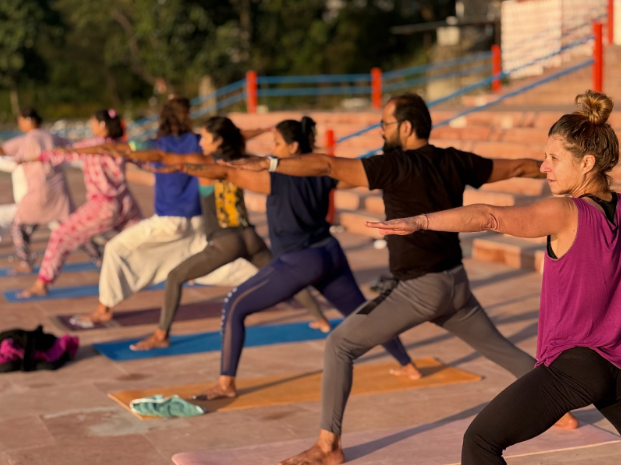
Yoga is an ancient form of exercise that began in India hundreds of years ago. The term “yoga” comes from the Sanskrit root “yuj” that means “to unite” representing the fusion of mind, body and the spirit. As time has passed yoga has evolved into a variety of styles and practices that each have their own advantages. You may want to improve your flexibility, reduce tension, build strength, or deepen your spiritual understanding.
If you love yoga and want to build your skills, a Yoga Teacher Training Course (TTC) can help.
It can also lead to yoga instructor certification and be a life-changing step. 200 hour yoga teacher training in rishikesh at Arogya Yoga School will give you the most popular fundamental certification in the world. Let’s look at the various forms of yoga and the things you can learn from the yoga TTC course.
Different Types of Yoga
1. Hatha Yoga
Hatha Yoga is one of the oldest and the most popular styles of yoga. It focuses on physical poses (asanas) as well as breathing practices (pranayama) as well as basic meditation. The classes are generally slower-paced, which makes it perfect for people who are just beginning.
What you get:
- Balance and flexibility are improved.
- A basic understanding of alignment
- Breath awareness
- Foundation for advanced practice
Hatha is the foundation of the most popular yoga practices.
2. Vinyasa Yoga
Vinyasa Yoga is dynamic and flow-based. The term “vinyasa” means to place in a particular manner. This style of movement syncs with the breath and creates a smooth transition from one position to the next.
What you get:
- Fitness for cardio
- Stamina and strength
- Coordination
- Mindful movement
Vinyasa classes are fun and can change from teacher to instructor.
3. Ashtanga Yoga
Ashtanga Yoga is a structured and physically demanding yoga practice that was created by K. Pattabhi Jois. You perform a particular sequence of poses in the same order each time.
What you get:
- Discipline and concord
- Physical physical strength
- Focus on the mind
- Detoxification by sweat
This is a great style for those who love the routine and challenges.
4. Iyengar Yoga
Iyengar Yoga was founded by B. K. S. Iyengar. It is a form of alignment that focuses on precision and uses props like belts, blocks, and bolsters to support the body.
What you get:
- Understanding alignment is essential
- Information on injury prevention
- Better posture
- Therapeutic benefits
This is a great choice for people of all age groups and abilities.
5. Kundalini Yoga
Kundalini Yoga aims to awaken dormant energy at the base of the spine through movement, chanting, breathing, and meditation.
What you get:
- Balance between emotions
- Spiritual awareness
- Energy efficiency has increased
- Reduce stress
Compared with the other forms, it is more spiritual and meditative.
6. Bikram Yoga
Bikram Yoga was created in the late Bikram Choudhury. It comprises 26 postures performed in a heated area (around 40 degrees Celsius).
What you get:
- Intense detoxification
- Flexibility
- Endurance
- Mental resiliency
Because of the heat, it might not be suitable for everyone.
7. Yin Yoga
Yin Yoga is a slow-paced practice where the postures are held longer (3-5 minute). It targets deep connective tissue and fascia.
What you get
- Relaxation deep
- Mobility in joint
- Release of emotions
- Mindfulness and patience
It can be used in conjunction with more active yoga practices.
8. Restorative Yoga
Restorative Yoga is deeply relaxing and makes use of props to assist the body during gentle postures.
What you get:
- Recovery of the nervous system
- Stress relief
- Better sleep
- Help with healing
Perfect for those recovering from injury or struggling with anxiety.
What You Learn in a Yoga TTC Course (200-Hour)
An Yoga Teacher Training Course is not just about learning the correct postures. It’s a complete experience that will help you improve your practice mentally, physically as well as spiritually.
1. Yoga Philosophy
It is advised to study old yogic texts, like the Yoga Sutras of Patanjali and the Bhagavad Gita. These texts provide ethical guidelines and self-control, meditation, and the meaning behind yoga, which goes beyond physical exercise.
Learn about:
- The Eight Limbs of Yoga
- Karma and Dharma
- Meditation principles
- Lifestyle that is yogic
This can help you comprehend yoga as a whole system.
2. Asana Practice and Alignment
Learn proper alignment the benefits, contraindications and variations on numerous yoga postures. Yoga teachers break down each pose step-by-step.
You develop:
- Teaching skills that are safe
- Adjustment techniques
- Modifications to injuries
- Sequencing information
Also, you will learn how to design well-balanced classes.
3. Pranayama (Breathing Techniques)
Breathing is a key element of yoga. In TTC, you practice techniques like:
- Nadi Shodhana (alternate nostril breathing)
- Kapalbhati
- Bhastrika
These methods help to increase lung capacity, increase focus, and help balance energy.
4. Meditation Techniques
Meditation is a must in TTC. You practice:
- Meditation with a guided guide
- Meditation in silence
- Mantra chanting
- Mindfulness techniques
You improve your concentration and develop emotional awareness.
5. Anatomy and Physiology
The human anatomy is vital to ensure that your teaching is safe. You will learn about:
- Muscular system
- Skeletal system
- Joint function
- Common injuries
This knowledge can help you avoid injuries and help students stay safe.
6. Teaching Methodology
The most crucial components that you can do in TTC is learning to instruct. You practice:
- Techniques for cueing
- Class management
- Building confidence
You can also instruct practice classes to trainees who are also students and get feedback.
7. Sequencing and Class Planning
Learn how to create classes to meet various levels and aims:
- Beginning classes
- Advanced flow sessions
- Classes that focus on relaxation
- Themes-based workshops
Sequencing allows for logical sequence from warm-up to peak posture to cooling down.
8. Ethics and Professional Development
TTC will teach you the duties of being a yoga instructor:
- Maintaining professional boundaries
- Connecting authentically
- Marketing fundamentals
- Making a career that is sustainable
Additionally, you will get to know more about Yoga Alliance standards when your class is accredited.
9. Self-Transformation
Beyond the technical, TTC is a personal learning experience. You develop:
- Self-discipline
- Resilience to emotional stress
- Inner awareness
- Confidence
Many students have said that TTC alters their outlook on life.
Who Should Join a Yoga TTC?
There is no need to be a teacher in order to become a part of TTC. Many enroll to:
- Intensify the practice
- Improve your health
- Get away from the everyday life
- Explore the spiritual side of life
If you’d like to become a professional teacher you must complete an Yoga TTC is the initial certification stage. Arogya Yoga School offers a Yoga Alliance USA certified yoga teacher training course. It is an intense experience beyond physical poses.
It integrates philosophy, anatomy as well as breathing, meditation and teaching methods to produce competent and experienced instructors. Whatever your goals are, in life or at work, TTC gives you a strong foundation. It is rooted in India’s ancient wisdom.