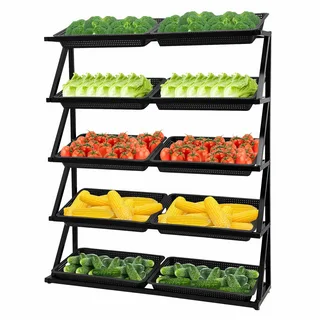
High-volume retail environments operate on thin margins and tight timelines. In fresh produce retail, this pressure is amplified by perishability, daily replenishment cycles, and constant movement of goods. Vegetables arrive, move through backrooms, reach display areas, and are replaced multiple times a day. Any inefficiency in this flow quickly turns into waste, congestion, or lost sales.
In cities like Chennai, where dense retail networks intersect with warm, humid conditions, physical infrastructure plays a defining role in whether operations scale smoothly or struggle under volume. Vegetable tray racks are one of the least visible yet most operationally critical elements in this system. Their design determines how quickly produce moves, how safely it is handled, and how consistently quality is maintained across high-throughput environments.
How Vegetable Tray Rack Manufacturers in Chennai Address High-Volume Retail Realities
For retailers working with vegetable tray rack manufacturers in chennai, the priority is not visual novelty but operational resilience. High-volume retail demands storage systems that can absorb constant loading and unloading without deformation, misalignment, or workflow disruption.
Local manufacturers design tray rack systems around the realities of Chennai’s retail ecosystem. This includes understanding how produce arrives from wholesale markets, how it is staged in backrooms, and how frequently staff need to replenish front-facing displays. Tray dimensions, rack spacing, and material strength are all informed by these patterns.
Instead of forcing retailers to adapt their workflows to generic shelving, these systems are built to support scale without adding complexity.
Volume Pressure and the Need for Structured Handling
High-volume retail creates pressure at every handling point. Produce arrives in bulk, often multiple times a day. Without structured storage, backrooms become crowded, and staff resort to floor stacking or temporary solutions that slow movement and increase damage risk.
Tray rack systems introduce order by breaking bulk loads into manageable units. Each tray becomes a controlled handling layer that can be moved, rotated, or replenished without disturbing adjacent stock.
This structure supports:
- Faster unloading and staging
- Clear separation between incoming and outgoing stock
- Reduced handling per unit
- Predictable movement patterns even during peak hours
Manufacturers design these systems with volume thresholds in mind, ensuring racks remain stable and accessible even when fully loaded.
Scaling Without Expanding Footprint
Retail space in Chennai is expensive and often constrained. Scaling operations does not always mean expanding floor area. It often means increasing throughput within the same footprint.
Vegetable tray racks support vertical utilization without compromising access. By stacking trays in stable, evenly spaced tiers, retailers increase capacity while maintaining visibility and reach.
Effective vertical design allows:
- Higher stock density in backrooms
- Faster identification of inventory levels
- Reduced need for overflow storage
- Clear zoning by vegetable type or supplier
Local manufacturers tailor rack heights and tray spacing to match staff ergonomics, ensuring that increased capacity does not come at the cost of safety or speed.
Backroom Throughput and Replenishment Speed
In high-volume retail, the backroom is not a storage space; it is a transit zone. Produce rarely sits idle for long. Tray racks must therefore support continuous movement rather than static storage.
Well-designed systems enable staff to:
- Pull entire trays for replenishment
- Replace empty trays without restacking
- Maintain clear aisles during peak activity
- Stage replenishment loads in advance
Manufacturers with operational insight design racks that align with these flows, minimizing bottlenecks during rush periods when delays are most costly.
Climate Resilience Under Heavy Use
Chennai’s climate adds stress to high-volume operations. Heat and humidity accelerate spoilage, while frequent cleaning introduces moisture exposure to storage infrastructure. Under high load cycles, weak materials or poor finishes fail quickly.
Local manufacturers account for these conditions by selecting materials and finishes that tolerate:
- Repeated washdowns
- Moisture exposure from produce and cleaning
- Temperature fluctuations
- Continuous mechanical stress
Design features such as slotted trays and corrosion-resistant finishes are not optional at scale. They are necessary to maintain performance under daily operational pressure.
Managing Hygiene at Scale
High-volume produce handling increases hygiene risk. More movement means more contact points, more debris, and more opportunities for contamination if systems are poorly designed.
Tray rack systems support hygiene by:
- Keeping produce off the floor
- Allowing airflow and drainage
- Enabling easier cleaning between cycles
- Reducing cross-contact between batches
According to guidance from the Food and Agriculture Organization of the United Nations on post-harvest handling, structured storage and proper airflow are central to maintaining quality and reducing losses in fresh produce supply chains. Tray-based systems align with these principles when implemented correctly.
Reducing Waste in High-Throughput Environments
Waste in high-volume retail often comes from small inefficiencies multiplied across scale. Forgotten stock, uneven stacking, and delayed rotation all contribute to shrinkage.
Tray rack systems reduce these risks by making inventory visible and accessible. Each tray represents a discrete unit that can be inspected, rotated, or removed without disturbing surrounding produce.
This visibility supports:
- First-in, first-out handling
- Faster identification of aging stock
- Reduced pressure damage
- Lower spoilage rates over time
Manufacturers who understand volume dynamics design racks that maintain this visibility even as throughput increases.
Durability Under Continuous Load Cycles
High-volume retail subjects racks to constant load variation. Trays are filled, emptied, and refilled throughout the day. Over time, poorly built racks warp, loosen, or become unstable.
Manufacturers focused on scalability prioritize:
- Reinforced joints and welds
- Even load distribution across frames
- Stable tray guides that resist wear
- Structural designs that maintain alignment
Durability is not just about longevity. It is about maintaining predictable performance so that staff can work at speed without hesitation or adjustment.
Supporting Multi-Store Consistency
Retail chains operating multiple locations benefit from consistent infrastructure. Standardized tray rack systems make it easier to train staff, move inventory practices between stores, and maintain quality benchmarks.
Local manufacturers often support:
- Standardized designs adapted to different store sizes
- Modular components shared across locations
- Repeatable layouts that scale with expansion
- Incremental additions as volume grows
This consistency reduces operational friction as retailers expand or adjust store formats.
Responsiveness to Demand Spikes
High-volume retail is rarely stable. Festivals, promotions, and seasonal demand spikes place sudden pressure on storage and display systems. Imported or rigid solutions struggle to adapt quickly.
Local manufacturing offers responsiveness through:
- Faster lead times for additional racks
- Custom adjustments for temporary layouts
- On-site support for reconfiguration
- Scalable designs that expand without redesign
This agility helps retailers manage volume surges without resorting to temporary or inefficient workarounds.
Labor Efficiency and Ergonomic Impact
At scale, small ergonomic improvements translate into significant labor savings. Tray height, reach distance, and stability all affect how quickly staff can move and how long they can maintain pace.
Manufacturers who design for high-volume use consider:
- Optimal tray access heights
- Reduced bending and lifting strain
- Smooth tray movement under load
- Clear spacing for staff movement
These factors reduce fatigue and error rates, supporting sustained throughput during long operating hours.
Cost Control Through Scalable Design
High-volume operations magnify both good and bad infrastructure decisions. A system that works well at low volume may become a liability as throughput increases.
Scalable tray rack systems help control costs by:
- Reducing product loss
- Lowering maintenance frequency
- Supporting faster labor cycles
- Extending service life under heavy use
Local manufacturers who design with scale in mind help retailers invest once and grow without repeated replacement.
Conclusion: Local Manufacturing as an Enabler of Retail Scale
High-volume retail success depends on systems that absorb pressure without breaking rhythm. Vegetable tray racks are part of that foundation. They shape how produce moves, how staff work, and how quality is preserved under constant demand.
By working with vegetable tray rack manufacturers in chennai who understand local conditions and high-throughput realities, retailers gain infrastructure that scales with volume rather than resisting it. In fast-moving produce environments, this alignment between design and demand is what allows growth without loss of control.