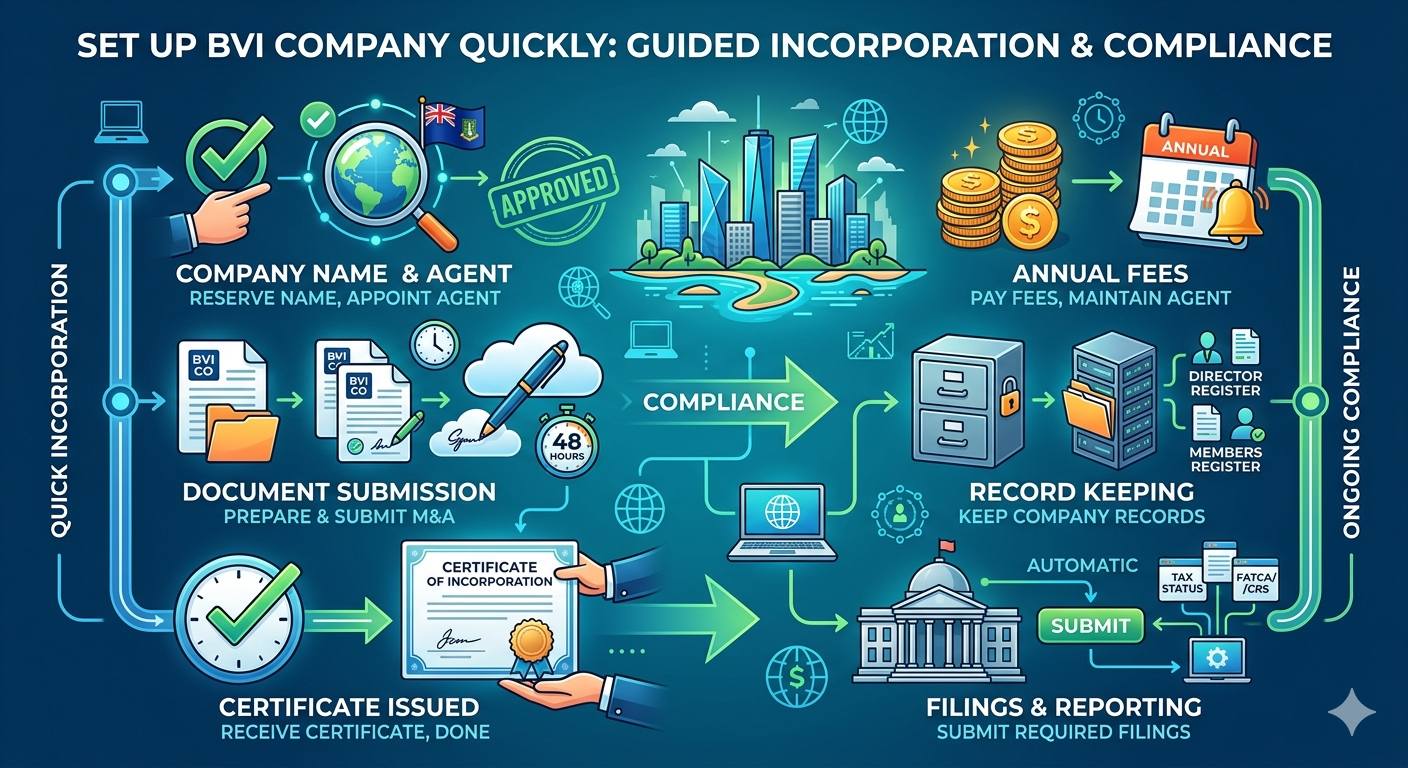
Thinking about how to set up BVI company? You can complete a straightforward, largely remote incorporation by reserving a name, appointing a registered agent, filing the required incorporation documents, and issuing shares—often within days—while enjoying BVI’s confidentiality and favorable tax framework. If you want rapid offshore incorporation with minimal residency requirements and clear ongoing filings, a BVI business company is a practical choice.
This article will walk you through the essential steps to form the company, what documents and service providers you’ll need, and the compliance and ongoing obligations—such as annual filings and economic-substance rules—that keep your structure lawful and effective. Follow along to understand the timeline, typical costs, and common pitfalls to avoid so you can make informed decisions for your business.
Essential Steps to Set Up a BVI Company
You will decide the legal form, pick a name that meets BVI rules, appoint the people or entities who will manage and own the company, and file incorporation documents with the BVI Registrar. Each step has specific documents, timelines, and fee implications you must handle precisely.
Selecting a Company Structure
Choose a BVI Business Company (BC) for most commercial activities; it offers limited liability and flexible corporate governance under the BVI Business Companies Act, 2004. You can use a single-member company, multiple shareholders, or have corporate shareholders. Decide whether you need bearer shares (largely obsolete and restricted) or only registered shares.
Consider tax and substance requirements: BVI has no corporate tax but requires economic substance for certain activities (e.g., banking, holding, insurance). Pick a structure that matches your activities and makes it straightforward to demonstrate substance—local directors, meetings, office space, and qualified employees where required.
Think about share classes and voting rights up front. Prepare an articles of association that sets out share rights, transfer restrictions, and director powers to avoid future disputes.
Choosing a Company Name
Select a name that is unique and not misleading or offensive under BVI rules. Avoid names implying government patronage (e.g., “Royal,” “Government”) unless you obtain permission. Names must be in the Latin alphabet or use approved transliteration.
Run a name availability check with an agent or the BVI Registrar before preparing documents. Reserve the name if you need time to finalize paperwork. Include any required corporate suffix such as “Limited,” “Ltd.,” or “Company” consistent with your chosen language and legal form.
If you plan to trade under a different brand, register that trading name or trademark separately; the company name and trademark are distinct legal protections. Also check domain and international trademark conflicts to prevent future rebranding costs.
Appointing Directors and Shareholders
You must appoint at least one director and one shareholder; both can be the same person or corporate entities. Directors do not need to be BVI residents, but you must provide full identification, proof of address, and, if required, professional references for KYC compliance.
Decide whether to use local nominee directors or corporate service providers for privacy and administration, keeping in mind substance rules may require genuine management activities in the BVI for certain business types. Record director powers, indemnities, and signing authorities clearly in board resolutions and the articles.
For shareholders, prepare subscription agreements, share certificates, and a shareholders’ register. If you plan multiple classes of shares, specify dividend, voting, and redemption rights at incorporation to avoid later disputes.
Registering with BVI Authorities
File incorporation documents with the BVI Registrar through an authorized local agent; direct filing by foreign applicants is not permitted. Required filings typically include the Memorandum and Articles of Association (or a constitution), particulars of the registered agent, and prescribed incorporation forms.
Pay statutory fees and provide certified copies of directors’ and shareholders’ IDs, proof of address, and a registered office address in the BVI. Expect the Registrar to issue a Certificate of Incorporation within 24–48 hours when filings are complete and compliant.
After incorporation, register for anti-money-laundering and beneficial ownership reporting as required. Maintain statutory registers, file annual returns if applicable, and ensure ongoing compliance with economic substance and any sector-specific filings.
Compliance and Ongoing Obligations
You must meet specific filing, recordkeeping, and tax-reporting duties to maintain good standing and avoid penalties. Deadlines, accurate registers, and timely beneficial ownership filings are the most critical recurring tasks.
Annual Filing Requirements
You must file an annual return with the BVI Registrar and pay the government annual fee by the due date. Annual returns typically confirm company details, registered agent information, and payment of the prescribed fee; late filings can incur penalties and risk administrative strike-off.
Many BVI companies also need to submit a financial return or an indication that no financial statements are required, depending on their activity and whether they are dormant. If your company carries on business that requires audited accounts or has local substance, prepare and retain financial statements in line with the BVI Business Companies Act and economic substance rules.
You must update the Registry promptly for any changes to directors, registered agent, company name, or share structure. Use the Registry’s electronic filing system where required and keep proof of submissions and payments.
Maintaining Corporate Records
You must keep and maintain statutory registers at your registered office or a designated records location. These include the register of members, register of directors, register of charges, and registered office record; they must be accurate and available for inspection by authorized persons.
Maintain minutes of director and shareholder meetings along with written resolutions. Record decisions that affect share capital, changes in directors, and material corporate actions; these documents support legal compliance and prove authority for banking and contracts.
You must also collect and retain beneficial ownership information (BOI) and supporting ID documents as required by BVI law. Ensure your beneficial ownership records are updated within prescribed timeframes and made available to the BVI Registrar or competent authorities under the access rules.
Taxation and Reporting Considerations
BVI companies are generally exempt from local corporate income tax, withholding tax, and capital gains tax, but you must still comply with international tax transparency rules. Prepare for Exchange of Information (EOI) requests, and ensure your company can demonstrate substance if required under economic substance legislation.
If your company has operations or tax residency elsewhere, you must meet those jurisdictions’ reporting obligations, including CRS and FATCA where applicable. Keep documentation showing where management and control take place, contracts, invoices, and evidence of physical presence to support tax-residence and substance claims.
Engage qualified advisors for cross-border tax planning and to complete any required country-by-country or transfer-pricing documentation. Proper documentation reduces the risk of challenges, penalties, and reputational harm.