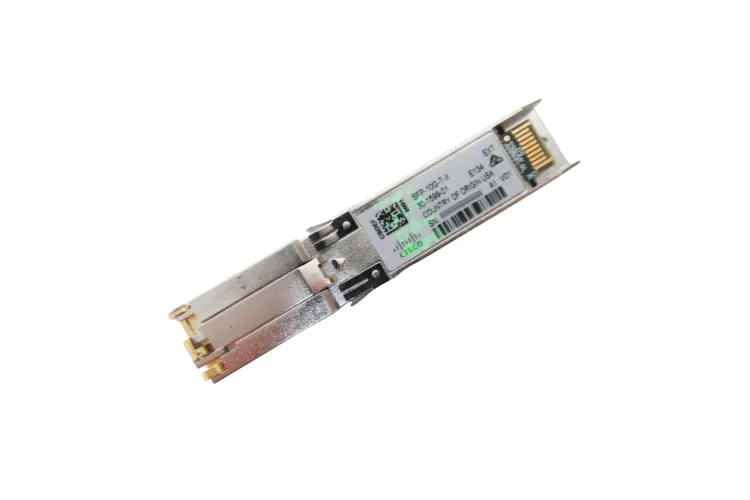
As 10G connectivity becomes a baseline requirement rather than a luxury, network architects are faced with an important decision: should they deploy fiber-based 10G SFP+ modules, or can copper-based 10GBASE-T SFP+ modules meet their needs? The answer is not always straightforward. While fiber has long dominated high-performance environments, copper solutions continue to evolve, offering flexibility and cost advantages that cannot be ignored.
The 10GBASE-T SFP+ copper transceiver brings familiar RJ-45 connectivity into SFP+ slots, allowing switches and servers to support 10G over Cat6a or Cat7 cabling. Compared to traditional 10G SFP+ modules used with fiber optics, this solution eliminates the need for optical patch cords and specialized termination, making it attractive for networks that already rely on structured copper cabling. But does that make it suitable for data centers, or is it better reserved for enterprise networks?
To answer this question, we need to examine performance characteristics, power consumption, latency, cabling infrastructure, and real-world deployment scenarios.
Understanding 10GBASE-T SFP+ Technology
How 10GBASE-T SFP+ Works
10GBASE-T SFP+ modules convert electrical signals from the SFP+ interface into 10GBASE-T signals that can travel over twisted-pair copper cabling. Using advanced modulation techniques and digital signal processing, these modules enable 10Gbps transmission over Cat6a or Cat7 cables, typically up to 30 meters in SFP+ form factor implementations.
Unlike native 10GBASE-T switch ports that may support up to 100 meters, SFP+ copper modules are usually optimized for shorter distances due to power and thermal constraints within the compact SFP+ housing. Nevertheless, the 30-meter range is sufficient for many top-of-rack to server connections or short inter-switch links within controlled environments.
Another advantage of 10GBASE-T technology is backward compatibility. These modules typically support auto-negotiation and can operate at 1G, 2.5G, or 5G speeds depending on connected equipment and cable quality. This flexibility is especially valuable in mixed-speed environments where gradual upgrades are required.
10GBASE-T SFP+ in Enterprise Networks
Why It Fits Enterprise Deployments Well
In enterprise networks, copper cabling remains dominant. Office buildings, campuses, and commercial facilities are commonly wired with Cat6a infrastructure. Replacing this existing copper with fiber solely to enable 10G can significantly increase costs, not only in materials but also in labor and downtime.
In such environments, 10GBASE-T SFP+ modules offer a practical upgrade path. Organizations can retain their structured cabling while upgrading switches and network interface cards to 10G. This approach reduces capital expenditure and simplifies deployment. The familiar RJ-45 interface also minimizes training requirements for IT staff who are already accustomed to copper patching.
Enterprise access layers often require moderate port density and manageable power budgets. In these scenarios, the slightly higher power consumption of 10GBASE-T SFP+ modules compared to optical solutions is typically acceptable. Latency differences, while measurable, rarely impact common enterprise applications such as file sharing, VoIP, video conferencing, and internal database access.
As a result, for enterprise networks seeking cost-effective and minimally disruptive 10G upgrades, 10GBASE-T SFP+ is not only suitable but often ideal.
Can 10GBASE-T SFP+ Meet Data Center Requirements?
Performance and Latency Considerations
Data centers operate under different constraints. High-density racks, virtualization clusters, and storage networks demand low latency and predictable performance. Fiber-based solutions traditionally dominate here because of their lower power consumption and lower latency characteristics.
10GBASE-T technology introduces slightly higher latency due to complex signal processing required for copper transmission. Although the delay is measured in microseconds, in large-scale east-west traffic environments or latency-sensitive applications such as high-frequency trading, these differences can accumulate. In such specialized cases, optical transceivers or direct attach copper (DAC) cables may provide a performance edge.
However, not all data centers are hyperscale facilities. Many small to medium-sized data centers prioritize flexibility and cost efficiency over ultra-low latency. In these environments, 10GBASE-T SFP+ can serve effectively in top-of-rack deployments where cable runs remain within 30 meters. It can also simplify connections to servers equipped with RJ-45 network interface cards, avoiding the need for additional fiber adapters.
Power and Thermal Impact
One of the main concerns in data centers is power density. Copper-based 10G modules typically consume more power than short-reach optical modules or DAC cables. In high-port-count switches, this additional power draw translates into greater heat generation, potentially impacting cooling strategies.
For hyperscale operators running thousands of ports, even small per-port power differences become significant. In these environments, optical solutions are generally more energy-efficient and scalable. But in moderate-density deployments where power budgets are less constrained, the difference may not justify a full migration to fiber.
Therefore, suitability depends largely on the scale and performance sensitivity of the data center in question.
Comparing Deployment Scenarios
Top-of-Rack Architectures
In top-of-rack architectures, servers connect to a nearby switch within the same rack or adjacent racks. Cable distances typically fall well below 30 meters. In such scenarios, 10GBASE-T SFP+ modules can function reliably while leveraging standard Cat6a patch cords.
For environments that already use copper-based network interface cards in servers, this approach reduces compatibility concerns. It also allows mixed-speed operation when legacy 1G devices coexist with newer 10G systems.
Aggregation and Spine Layers
In aggregation or spine layers, link distances may extend beyond 30 meters, and port density requirements increase significantly. Here, fiber-based 10G SFP+ modules or even higher-speed optical solutions are usually more appropriate. Their lower power consumption and longer reach align better with the architectural demands of these layers.
Thus, while 10GBASE-T SFP+ can serve specific roles within a data center, it is rarely the universal solution across all tiers.
So, Is It Only for Enterprise Networks?
The idea that 10GBASE-T SFP+ is strictly for enterprise networks oversimplifies the picture. It excels in enterprise access layers and structured copper environments, but it also has a place in certain data center scenarios, particularly in small to medium facilities or edge data centers where cost control and infrastructure reuse are priorities.
Ultimately, the choice between copper and fiber is not about superiority but about alignment with network design goals. If the priority is maximum density, minimal latency, and optimal energy efficiency at scale, optical solutions remain dominant. If the goal is cost-effective upgrades, simplified deployment, and compatibility with existing copper cabling, 10GBASE-T SFP+ offers compelling advantages.
In modern networking, hybrid architectures are increasingly common. Many organizations deploy fiber in core and aggregation layers while using copper at the edge. Within such designs, 10GBASE-T SFP+ modules serve as a flexible bridge between traditional enterprise cabling and high-speed data center performance.
Rather than asking whether 10GBASE-T SFP+ belongs only in enterprise networks, a better question might be this: where within your architecture does copper provide the most strategic value? The answer to that question ultimately determines whether this technology is merely convenient—or genuinely essential.