Choosing the right OEM manufacturer is an important decision for businesses developing or expanding their product lines. Your manufacturing partner affects product quality, production costs, delivery times, and long-term business performance.
A competitive quotation does not always mean a supplier can meet your requirements. You also need to evaluate manufacturing facilities, engineering capabilities, customization options, quality control, and technical support.
This is particularly important when sourcing electronic equipment and printing solutions, where product specifications and performance directly affect daily operations.
Here are seven important factors to consider before selecting an OEM manufacturing partner.
1. Evaluate Manufacturing Experience and Production Capacity
Start by checking how long the manufacturer has been operating and whether its production facilities can handle your requirements.
Look beyond the company’s establishment date. Examine its workforce, manufacturing space, production equipment, and engineering resources.
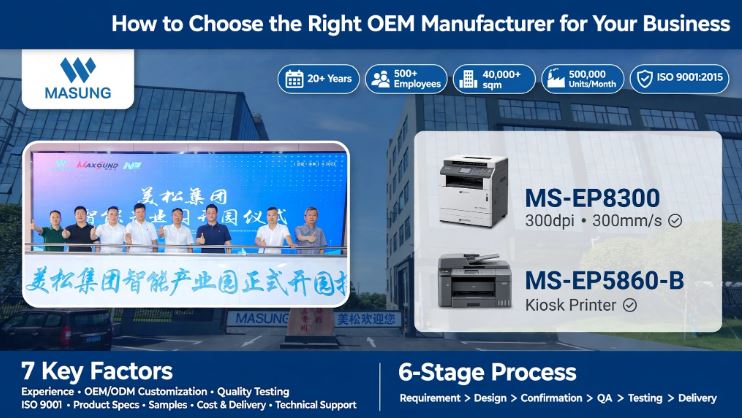
For example, Masung Group, founded in 2006 in Shenzhen, China, reports the following manufacturing figures:
- 20+ years of printer manufacturing experience.
- 500+ employees.
- 40,000+ square meters of industrial facilities.
- 500,000 units of reported monthly production capacity.
- 8 subsidiaries.
The company also reports having two research and development teams with more than 80 designers and engineers.
These figures provide an indication of its manufacturing and development resources. However, buyers should confirm available production capacity for their specific product and order quantity.
2. Check OEM and ODM Customization Capabilities
Not every business needs a standard product. Some require customized designs, specific technical features, or equipment that integrates with existing systems.
Understanding OEM and ODM services helps you identify the right manufacturing partner.
- OEM (Original Equipment Manufacturing): Products are manufactured according to the buyer’s specifications or design.
- ODM (Original Design Manufacturing): The manufacturer provides product design and development capabilities that businesses can use for their products.
Before choosing a supplier, check whether it supports mechanical design, hardware customization, firmware development, software integration, and custom branding.
For example, a self-service kiosk manufacturer may require an embedded printer with specific dimensions, paper width, connectivity, and cutting functions.
A manufacturer with in-house engineering capabilities can help develop a solution that fits the equipment instead of forcing the business to adapt to a standard product.
3. Examine Product Quality and Testing Standards
Product quality directly affects customer satisfaction, warranty expenses, and brand reputation.
A reliable printer manufacturer should inspect materials, monitor production, and test finished products before shipment.
Ask potential suppliers about:
- Quality management certifications.
- Incoming component inspections.
- Product performance testing.
- Durability and operating tests.
- Defect handling and replacement policies.
Masung reports ISO 9001:2015 certification and product certifications including CCC, CE, RoHS, FCC, and UL.
The company also reports an after-delivery product defect rate below 0.5%. This is a company-reported figure, so buyers should request supporting quality records and understand how the rate is calculated.
Always verify that certifications apply to the specific product model you intend to purchase.
4. Examine Actual Product Specifications
A manufacturer’s technical capabilities become clearer when you examine its actual products rather than relying on general marketing claims.
For printing equipment, important specifications include resolution, printing speed, paper width, cutter life, connectivity, and expected operating life.
Masung’s product range provides several examples:
MS-EP8300 Embedded Thermal Printer
- Resolution: 300 dpi.
- Maximum printing speed: 300 mm/s.
- Maximum paper width: 80 mm.
- Printer life: 100 km.
- Cutter life: Up to 1 million cuts.
- Connectivity: USB and RS232.
MS-EP5860-B Kiosk Printer Module
- Maximum printing speed: 200 mm/s.
- Maximum printing width: 56 mm.
- Maximum paper roll diameter: 80 mm.
- Printer life: Up to 100 km.
- Connectivity: USB and RS232.
These specifications demonstrate why product-level evaluation matters. Different printer models serve different applications, and businesses should select equipment according to their actual operating requirements.
5. Request Samples Before Placing Bulk Orders
Never approve a large order based only on product photographs or catalog descriptions.
Request a sample and test it under conditions similar to its intended business application.
For printers, evaluate:
- Print quality and speed.
- Paper feeding and cutting performance.
- Connectivity and software compatibility.
- Operating stability.
- Product construction and materials.
If you are developing customized equipment, involve your technical team in the testing process.
Once the sample is approved, document its specifications. This gives both parties a clear reference for mass production and quality inspection.
6. Compare Total Costs and Delivery Capabilities
The cheapest quotation is not always the most cost-effective option.
A supplier may offer a low unit price but charge additional fees for product development, customization, packaging, or technical support.
Compare the complete sourcing cost, including manufacturing, samples, shipping, insurance, import duties, and warranty expenses.
Delivery time also deserves attention.
According to Masung’s published FAQ, its typical production timelines are:
- Orders below 50 units: Within 7 days.
- Orders between 50 and 1,000 units: Within 14 days.
- Orders above 1,000 units: Longer, depending on the printer model.
These are indicative company-published timelines, not guaranteed delivery dates. Customization, production schedules, and order requirements can affect the actual lead time.
Ask every shortlisted manufacturer for a written production and delivery estimate.
7. Review Technical Support and Manufacturing Agreements
Your relationship with a manufacturer should not end when the products leave the factory.
Technical documentation, software compatibility, replacement services, and warranty support can affect your long-term operating costs.
Before signing an agreement, clarify:
- Product warranty and replacement conditions.
- Availability of drivers and SDKs.
- Technical troubleshooting support.
- Ownership of custom designs and software.
- Production deadlines and payment terms.
- Quality inspection and defect responsibilities.
For customized products, clearly document who owns the intellectual property and whether the manufacturer can reuse your design for other customers.
Why Consider Masung Group for OEM Printer Manufacturing Service?
For businesses sourcing customized printing equipment, Masung Group is a manufacturer worth evaluating.
Founded in 2006, the company develops and manufactures receipt printers, kiosk printers, POS printers, label printers, thermal transfer printers, mobile printers, and embedded printer modules.
Its manufacturing capabilities cover product design, mechanical engineering, hardware integration, assembly, testing, and OEM/ODM customization.
Masung also reports more than 200 software-related patents, along with two R&D teams and over 80 designers and engineers.
Its OEM/ODM process includes six stages:
- Requirement gathering.
- Design engineering.
- Design confirmation and fabrication.
- Quality assurance.
- Testing and compliance.
- Delivery and after-sales support.
This process gives buyers a clearer understanding of how a customized printing project moves from initial requirements to production.
For businesses comparing an OEM printer manufacturer, Masung offers experience in printing technology, engineering resources, and a range of customizable printing solutions.
Companies can review its product specifications, request samples, and discuss their technical requirements before deciding whether its manufacturing capabilities match their project.
Final Thoughts
Choosing the right OEM manufacturer requires more than comparing prices. You need to evaluate manufacturing experience, engineering resources, product specifications, quality control, and technical support.
Request samples, verify certifications, compare complete costs, and document your requirements before approving production.
If your business needs customized printing equipment, consider a Chinese OEM printer manufacturing company with relevant engineering experience and proven product capabilities.
The right manufacturing partner can help reduce sourcing risks, maintain product quality, and support your business as production requirements grow.