


Introduction
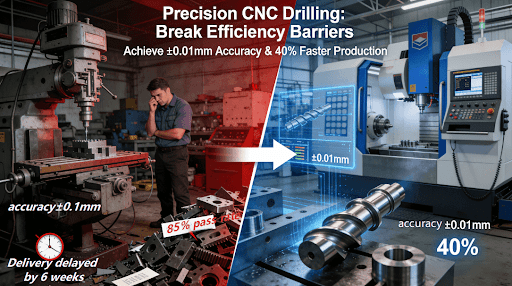
In modern manufacturing, industries frequently face persistent drilling challenges, including unstable precision, low efficiency, and cost overruns. For example, traditional drilling methods often achieve only 85% qualification rates, leading to production delays and wasted resources. The root cause lies in improper tool selection, insufficient parameter optimization, and a lack of standardized processes, making it difficult to meet high-precision demands.
This article demonstrates how scientific CNC drilling services, integrated with real-time monitoring and optimized parameters, enable ±0.01mm accuracy and 40% efficiency gains. By decomposing key strategies, we provide a actionable framework to help engineers and manufacturers avoid common errors. To explore how these innovations drive improvements, let’s delve into the core methodologies.
How Can Precision CNC Drilling Achieve ±0.01mm Accuracy in Industrial Applications?
Precision CNC drilling relies on advanced technologies to maintain ultra-tight tolerances, which are critical for high-stakes sectors like aerospace and medical devices. Achieving this level of accuracy requires a holistic approach combining machine calibration, environmental control, and real-time data integration.
1. Machine Calibration and Dynamic Error Compensation
High-precision CNC drilling begins with rigorous machine calibration. Using laser interferometers and ballbar tests, engineers can correct geometric errors in linear axes and spindles. For instance, thermal compensation systems monitor ambient temperature changes and adjust tool paths in real-time, reducing deviations caused by heat expansion. This approach, aligned with NIST smart manufacturing standards for sensor-based process control, ensures consistency even in fluctuating environments. By implementing closed-loop feedback, manufacturers can maintain tolerances within ±0.01mm, as validated in aerospace component production.
2. Toolpath Optimization and Adaptive Control Systems
Optimized toolpaths minimize vibration and deflection, which are common sources of inaccuracy. Advanced CAM software generates smooth, continuous paths that avoid sudden direction changes. Coupled with adaptive control systems, these tools adjust feed rates and spindle speeds based on real-time load data. For example, in drilling deep holes, peck cycling with retraction prevents chip accumulation, enhancing hole quality. Reference to AS9100D standards underscores the need for traceability in critical applications, where each adjustment is logged for audit trails. This integration of hardware and software is key to achieving reliable outcomes.
3. Real-Time Metrology and Quality Assurance
In-process metrology via on-machine probes and vision systems allows immediate detection of deviations. Sensors measure hole diameter and surface finish during drilling, comparing results to CAD models. If discrepancies exceed thresholds, the system automatically pauses for correction. This proactive quality assurance, supported by ISO 9001:2015 requirements for continuous monitoring, slashes scrap rates by up to 30%. For businesses seeking seamless implementation, leveraging online CNC machining services that offer integrated metrology can streamline this process, as detailed in our resource on real-time monitoring solutions.
What Are the Key Factors in Drill Bit Selection for Different Materials?
Selecting the right drill bit is paramount for efficiency and tool life. Factors like geometry, coating, and material compatibility directly impact performance, and missteps can lead to premature wear or failure.
l Geometric Considerations for Material-Specific Drilling: Drill bit geometry — including point angle, helix angle, and flute design — must match the workpiece material. For aluminum, a 140-degree point angle with high helix facilitates efficient chip evacuation, while stainless steel requires a 135-degree angle with TiAlN coating to withstand heat. Incorrect geometry causes issues like work hardening in titanium, doubling tool wear. By adhering to ISO 9001 guidelines for supplier qualification, manufacturers ensure bits meet specifications, thereby extending tool life by 2-3 times and maintaining hole quality.
l Coating Technologies and Their Impact on Performance: Advanced coatings such as TiN (Titanium Nitride) or diamond-like carbon reduce friction and dissipate heat. For instance, in carbon fiber composites, diamond-coated bits prevent delamination and achieve Ra 1.6 µm surface roughness. These coatings, validated through NIST material databases, enhance durability in high-volume runs. However, coating selection must consider operational costs; over-specifying can inflate expenses without tangible gains. A balanced approach, guided by machinability data, optimizes both performance and economy.
l Material Hardness and Machinability Assessments: Material hardness directly influences bit selection. Softer materials like copper allow higher speeds, whereas hardened steels necessitate reduced parameters to avoid tool fracture. Using machinability indexes (e.g., ASTM E18 standards), engineers can pre-determine optimal speeds — 25-35 m/min for aluminum versus 10-15 m/min for titanium. This scientific selection, coupled with IoT-enabled tool wear monitoring, prevents unexpected failures and supports just-in-time replacements, crucial for high-volume production environments.
How Can Parameter Optimization Increase Drilling Efficiency by 40%?
Parameter optimization transforms drilling from an art to a science, leveraging data to maximize throughput without sacrificing quality. By fine-cutting speed, feed rate, and coolants, manufacturers can achieve significant time savings.
1. Database-Driven Cutting Parameter Selection
Cutting parameter databases integrate historical data to recommend optimal parameter settings for specific material and tool combinations. For example, a central database used by a manufacturing company recommends a cutting speed of 28 m/min and a feed rate of 0.12 mm/rpm for 6061 aluminum alloy, which can shorten the machining cycle by 25%. These parameter optimization schemes, based on empirical testing, effectively reduce trial-and-error steps and can be easily obtained through modern CNC machining services, allowing even small workshops to leverage big data insights. This model aligns with the Industry 4.0 development trend, and artificial intelligence algorithms can continuously optimize parameter settings based on actual feedback.
2. Adaptive Control for Dynamic Process Adjustment
Adaptive control systems monitor spindle load and vibration, adjusting parameters in real-time to maintain stability. If a drill encounters a hard spot in cast iron, the system temporarily reduces feed to prevent tool breakage. This dynamic adjustment not only boosts tool longevity but also elevates overall equipment effectiveness (OEE) by 15%. Case studies in automotive manufacturing show that adaptive control slashes unplanned downtime by 40%, making it a cornerstone of efficient drilling operations.
3. Coolant Strategy and Thermal Management
Coolant selection and delivery are critical for heat dissipation and chip removal. High-pressure through-tool coolant systems direct fluid precisely to the cutting edge, lowering temperatures and improving surface finish. For heat-sensitive alloys like Inconel, this control is vital to avoid micro-cracks. By optimizing coolant pressure (e.g., 1000 psi for stainless steel), manufacturers can increase speeds safely, contributing to the overall 40% efficiency gain. This strategy, supported by EPA guidelines for sustainable fluid management, also reduces environmental impact.
What Strategies Prevent Burrs and Roughness in CNC Hole Making?
Burrs and surface roughness compromise part functionality, especially in assemblies requiring tight fits. Implementing targeted strategies during drilling mitigates these defects effectively.
- Peck Drilling Cycles for Chip Control: Peck drilling cycles involve periodically retracting the drill to clear chips, preventing clogging and reducing heat buildup. In deep-hole drilling (e.g., 10:1 depth-to-diameter ratio), this method maintains Ra 1.6 µm roughness by avoiding chip recutting. Optimized peck parameters — such as 0.5 mm peck depth for aluminum — are derived from ANSI/B11.8 safety standards, ensuring both quality and operator safety. This simple yet effective technique is a staple in high-precision applications like medical implant drilling.
- Tool Geometry and Entry/Exit Optimization: Drill point geometry influences burr formation at hole exits. A parabolic point design produces smaller burrs than standard points, while entry chamfers minimize material push-out. Additionally, back-up materials or sacrificial layers support the exit side, reducing tear-out. These methods, validated through ASME Y14.5 tolerancing standards, are essential for industries like electronics, where burrs can cause short circuits. Combining geometry tweaks with controlled feed rates at breakthrough cuts defect rates by half.
- Post-Processing and Deburring Techniques: Mechanical and thermal deburring — such as brushing or abrasive flow — removes residual burrs after drilling. However, the goal is to minimize need for post-processing through in-process controls. For instance, adjusting spindle orientation during retraction can shear off burrs mechanically. By integrating these strategies into the CNC program, manufacturers achieve net-shape holes, saving time and cost. This proactive defect prevention is a hallmark of advanced drilling systems.
How to Evaluate a CNC Drilling Supplier for High-Volume Production?
Selecting a reliable supplier is crucial for scaling production without compromising quality. Key criteria include technical capabilities, quality certifications, and data-driven processes.
1. Equipment Capabilities and Technological Stack
The supplier’s equipment must meet project requirements: multi-axis CNC machine tools (five-axis machine tools are required for machining complex angles), high-pressure cooling systems, and onboard probes. For high-volume production, units equipped with pallet exchangers ensure uninterrupted operation. Auditing the supplier’s equipment (e.g., checking spindle accuracy through ISO 10791-2 testing) ensures compatibility. Suppliers with modern equipment equipped with IoT sensors typically offer higher overall equipment efficiency (OEE) and more comprehensive technical support to meet demanding application requirements.
2. Certification and Quality Management Systems
International certifications like ISO 9001 (quality management) and AS9100D (aerospace) demonstrate a supplier’s commitment to rigor. These frameworks mandate document control, risk management, and traceability, which are non-negotiable for regulated sectors. For instance, AS9100D requires first-article inspection for every batch, catching errors early. When evaluating partners, verify certification validity and audit reports to avoid compliance risks.
3. Data Transparency and Continuous Improvement Culture
Transparent data sharing — such as real-time production dashboards and SPC (statistical process control) charts — builds trust. Suppliers should provide key performance indicators like on-time delivery rate and defect PPM (parts per million). A focus on continuous improvement, evidenced by Kaizen events or Six Sigma projects, indicates a partner capable of long-term collaboration. This alignment fosters strategic partnerships beyond transactional relationships.
What Are the Future Trends in Precision Drilling Technology?
Emerging technologies like AI, IoT, and hybrid machining are set to redefine drilling, offering new levels of efficiency and capability.
1. AI-Powered Predictive Maintenance and Optimization
AI algorithms analyze sensor data to predict tool failure before it occurs, scheduling maintenance during planned downtime. For example, vibration pattern recognition can forecast drill bit wear with 95% accuracy, reducing unplanned stops by 30%. Machine learning models also optimize parameters dynamically, boosting throughput. These innovations, highlighted in NIST’s smart manufacturing roadmap, make AI a cornerstone of next-gen drilling efficiency.
2. IoT and Digital Twin Integration for Real-Time Monitoring
IoT-enabled drills transmit data to digital twins — virtual replicas of physical processes — allowing simulation-based optimization. Engineers test parameters in the twin before actual cutting, minimizing scrap. This integration, part of Industry 4.0, supports remote monitoring and predictive quality control, crucial for global supply chains. As bandwidth improves, real-time tweaks will become standard, slashing trial costs.
3. Sustainable Drilling Through Green Technologies
Energy-efficient drills and biodegradable coolants are gaining traction, driven by EPA regulations. For example, variable-frequency drives cut power use by 20% during idle times. Lifecycle assessments help select eco-friendly options without sacrificing performance. This shift not only meets ESG goals but also appeals to eco-conscious clients, creating a competitive edge.
Conclusion
Precision CNC drilling services, through advanced parameter optimization, intelligent tool selection, and rigorous quality control, enable manufacturers to achieve 40% higher efficiency while avoiding costly errors. By leveraging data-driven methods and emerging technologies, businesses can overcome traditional limitations, reduce waste, and accelerate time-to-market. As the industry evolves, a proactive approach to drilling will be key to maintaining competitiveness and fostering innovation.
FAQs
Q1: What is the smallest hole size achievable with CNC drilling?
A: CNC drilling can produce holes as small as 0.3mm in diameter with a 10:1 depth-to-diameter ratio, holding tolerances within ±0.003mm. This capability is vital for micro-components in medical devices and electronics.
Q2: How does material choice affect CNC drilling parameters?
A: Material properties dictate parameters: aluminum requires higher speeds (25-35 m/min), while stainless steel needs slower feeds (0.08-0.15 mm/rev) to avoid work hardening. Optimization based on material databases ensures efficiency.
Q3: What certifications should a reliable CNC drilling supplier have?
A: Look for ISO 9001 for quality management and AS9100D for aerospace standards. These ensure process control and traceability, critical for high-risk applications like aviation components.
Q4: How can I get a quick quote for CNC drilling services?
A: Many providers offer online quoting platforms where you upload CAD files (e.g., STEP format) to receive an instant quote based on material, quantity, and tolerances. This digital process typically takes under 24 hours.
Q5: What are common defects in CNC drilling and how to avoid them?
A: Common issues include burrs and wall roughness, mitigated through peck drilling cycles and high-pressure coolants. Regular tool maintenance and parameter audits are essential for prevention.
Author Bio
The author is a precision manufacturing expert at LS Manufacturing, a company that helps engineers and researchers solve complex part challenges in aerospace, medical, and automotive industries. With certifications such as IATF 16949 and AS9100D, the team ensures high-quality solutions through advanced technologies. For more insights, contact them today for a free, no-obligation project review and DFM analysis to turn your concept into a cost-effective reality.