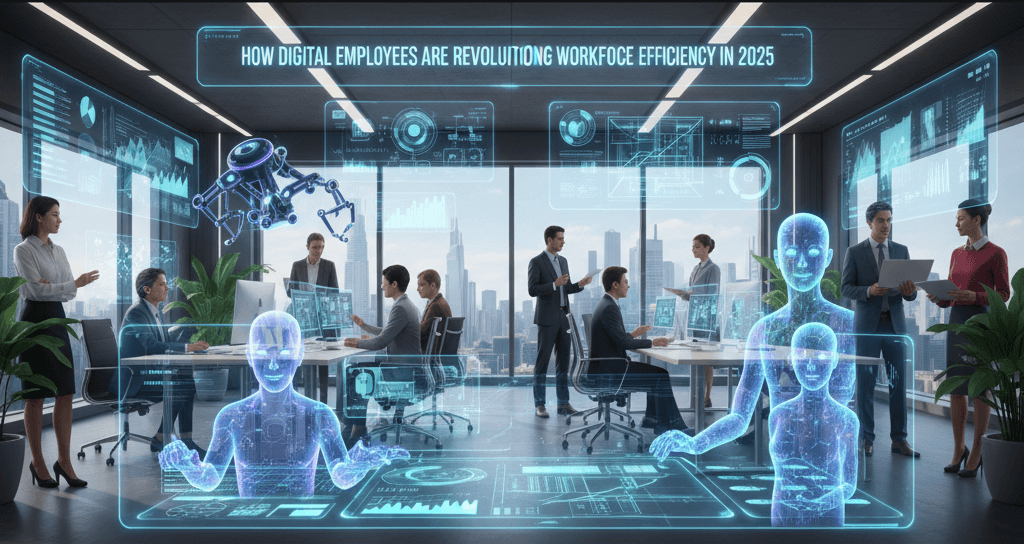
The world of work has entered a new era, one where human employees no longer carry the entire burden of productivity. Across industries, digital employees, AI-powered systems that think, learn, and act like human colleagues, are quietly transforming how teams operate. Unlike the clunky bots of the past, these digital coworkers are intelligent, adaptive, and capable of handling complex workflows in ways that amplify human potential rather than replace it.
In 2025, we’ve reached an inflection point. Businesses are no longer asking if they should integrate digital employees, they’re asking how fast they can scale them. This shift is reshaping everything from how organisations manage time to how people experience their work.
Understanding the Rise of the Digital Employee
Before diving into how digital employees are improving efficiency, it’s important to clarify what they actually are.
A digital employee is not a simple chatbot or automation script. It’s an AI-driven virtual worker that can perform end-to-end tasks across departments, whether that’s onboarding new hires, managing invoices, coordinating supply chains, or analyzing customer feedback.
What makes them distinct from traditional automation is their ability to:
- Learn and adapt from experience.
- Collaborate with human colleagues through natural conversation.
- Make decisions based on context and data rather than fixed rules.
Think of them as tireless digital teammates who handle repetitive, data-heavy, or time-consuming tasks so humans can focus on creative, strategic, and interpersonal work.
From Automation to Collaboration
In the early years of automation, the narrative was all about replacement, machines doing what humans once did. But 2025 has marked a new phase: collaboration over competition.
Digital employees now integrate seamlessly with human teams. Instead of existing in separate silos, they work side by side with people, complementing skills and filling operational gaps. For example:
- A marketing team might rely on a digital employee to draft personalised emails while human members focus on campaign strategy.
- A finance department could use one to manage routine reconciliation so analysts can spend time on financial planning.
- A customer service division might deploy digital employees to handle inquiries overnight, ensuring 24/7 support without burnout.
This partnership model means organisations no longer have to choose between human intuition and digital precision, they can have both.
The Efficiency Revolution
So how exactly are digital employees driving efficiency in 2025? The impact can be seen in three major areas: time, quality, and experience.
1. Time Optimization
One of the clearest benefits is time reclaimed. Digital employees don’t take breaks or vacations, and they operate at speeds that no human can match. But the real advantage lies not in doing things faster, it’s in freeing humans to do things better.
When they handle the repetitive backbone of work, such as scheduling, reporting, or data entry ,human teams can focus on innovation, relationship-building, and problem-solving. This has shifted how organisations view productivity: from “doing more” to “achieving more meaningful outcomes.”
2. Quality Enhancement
Digital employees bring consistency and accuracy to every process. Human errors—caused by fatigue, distraction, or simple oversight, are virtually eliminated. Tasks that require precision, like compliance checks or document processing, become more reliable and transparent.
This consistent quality reduces rework, minimises delays, and creates smoother handoffs between departments. In turn, employees experience less frustration, and customers notice the improvement in service delivery.
3. Enhanced Employee Experience
Ironically, digital employees have made human work more human. By offloading mundane tasks, they’ve allowed people to focus on creativity, empathy, and innovation, the traits that define us.
Teams are discovering new ways to collaborate, experimenting with fresh ideas, and finding deeper satisfaction in their roles. This shift has contributed to higher engagement and retention, as employees no longer feel trapped in repetitive cycles of low-value work.
Rethinking Roles and Responsibilities
With digital employees embedded across departments, the definition of a “job” is evolving. Instead of rigid titles tied to specific tasks, work is now structured around responsibilities and outcomes.
For instance, a project manager’s role may now include overseeing both human and digital team members, allocating tasks, monitoring workflows, and ensuring harmony between the two. Similarly, an HR professional might collaborate with them to screen resumes, track engagement metrics, and provide data-driven insights for decision-making.
In this new environment, humans are not losing relevance, they’re gaining leverage. Their ability to guide, interpret, and connect is more valuable than ever.
The New Skillset: Human Intelligence Meets Digital Fluency
As digital employees become mainstream, the most in-demand skill isn’t coding or engineering—it’s digital fluency. That means understanding how to work with, manage, and communicate through digital counterparts.
Employees who thrive in this landscape are those who can:
- Collaborate effectively with AI systems.
- Translate business challenges into digital tasks.
- Interpret insights generated by their virtual colleagues.
This blend of human intelligence and digital capability has created a new kind of professional, one who can navigate between technology and people with ease.
Real-World Scenarios: How Organisations Are Adapting
Across industries, digital employees are taking on diverse roles:
In Healthcare
Hospitals and clinics use them to handle patient intake, appointment scheduling, and billing. This ensures medical professionals can devote more time to patient care rather than paperwork.
In Finance
Banks deploy them to process transactions, detect anomalies, and generate reports in real-time. Human analysts then focus on interpreting these insights and advising clients.
In Retail
Digital employees manage inventory updates, coordinate logistics, and even respond to customer inquiries online, ensuring faster turnaround and better service continuity.
In Human Resources
They are revolutionizing hiring and employee management. They screen resumes, handle onboarding paperwork, and assist in performance tracking, allowing HR teams to concentrate on culture, growth, and wellbeing.
Each example shows the same pattern: when digital employees handle the operational load, human teams are free to innovate, empathise, and lead.
Overcoming Common Misconceptions
Despite their growing presence, digital employees are still misunderstood. Some assume they’re just fancy chatbots; others fear they’ll lead to widespread job loss. Both views miss the bigger picture.
They are tools for transformation, not threats to employment. Just as calculators didn’t eliminate accountants, digital employees won’t eliminate people, they’ll redefine their roles.
The most successful organisations are the ones that view digital employees as partners, not replacements. They invest in training, foster collaboration, and ensure transparency about how AI is used. This builds trust, boosts adoption, and accelerates results.
Ethics, Trust, and Transparency
As digital employees become decision-makers in critical workflows, questions about ethics and transparency naturally arise. Who’s accountable for their decisions? How do we ensure fairness and integrity?
Forward-thinking companies in 2025 are addressing this by designing responsible AI frameworks, ensuring that every digital employee operates under clear ethical guidelines and is auditable when needed.
Trust is the foundation of this new workplace. When humans understand and trust the actions of their digital colleagues, collaboration thrives.
The Future: A Workforce Without Boundaries
Looking ahead, digital employees are setting the stage for a borderless workforce. Teams can now operate 24/7 across time zones without the constraints of physical presence or human fatigue.
Imagine a global project where human designers in Paris brainstorm ideas by day, and digital employees in Singapore execute them overnight, so that by morning, the next phase is already complete. This continuous collaboration is rewriting the rules of productivity and redefining what it means to be a global organization.
How Leaders Can Prepare
For leaders, embracing digital employees isn’t just a technology decision—it’s a culture decision. To succeed, leaders should focus on three core principles:
- Empower, don’t replace.
View digital employees as enablers of human excellence, not substitutes. Their purpose is to enhance creativity, not suppress it. - Train your teams.
Equip employees with digital literacy and the confidence to work alongside AI tools. Comfort with technology should be a core competency. - Lead with transparency.
Communicate openly about how digital employees function, what data they use, and how decisions are made. Transparency builds trust and reduces resistance.
Leaders who approach digital transformation with empathy and clarity will see faster adoption and stronger collaboration between humans and machines.
Redefining Efficiency for the Future Workforce
In the traditional sense, efficiency meant doing more with less, less time, less cost, less effort. In 2025, efficiency has a new meaning: doing the right things with the right mix of people and digital intelligence.
Digital employees are not replacing human efficiency ,they’re expanding it. They make it possible to focus on what truly matters: creativity, purpose, and progress.
The result is a workplace that’s not just faster, but smarter, more balanced, and more human.
Final Thoughts
The arrival of digital employees represents more than just a technological milestone, it’s a cultural transformation. It’s about redefining work itself, shifting from routine execution to meaningful collaboration.
In this hybrid future, humans bring empathy and imagination; digital employees bring precision and endurance. Together, they form a workforce that’s agile, resilient, and ready for the challenges of tomorrow.
The organisations that thrive in this new landscape will be those that understand one simple truth: the future of efficiency isn’t about replacing people with machines, it’s about empowering people through machines.