


Introduction
In the competitive medical technology sector, rapid time-to-market is crucial. Manufacturers face prolonged development cycles and high iteration costs due to inflexible traditional methods like injection molding, which rely on expensive molds. Adopting rapid prototype manufacturing—integrating 3D printing and CNC machining—enables a flexible workflow for quick design iteration and validation, reducing upfront risks and costs. This analysis will detail how rapid prototyping addresses key challenges in medtech and other high-tech industries.
Why Do Medical Device Manufacturers Need Rapid Prototype Manufacturing?
The development of medical devices is not only a matter of commercial success but also directly impacts patient safety and treatment outcomes. Consequently, the demand for prototype iteration is more rigid than in many other industries. Research from the National Institute of Standards and Technology (NIST) on medical device development cycles indicates that it typically takes 3 to 7 years for a Class II device to move from concept to market, with the prototyping, testing, and modification phases accounting for over 30% of this timeline.
The contrast between traditional manufacturing and rapid prototyping is stark across key metrics:
| Metric | Traditional Manufacturing (e.g., Injection Molding) | Rapid Prototyping (e.g., CNC/3D Printing) |
| Lead Time | Long (weeks to months for mold design and fabrication) | Short (digital file to part, often 1-2 weeks) |
| Initial Cost | Very High (significant mold cost) | Low (per-part pricing, no tooling cost) |
| Design Changes | Difficult and Expensive (requires mold modification) | Flexible and Low-Cost (simple digital file edit) |
| Low-Volume Feasibility | Not Economical (high per-part cost) | Ideal (suited for single units to small batches) |
Furthermore, rapid prototyping provides crucial support for functional testing and compliance certification. Guidelines from the International Medical Device Regulators Forum (IMDRF) require thorough performance and safety testing on physical prototypes for design validation and verification. Obtaining high-fidelity, precision prototypes quickly allows engineers to conduct early usability testing, mechanical performance validation, and integration testing with electronics, ensuring the product meets stringent regulatory requirements before committing to mass production, thereby accelerating the registration process.
How to Choose the Right Rapid Prototyping Process for Medical Devices?
Selecting the appropriate Prototype Manufacturing Services is the first step to ensuring project success. Medical device prototypes require not only geometric accuracy but also strict adherence to material performance, biocompatibility, and precision standards.
Comparing the Applicable Scenarios of Main Processes
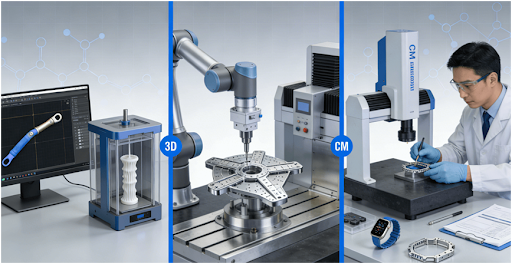
3D Printing (SLA/DLP/LPBF): Ideal for creating prototype plastic parts or lightweight metal structures with complex geometries, internal channels, or fine textures. It is suitable for early concept models, surgical guides, custom implant trials, and form-and-fit verification.
CNC Machining: Offers the highest dimensional accuracy and superior material properties. It is the preferred method for functional prototypes, especially for parts that must withstand loads, undergo dynamic testing, or mimic the final production material, such as housings, gears, and connectors.
Vacuum Casting: Serves as an efficient bridge between prototyping and production when small batches (tens to hundreds) of parts made from production-grade materials (e.g., medical-grade silicones, ABS, PC) are needed for clinical trials or market testing.
Core Considerations: Material Selection and Quality Systems
The choice of material is as critical as the process in determining a prototype’s suitability for rigorous testing.
Biocompatibility Material Standards
For components that contact patients directly or indirectly, materials compliant with ISO 10993 or USP Class VI standards are mandatory. For instance, PEEK is widely used for orthopedic and dental implant prototypes due to its high strength, resistance to sterilization, and excellent biocompatibility. Medical-grade PC and ABS are common for non-implantable parts like housings and handles.
Integrating Process with Quality Systems
The value of a reliable provider of Precision Engineering Solutions lies not only in its equipment but also in its integrated quality management. As outlined in the comprehensive Prototype Manufacturing Guide, process selection must balance design complexity, quantity, material, and post-processing needs. Crucially, the supplier should hold ISO 13485 certification, ensuring that every step—from design input and material traceability to production and inspection—meets the regulatory expectations of the medical device industry, thereby guaranteeing the prototype’s compliance.
How Does Rapid Prototyping Meet the Stringent Standards of Aerospace Components Manufacturing?
The aerospace sector demands extreme performance from its components: absolute reliability and safety under conditions of extreme temperature, pressure, and stress. This presents unique challenges for the prototyping phase of Aerospace Components Manufacturing.
Driving Innovation Through Advanced Materials and Manufacturing Techniques
Aerospace components demand ultimate lightweighting and strength, with standards like those from the European Space Agency (ESA) imposing rigorous mechanical and physical criteria. Rapid prototyping, especially metal 3D printing (e.g., titanium/aluminum alloys), enables creation of complex lattice or topologically optimized structures as single pieces, achieving maximum weight reduction without sacrificing strength—a challenge for traditional methods.
Material Innovation for Extreme Environments
Advanced materials must withstand space conditions, requiring compliance with strict ESA standards. Metal 3D printing allows for designs that optimize performance while minimizing mass.
Precision Manufacturing for Critical Components
For load-bearing structures, engine parts, or avionics housings, five-axis CNC machining ensures high precision, superior surface finish, and material consistency. It sculpts complex contours and deep cavities from solid metal stock, mirroring final part properties for rigorous testing.
Ensuring Quality and Compliance in Aerospace Prototyping
Aerospace prototypes require adherence to strict standards like AS9100D, covering project review, process control, and inspection. Leading prototyping manufacturers integrate this system, providing full documentation (material certs, machining records, dimensional/NDE reports) to meet client demands for quality and traceability.
How Does Rapid Prototyping Optimize the Consumer Electronics Component Development Process?
The consumer electronics industry, defined by short lifecycles and rapid iteration, relies on rapid prototyping for innovation. Physical prototypes are essential for testing ergonomics, user experience, and the compact integration of internal components like PCBs. Quick access to prototype parts enables multiple “design-test-modify” cycles within days, accelerating development.
For market testing upon design finalization, rapid tooling bridges the gap to mass production. Using aluminum molds, it cost-effectively produces hundreds to thousands of near-final parts in weeks. IEEE research indicates this combined rapid prototyping and tooling strategy reduces time-to-market by an average of 40%.
How to Mitigate Development Risks for Robotic Automation Parts Through Rapid Prototyping?
Robotic automation parts demand exceptional motion precision, repeatability, and long-term durability, where a single component failure can halt entire production lines. Thorough validation during prototyping is therefore critical. Rapid prototyping enables rigorous performance limit testing before committing to costly production tooling. For instance, CNC machining produces high-precision gearbox prototypes for extensive life testing.
For components with complex internal channels or lightweight structures, metal 3D printing creates conformal cooling channels or topologically optimized designs unachievable by traditional methods, accelerating development and enhancing performance. This process requires a robust quality system, incorporating principles from standards like IATF 16949 and certifications such as ISO 9001, to ensure reliable Precision Engineering Solutions from prototype to production.
Conclusion
In summary, rapid prototyping integrates digital technologies to provide efficient, low-risk development solutions for high-tech sectors. It significantly shortens the time from concept to validation and reduces costs by enabling early, thorough physical testing, minimizing late-stage design changes.
Obtain your customized solution now! Submit your design files for an instant quote and expert Design for Manufacturability (DFM) analysis to optimize your design and ensure project success.
Author Biography
The author is a senior precision manufacturing expert with over a decade of experience, specializing in medical and aerospace components. Having led numerous complex projects for multinational clients, JS Precision is dedicated to turning innovative concepts into reality through advanced manufacturing technologies.
FAQ
Q1: What is the smallest tolerance achievable in rapid prototyping?
A1: Precision rapid prototyping, particularly through CNC machining, can achieve tolerances as tight as ±0.005mm. The specific achievable tolerance depends on material properties, part size, geometry, and the chosen manufacturing process, meeting the validation needs of most high-precision components.
Q2: What certifications are required for medical device prototype manufacturing?
A2: It is highly recommended to select a supplier certified under ISO 13485 for medical device quality management systems. This certification ensures the entire process from design control to production meets industry regulatory requirements, significantly reducing compliance risks during the prototyping phase.
Q3: How to decide if a product is more suitable for 3D printing or CNC prototype manufacturing?
A3: Parts with highly complex internal structures, lattices, or organic shapes are better suited for 3D printing. Parts requiring high strength, material isotropy, and superior surface finish are advised to use CNC machining. A professional prototype manufacturing services provider can offer a process evaluation.
Q4: What is the average delivery time for rapid prototyping?
A4: For simple structures, parts can be delivered within 3-5 business days. For complex assemblies requiring multiple processes or special post-processing, the timeline may extend to 7-15 business days, depending on the specific requirements.
Q5: How to control costs for small-batch prototype manufacturing?
A5: Costs can be optimized by: 1) Using the supplier’s standard material library; 2) Optimizing design for manufacturability (DFM) to reduce machining difficulty; 3) Optimizing material nesting for CNC machining; 4) Combining post-processing steps. Proper planning can typically reduce costs by over 30%.