



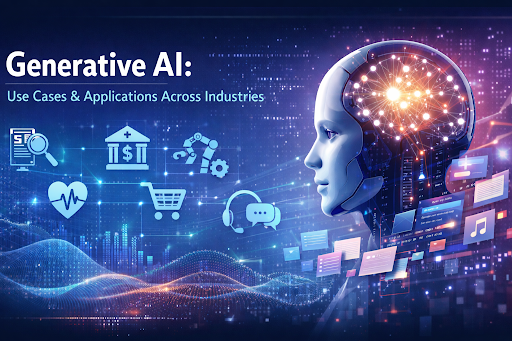
Generative AI is quickly emerging as a key driver of enterprise innovation, helping organizations automate complex workflows, improve decision-making, and deliver highly personalized experiences at scale. Unlike traditional AI systems that primarily focus on prediction or classification, generative AI produces new content—including text, images, code, audio, and synthetic data—by learning patterns from large datasets.
As businesses across industries prioritize agility and operational efficiency, generative AI is increasingly being adopted to address real-world challenges. From content generation and software development to HR automation and advanced analytics, its adoption continues to expand across the enterprise ecosystem.
Generative AI Use Cases and Applications by Industry
Generative AI is not confined to a single function or sector. Its strength lies in its adaptability to industry-specific processes and operational requirements.
Human Resources and Talent Management
HR teams are leveraging generative AI to streamline recruitment and workforce management processes. Common applications include resume screening, interview question generation, policy documentation, and job description creation. AI-powered tools such as ZBrain’s JD Builder, for instance, enable HR teams to create accurate, role-specific job descriptions efficiently, improving consistency while reducing manual effort.
Healthcare
In the healthcare sector, generative AI supports drug discovery, clinical research, and medical documentation. AI models can generate synthetic patient data to enhance training datasets while preserving privacy and regulatory compliance. Additionally, generative AI is used to summarize clinical notes and assist healthcare professionals in making faster, more informed decisions.
Banking and Financial Services
Financial institutions adopt generative AI to automate reporting, strengthen fraud detection, and enhance risk analysis. AI-generated insights enable analysts to interpret large volumes of financial data more effectively, while conversational AI systems assist customers with account inquiries, transaction summaries, and personalized financial guidance.
Retail and E-Commerce
Retailers use generative AI to personalize customer interactions and optimize operations. Key use cases include AI-generated product descriptions, tailored marketing content, demand forecasting, and virtual shopping assistants. These applications help businesses boost customer engagement while minimizing manual content creation.
Manufacturing and Supply Chain
Within manufacturing, generative AI supports design optimization, predictive maintenance, and supply chain modeling. AI-generated design alternatives allow engineers to assess performance trade-offs, while AI-driven insights help operations teams reduce downtime and improve logistics planning.
Telecommunications and Customer Experience
Telecom providers rely on generative AI to enhance customer support through intelligent virtual assistants. These systems generate context-aware responses, automate issue resolution, and deliver real-time assistance across channels, improving both customer satisfaction and operational efficiency.
Cross-Functional Enterprise Applications of Generative AI
In addition to industry-specific use cases, generative AI is widely applied across core enterprise functions, including:
- Content creation and marketing automation for blogs, campaigns, and social media
- Software development through code generation, testing, and documentation
- Data analysis using natural language queries and automated insights
- Customer support via conversational AI and ticket automation
A comprehensive overview of these enterprise-wide implementations is presented in Generative AI: Use Cases, which outlines how organizations apply generative AI across business functions and industries.
Key Benefits of Generative AI for Enterprises
Organizations that adopt generative AI realize tangible business advantages, such as:
- Faster content creation and software development
- Increased operational efficiency
- Scalable personalization
- Reduced reliance on manual processes
- Improved utilization of enterprise data
With appropriate governance and data controls in place, generative AI becomes a powerful enabler of long-term digital transformation.
Conclusion
Generative AI is transforming enterprise operations across industries. By enabling intelligent content generation, automation, and data-driven insights, it empowers organizations to innovate more rapidly and operate more efficiently. As adoption accelerates, enterprises that align generative AI initiatives with industry-specific requirements and strategic objectives will be best positioned to achieve sustainable competitive advantage.