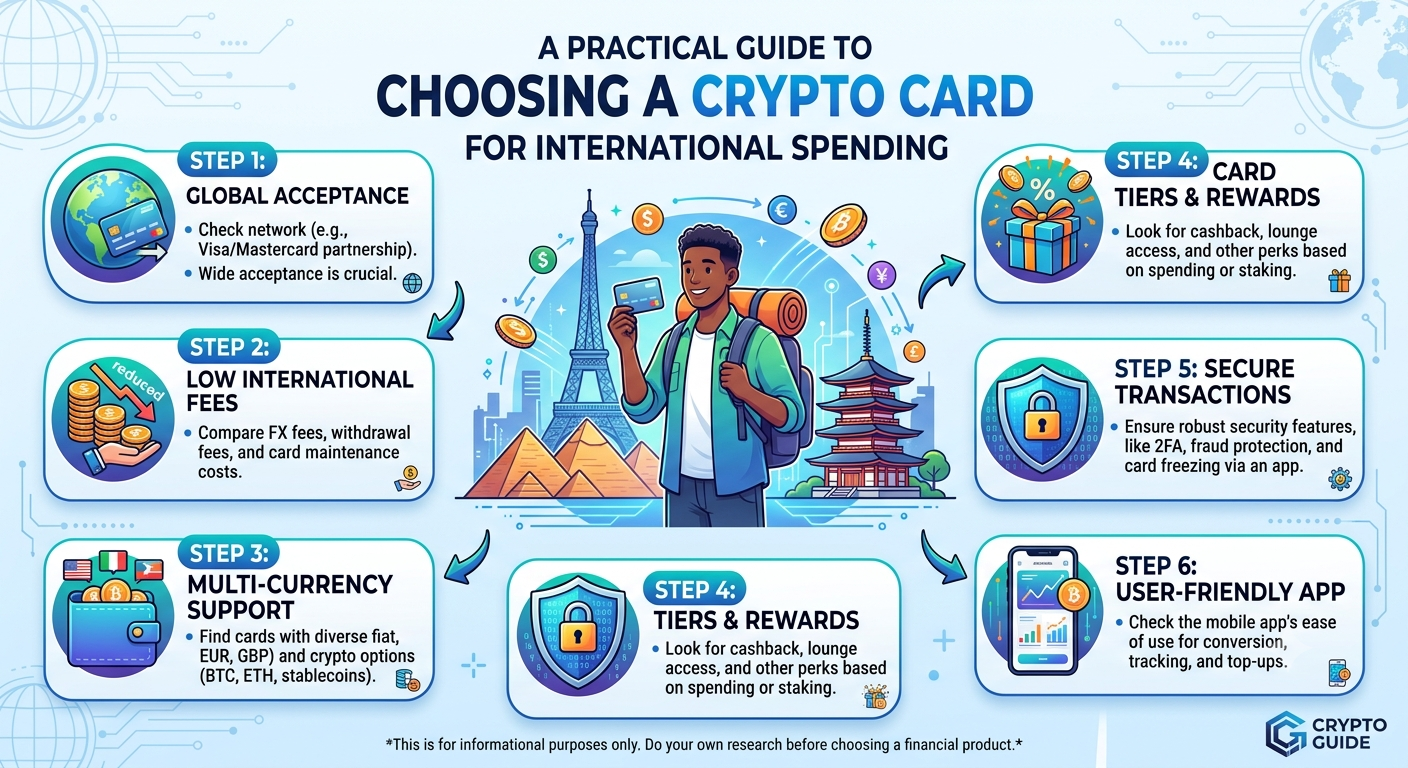
For remote workers, frequent travelers, and anyone earning in crypto, a crypto card can be the simplest way to turn digital assets into everyday spending power across borders. But the category is crowded and uneven, and the difference between a good pick and a costly one comes down to a handful of practical factors. A side-by-side view like this crypto card comparison makes the trade-offs obvious before you commit.
Start with fees, because they hide in more places than most people expect. The conversion spread is the margin taken when your crypto is converted to fiat at the point of sale, and it is frequently the single biggest real cost of using the card. Foreign-exchange fees apply when you spend outside the card’s base currency, which is critical for international use. ATM withdrawals usually come with a free monthly allowance followed by a percentage fee, and some cards add top-up or monthly maintenance charges that quietly erode any rewards you earn.
Next, consider coverage and limits. A card is only useful where it is accepted and legal, so check that it operates in your country of residence and in the places you travel most. Review the daily and monthly spending and withdrawal limits against your real usage, because a card that looks great on paper can become useless if its ceilings are too low for how you actually live and spend.
Then look at the custody model. Custodial cards convert your crypto and hold a fiat balance on your behalf, which is simple but ties your money to the provider’s solvency. Non-custodial cards spend directly from your own wallet, reducing that dependency at the cost of a slightly more involved setup. Given how many card programs have shut down over the years, the resilience of the model is no longer a purely academic concern.
Finally, weigh the rewards, but read the fine print. Headline cashback numbers frequently depend on staking a native token or hitting monthly spend thresholds, and the effective rate for a typical user is often far below the advertised maximum. Calculate what you would actually earn on your real spending pattern rather than the best-case figure printed on the landing page.
For international spenders specifically, the priority order is usually straightforward: low conversion spread and foreign-exchange fees first, broad acceptance second, sensible limits third, and rewards last. A card that pays two percent back but charges a three percent conversion spread is a net loss on every purchase, no matter how attractive the rewards look in isolation.
There is also a practical reliability angle. When you are standing at a checkout abroad, an authorization that fails because of a slow conversion or a regional restriction is far more painful than a slightly lower cashback rate. Established providers with solid banking partners tend to handle those edge cases better, which is worth factoring in alongside the raw numbers.
Because all of these variables interact, comparing cards line by line on fees, coverage, and reliability, rather than trusting any single provider’s pitch, is the difference between a card that quietly saves you money abroad and one that quietly drains it. A few minutes of genuine comparison up front tends to pay for itself many times over.