For businesses striving to maintain excellent customer service, the role of a robust contact center cannot be overstated. Reports indicate that enhancing customer experience leads to a revenue increase of 4-8% above the market average. The choice of contact center software solutions is a critical piece of this puzzle, impacting everything from customer satisfaction to operational efficiency.
In this article, we’ll delve into the essential criteria for selecting contact center software that aligns with your business objectives and enhances customer interactions. Below, discover the key features to look for, integration advice, and methods to evaluate the success of your contact center software.
Selecting the Right Contact Center Software for Your Business Needs![]()
Choosing the most suitable contact center software hinges on understanding your business’s specific requirements and customer service goals. Software solutions come in various forms, from omnichannel capabilities to automation features aimed at different business sizes and sectors.
Consider the volume of customer interactions and the diversity of communication channels your business uses. A retail business with high customer chat inquiries may benefit from advanced chatbot capabilities, while a B2B entity might place more value on seamless CRM integration for personalized customer care.
Analyze the scalability and flexibility of the software. Look for options that allow for easy adjustments as your business and contact volume grow. At this stage, involve both your technical team and customer service representatives in the decision-making process to ensure the selected software meets the needs of all stakeholders.
Key Features to Consider in Contact Center Solutions
When assessing contact center solutions, certain key features stand out as particularly beneficial. These include self-service options, real-time analytics, and the provision of self-service options for customers.
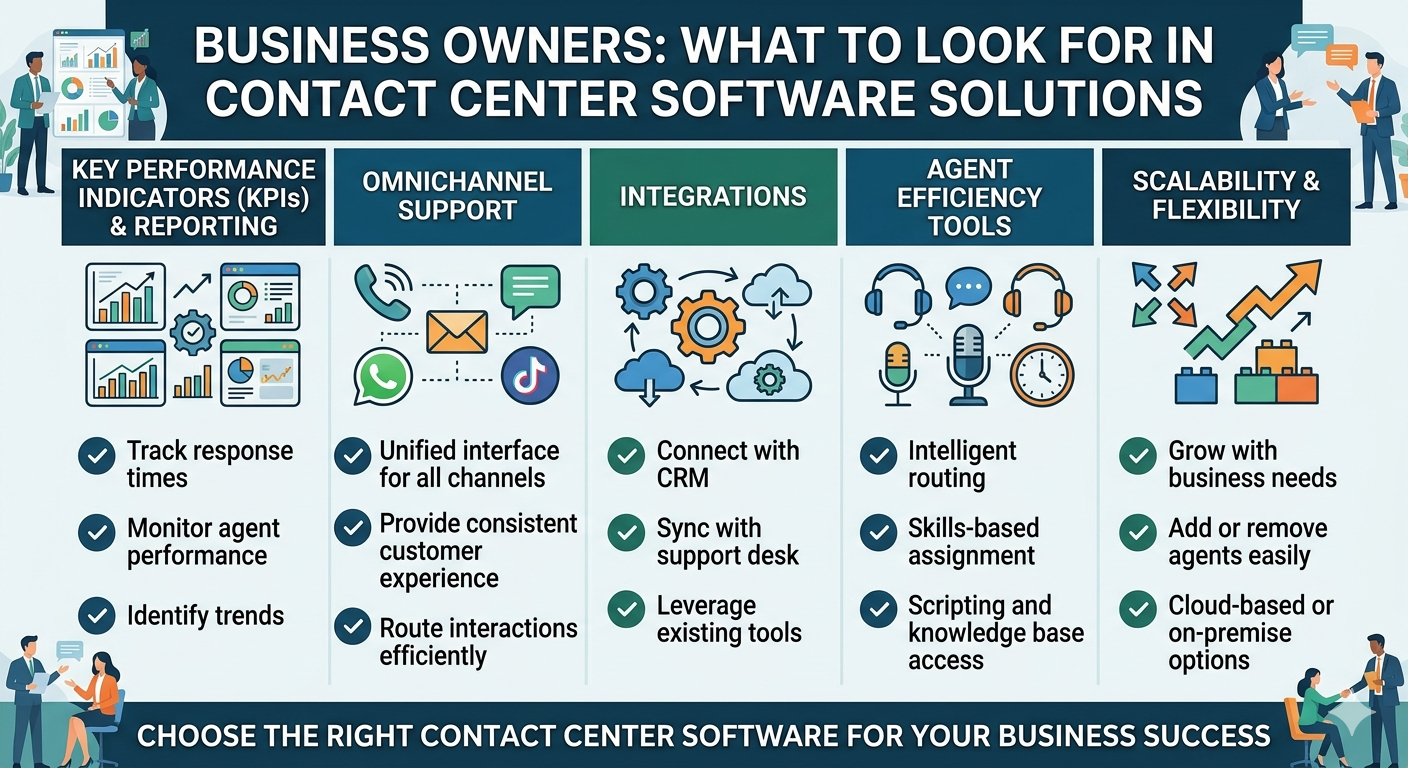
Multichannel support enables customers to reach out through their preferred channel, whether it’s voice, email, chat, or social media. This flexibility can significantly enhance the customer experience. Additionally, real-time analytics provide insights that can be used to optimize agent performance and customer satisfaction. Self-service options, like knowledge bases and automated FAQs, empower customers to find quick resolutions without agent intervention.
Evaluate the ease of use and the level of customer support provided by the software vendor. This can greatly impact the speed of deployment and the learning curve for your staff. Prioritize solutions with an intuitive interface and comprehensive support, ensuring a smooth transition and continual improvement in customer service delivery.
Integrating Contact Center Software with Your Business Systems
Successful integration of contact center software within your existing business systems is paramount for streamlined operations. The focus should be on creating a unified platform that enables data sharing and process coordination between departments.
Review the contact center software’s compatibility with your current CRM, ERP, and marketing platforms. Seamless integration can lead to better customer insights, greater efficiency, and more personalized communications. Additionally, ensure that the software provider adheres to industry standards for contact center software solutions security and data privacy, as data breaches can be both costly and damaging to your brand.
Proactive planning is essential. Before implementation, outline a strategic integration plan and provide ample training for your team. Strong collaboration between your IT department and the software vendor can facilitate a smoother integration process and help avoid costly disruptions down the line.
Measuring the Success of Your Contact Center Software Investment![]()
The value of your contact center software investment must be assessed through concrete metrics related to customer service performance and business outcomes. Key performance indicators (KPIs) like first contact resolution, average handle time, and customer satisfaction scores are central to this evaluation.
Monitor on an ongoing basis to observe not only immediate results but also long-term trends that may emerge. This data can inform iterative improvements and strategic planning. Furthermore, integrating feedback mechanisms directly into your contact center can provide immediate insights into customer perceptions and service quality. Good judgment in selecting the right metrics to track is crucial.
Consider employing advanced analytics to uncover deeper insights into agent performance and customer behavior. Using these analytical tools can help you predict customer needs and make adjustments before issues become systemic problems, thus not only justifying but also maximizing the return on your software investment.
Ultimately, selecting the right contact center software is a nuanced process that demands attention to your unique business needs, the software’s features, and how it will integrate with your wider business infrastructure. By carefully considering these factors, you can make an informed decision that will improve customer experience, streamline operations, and align with your business growth. Measure success through comprehensive KPIs and use insights to continue refining your approach to customer service management.