There is a particular look that people give when they open a gift that surprises them — not the polite smile that covers disappointment, and not the exaggerated enthusiasm that covers indifference. The genuine one. The one where the expression changes before the person has decided what expression to have. It lasts about two seconds before self-consciousness arrives and turns it into something more composed. Those two seconds are the entire point of gift giving. And they are almost never produced by the expected gift.
The expected gift is safe. It arrives in a category the recipient already occupies — a book by an author they like, an item from a brand they wear, a voucher for an experience they have mentioned. The unexpected gift arrives from a direction nobody anticipated, references something specific and personal, and communicates that the giver paid a quality of attention that most people simply do not bother paying. Model cars and model planes are unexpected gifts almost by definition. They are specific, three-dimensional, and entirely impossible to generalise. They are also, consistently, among the most remembered gifts that people receive across their entire lives.
Why Expected Gifts Disappoint Even When They Are Good
The gift market is built around safety — around objects that carry low risk of disappointing and equally low risk of genuinely delighting. A gift card is the ultimate safe gift: it transfers the gifting decision entirely to the recipient and eliminates the possibility of getting it wrong. It also eliminates the possibility of getting it memorably right. The corporate gift catalogue exists for the same reason — to provide options that nobody will object to and nobody will remember. Neither of these outcomes is what gift giving is actually for.
The gifts that stay — the ones that end up on permanent display rather than in a drawer, that come up in conversation years later, that recipients specifically mention when asked about the best gift they have ever received — share one consistent quality: they were chosen with genuine knowledge of the recipient’s specific passion, history, or identity rather than their general demographic profile. A gift chosen for a car enthusiast as a car enthusiast rather than as a forty-year-old professional who seems to like cars is a fundamentally different object, even when the subject matter is identical.
Why Model Cars Land When Nothing Else Does
A model car chosen for the right person operates on a level that most gifts cannot reach. It is specific — a particular vehicle, a particular era, a particular livery that means something to the recipient because of where they were when they first encountered the real thing. It is three-dimensional — a physical object that occupies space, rewards close inspection, and holds its presence in a room rather than disappearing into a bookshelf or a wardrobe. And it is permanent — a quality die-cast or commissioned replica does not wear out, does not go out of fashion, and does not require updating.
The car enthusiast who has driven the same model for twenty years and considers it the finest vehicle they have ever owned does not need another driving experience. They do not need a subscription to an automotive magazine they probably already read. They need someone to acknowledge, in permanent and three-dimensional form, that you understand which car it is — and why. A precision 1:18 replica of the specific model they drove, in the correct colour, is that acknowledgement. It is the gift that says: I was paying attention. Every serious car modeller and collector understands this instinctively — which is why the most meaningful pieces in any serious collection are almost always the ones that arrived as gifts from people who had paid exactly that quality of attention.
The gift that arrives in a category the recipient had not anticipated communicates something no expected gift can: that the giver thought about who this person actually is — not who they are expected to be.
The Aviation Equivalent — and Why It Works Even Better
The same logic applies to model planes — with one additional dimension. Aviation is an identity, not just an interest. The person who holds a pilot’s licence, who spent their early career flying a specific aircraft type, or who has followed a particular chapter of aviation history for decades carries that identity in a way that most enthusiasms do not quite match. They are not simply someone who is interested in aircraft. They are someone for whom aviation is a fundamental part of how they understand themselves and their relationship with the world.

A scale replica of the aircraft that defined their aviation identity — the type they trained on, flew operationally, or have spent years studying and admiring — reaches that identity directly. It does not arrive in the general category of aviation gifts. It arrives in the specific category of this aircraft, this livery, this moment in their personal history. The unexpectedness is built into the specificity: nobody gives a gift that specific unless they have genuinely paid attention to who the recipient is rather than what demographic they occupy.
When the Unexpected Gift Becomes the Unrepeatable One
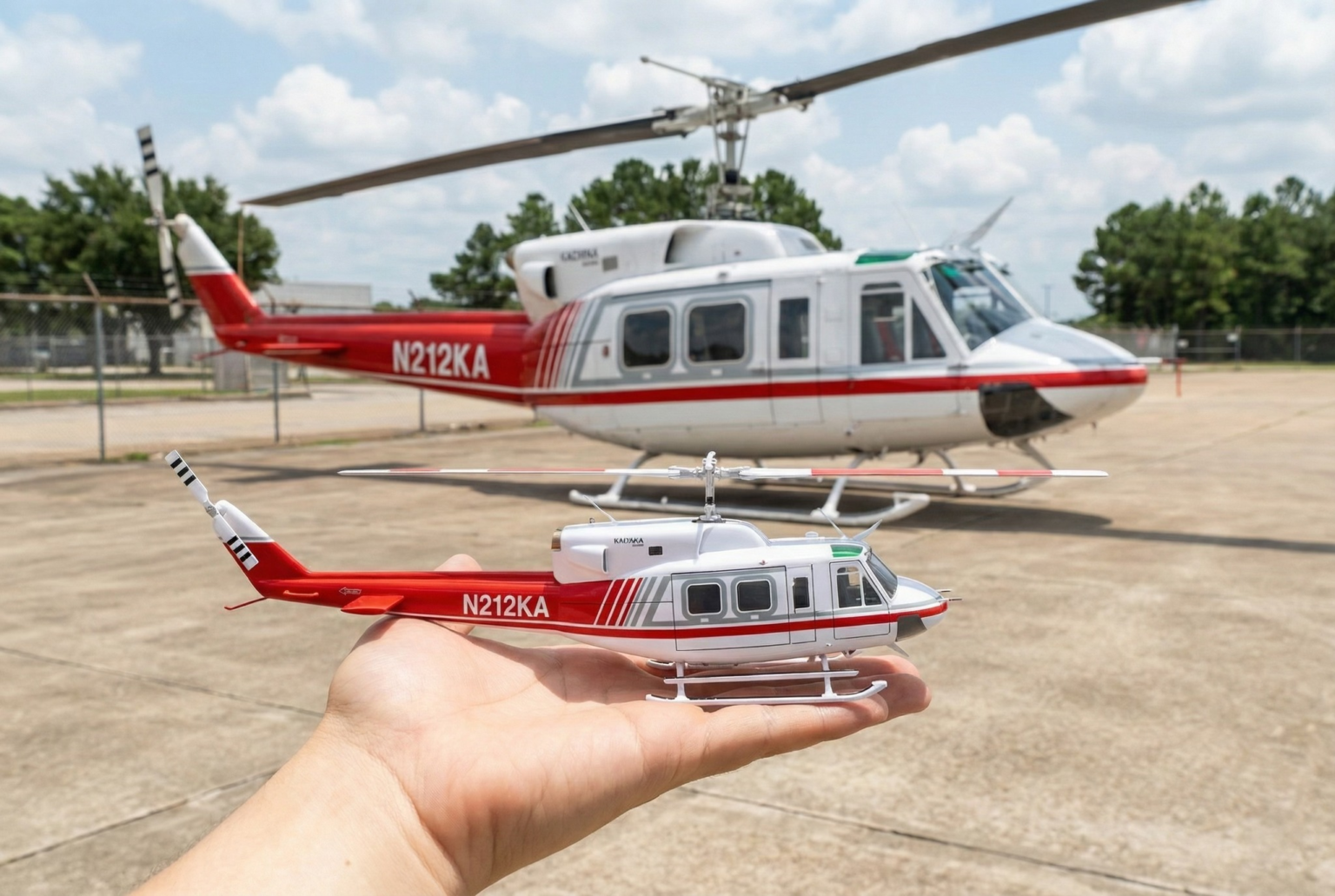
The most unexpected gifts of all are the commissioned ones — pieces built to a specific brief that no production catalogue supplies. A model car in the exact specification and colour of the vehicle the recipient drove in their twenties, long since scrapped. A model plane in the specific livery and registration of the aircraft they flew their first solo in. A replica of the helicopter their company operates, in the fleet’s current scheme, presented with a nameplate and a display case for a boardroom.
These gifts are unexpected not because the recipient did not know they were coming — they occasionally do — but because they arrive with a level of personal reference that nobody anticipates. The object communicates, without ambiguity, that someone spent real time and real thought producing something that exists for one person and could not exist for anyone else. That category of gift has no equivalent in any catalogue. It cannot be found on a shelf. It has to be decided upon, briefed, waited for, and unwrapped by the specific person it was always going to be for.
Frequently Asked Questions
Why do model cars and planes make such good gifts?
Because they are impossible to choose generically. A model car or plane that lands well requires specific knowledge of the recipient’s passion — the vehicle that defined a period of their life, the aircraft that represents their aviation identity, the subject that means something personally rather than categorically. That specificity is what most gifts lack and what makes the ones that have it so memorable. The object proves that the giver was paying attention in a way that most gifts simply do not demonstrate.
What occasions work best for model car and plane gifts?
Milestone occasions produce the strongest response — retirements, significant birthdays, career achievements, anniversaries, and professional milestones like type ratings or licence completions. These occasions justify a gift of genuine weight and permanence. For automotive enthusiasts, a retirement gift that references the specific car they are most associated with carries enormous personal weight. For pilots, a replica of the aircraft they flew their final commercial sector in is a record of a career endpoint that no other object category can provide.
How specific can a commissioned model car or plane gift be?
Fully specific. A commissioned replica can reproduce a named vehicle’s exact registration, colour, specification, and configuration — including non-standard modifications, personalised number plates, or specific period-accurate details. For aircraft, the tail number, operator livery, era-appropriate avionics configuration, and markings can all be specified from reference photographs. The more reference material provided, the more accurate the commission. Lead times typically run six to twelve weeks depending on scale and complexity.
The Gift That Proves You Were Paying Attention
The expected gift is a gesture. The unexpected gift is a statement — about how carefully the giver looked, how specifically they understood what they found, and how much they valued the relationship enough to act on what they learned. Model cars and planes occupy this category not by accident but because of what they inherently require: a specific subject, chosen for a specific person, for a specific reason. That triple specificity is what makes them unexpected, and what makes them remembered.
The two-second look of genuine surprise is worth every bit of attention it took to produce. It is also, for the person who gave the gift, the confirmation that they actually know the person they were buying for. That knowledge, demonstrated in miniature on a shelf, tends to last considerably longer than the wrapping it arrived in.