Advertisement
As modern networks continue to expand and evolve, the demand for faster, more flexible, and cost-effective connectivity has never been greater. Data centers, enterprise IT infrastructures, and service provider networks are all under pressure to deliver higher bandwidth while keeping deployment simple and affordable. While fiber optics dominates in many long-distance and high-capacity applications, copper-based solutions still play a critical role, especially when it comes to short-range connections. Among these, the 10GBASE-T SFP+ transceiver has emerged as a practical and highly valuable option for organizations looking to transition smoothly to 10 Gigabit Ethernet without unnecessary complexity or expense.
What is a 10GBASE-T SFP+ Transceiver?
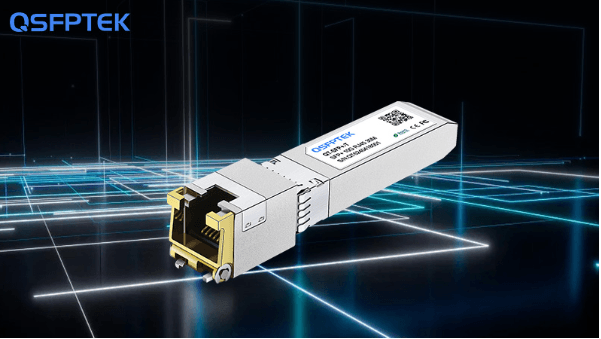
A 10GBASE-T SFP+ transceiver is essentially an RJ45 copper module in the SFP+ form factor, designed to provide 10-gigabit connectivity over standard twisted-pair copper cabling such as Cat6a or Cat7. With a transmission distance typically reaching 30 to 80 meters, it is not intended to replace fiber optics for long hauls, but rather to complement them by offering a flexible copper solution within racks or between adjacent racks. One of its strongest attributes is backward compatibility. Instead of being limited solely to 10G operation, the transceiver supports multiple speeds including 1G, 2.5G, and 5G, which allows it to work seamlessly with legacy equipment while enabling gradual upgrades to higher speeds as needed.
Compatibility and Infrastructure Reuse
The advantages of using such modules in modern networks begin with compatibility. Many organizations have already invested heavily in structured copper cabling over the years. Replacing this infrastructure with fiber can be both disruptive and costly, requiring not only new cables but also patch panels, connectors, and sometimes entirely new switch hardware. A 10GBASE-T SFP+ transceiver makes it possible to leverage the existing copper plant while still delivering gigabit-class performance, thus protecting past investments and reducing the barrier to 10G adoption. This is particularly important for enterprises that need to upgrade access or aggregation layers without undertaking a complete overhaul of their cabling systems.
Simplified Deployment and Flexibility
Another significant advantage is the simplicity of deployment. The hot-swappable design of SFP+ modules allows network administrators to add or replace transceivers without shutting down equipment or interrupting operations. This flexibility is invaluable in dynamic environments such as data centers where workloads shift rapidly and new demands arise constantly. The plug-and-play nature of copper modules means that upgrades can be rolled out gradually and strategically, rather than requiring large-scale projects with extended downtime. The ease of integration allows businesses to scale bandwidth where it is needed most, without complicating their network architecture.
Cost Efficiency in Network Upgrades
Cost efficiency is also a major driver for the adoption of 10GBASE-T SFP+ technology. Compared to optical transceivers and fiber cabling, copper modules and Cat6a/7 cables are typically less expensive to purchase and install. For short-range connections—such as between servers and top-of-rack switches—the performance of fiber may be unnecessary, while the cost difference remains significant. By relying on copper-based modules, organizations can achieve high-speed connectivity without overspending on infrastructure that exceeds their operational requirements. Furthermore, the ability to reuse existing copper cabling reduces not only capital expenditures but also the labor costs associated with new installations.
Backward Compatibility and Performance for Short Distances
In addition to financial and operational considerations, the versatility of 10GBASE-T SFP+ modules adds considerable value. Their backward compatibility means that a single module can adapt to multiple speeds depending on the connected devices, creating a bridge between older and newer generations of networking equipment. This versatility ensures that networks can evolve at a pace that matches business priorities rather than forcing a rapid and costly overhaul. The performance of copper transceivers at short distances is also highly reliable. In rack-to-rack or intra-rack scenarios, they deliver stable and consistent throughput with minimal latency, making them well-suited for high-bandwidth applications that demand real-time responsiveness.
Applications in Modern Networks
These benefits translate into a wide range of practical applications. In data centers, 10GBASE-T SFP+ modules are often used for connecting servers to switches in top-of-rack configurations, where the required distances fall well within the copper limits. In enterprise networks, they enable a smooth transition from one gigabit to ten gigabits at the access or aggregation layer, supporting the growing need for bandwidth-intensive applications such as cloud computing, video conferencing, and virtual desktop infrastructure. Even in specialized sectors such as education, healthcare, or research, where budgets are often constrained but demand for high-speed connectivity is increasing, copper transceivers provide an affordable pathway to modern performance standards.
Comparing 10GBASE-T with Optical SFP+
When compared directly with optical SFP+ modules, the distinctions become clearer. Optical transceivers excel in long-distance transmission, low latency, and energy efficiency over extended runs, but they require fiber cabling and more specialized installation. By contrast, 10GBASE-T SFP+ modules are ideally suited to shorter connections where the advantages of copper—simplicity, cost savings, and compatibility—outweigh the benefits of fiber. This does not mean copper will replace fiber in every scenario, but it highlights how the two technologies complement each other. Fiber is the backbone for long-haul, high-density interconnections, while copper SFP+ modules serve as the cost-effective solution for edge or rack-level connections where distance is limited but performance must remain high.
Conclusion: A Practical Step Toward 10GbE
Ultimately, the adoption of 10GBASE-T SFP+ transceivers reflects a broader trend in networking: the pursuit of practical solutions that balance performance, cost, and flexibility. Modern networks are not built on a single technology but rather on the integration of multiple options that address specific needs. By providing a straightforward way to deliver 10G connectivity over existing copper cabling, these transceivers reduce complexity, accelerate upgrades, and preserve valuable infrastructure investments. For organizations navigating the transition to higher-speed networks, they represent an ideal middle ground—one that combines the familiarity of copper with the speed of ten-gigabit Ethernet. In an era where agility and efficiency define competitive advantage, the ability to upgrade at the right pace with the right tools makes these copper transceivers a strategic asset for network designers and operators alike.